

V · Santa
Who brings the presents around the world? Santa’s names
 Christmas magicHow to read this bookReads aloud in 7 minutesRead it to a childAdded to the book
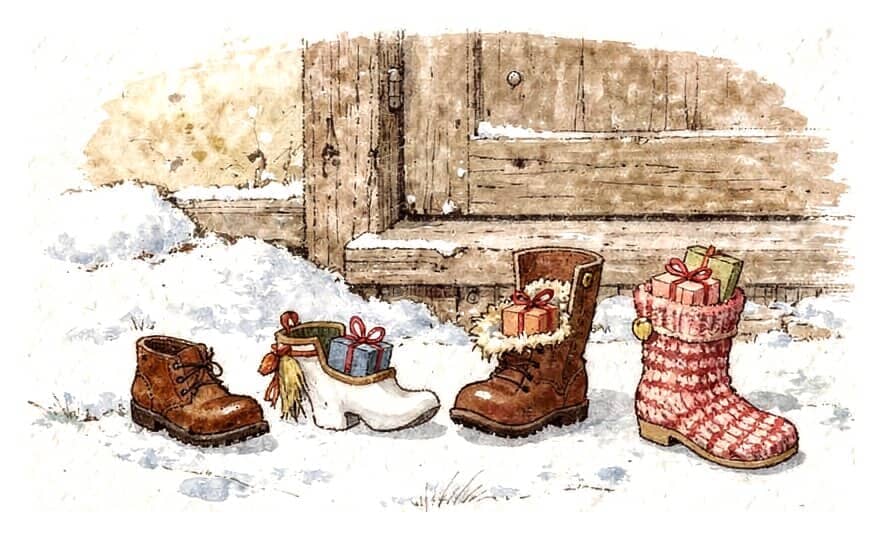


It depends where you wake up. In the United States it is Santa Claus, on Christmas Eve. In Germany it may be the Weihnachtsmann or the Christkind, in Italy Babbo Natale and then La Befana on January 6, in Finland Joulupukki, in Mexico the Three Kings, and in the Netherlands Sinterklaas, early in December.
 True story
At a glance
- Germany: the Weihnachtsmann, especially in the north; the Christkind in other homes
- Italy: Babbo Natale; La Befana at Epiphany, January 6
- Finland: Joulupukki, Christmas Eve
- Poland: Święty Mikołaj; the Gwiazdor in some parts, and the Dzieciątko in Silesia
- Mexico: the Three Kings, January 6; Santa Claus in many homes
- The Netherlands: Sinterklaas, December 5
- Japan: Santa, on Christmas Eve night
Santa Claus
In the United States, Santa Claus comes on Christmas Eve, with his sleigh and his reindeer, and in the morning the stockings are full. In Japan, too, Santa (サンタクロース, Santa Kurōsu, or just サンタ, Santa) comes on Christmas Eve night with presents for children.
True storyThe Japanese word was already in a Japanese book by 1909, a translated story told as a mischievous boy’s diary. And how Saint Nicholas became Santa Claus in the first place is a story of its own: from Saint Nicholas to Santa Claus.
Saint Nicholas and Sinterklaas
True storyIn many countries Saint Nicholas has a day of his own, December 6, and the celebrating starts the night before, when children set out their shoes. Saint Nicholas Day tells the whole story. In the Netherlands, the big evening is December 5, called pakjesavond, “parcels evening,” when families unwrap their Sinterklaas presents.
In Belgium, Sinterklaas (Saint Nicolas in French) comes during the night of December 5 to 6. Many children set out a shoe with a drawing and a carrot for his horse, and in the morning they go downstairs to find their presents.
The Christmas Man and the Christ Child
In much of Germany, especially the north, the presents come from the Weihnachtsmann, the Christmas Man. In other German homes they come from the Christkind, a child figure modeled on the Christ Child.
True storyIn earlier centuries, Saint Nicholas, not the Weihnachtsmann, was the gift-bringer of German children.
Święty Mikołaj and the Gwiazdor
In Poland, Święty Mikołaj, which is Polish for Saint Nicholas, brings children their Christmas presents. In some parts of Poland the Gwiazdor comes instead: in Wielkopolska, the region around Poznań, he brings the presents on Christmas Eve. And in Silesia, many families say the presents come from the Dzieciątko, the Christ Child.
True storyIn Poland, December 6 is mikołajki, when people give each other small presents.
Babbo Natale and La Befana
In Italy, Babbo Natale, a bearded old man dressed in red trimmed with white, brings children their Christmas presents. Then, at Epiphany, January 6, comes La Befana, a kind old woman who climbs down the chimney by night with sweets for good children and a lump of coal for naughty ones.
Joulupukki
In Finland, Joulupukki visits children at home on Christmas Eve. His name means “Christmas goat,” and he lives on Korvatunturi, a fell in Lapland.
The Three Kings
In Mexico the big morning for presents is January 6, Día de Reyes, when children find what the Three Kings left by the nativity scene or under the tree. Santa Claus visits plenty of Mexican homes too, but January 6 is still the day of the Kings. Who the wise men were tells their story.
And in Sweden
True storySweden’s Christmas figure is the jultomte. His familiar look is credited to the artist Jenny Nyström, whose pictures for a Christmas Eve tale by Viktor Rydberg are thought to be the first to show him.
Read it to a child
Reads aloud in a minute
All around the world, children wait for someone special at Christmas. In Germany it might be the Christkind. In Italy, La Befana comes on January 6. In Finland, Joulupukki visits on Christmas Eve. In Mexico, the Three Kings come. And in the Netherlands, Sinterklaas comes early, in December. Who comes to your house?
Quick answers
What is Santa called in other countries?
In Germany, the Weihnachtsmann; in Italy, Babbo Natale; in Finland, Joulupukki; in Poland, Święty Mikołaj; in Japan, サンタクロース, Santa Kurōsu. In some places the presents come from someone else: the Christkind, La Befana, the Three Kings or Sinterklaas.
When does La Befana come?
At Epiphany, January 6, by night, down the chimney.
Who brings the presents in Mexico?
The Three Kings, on January 6, and Santa Claus in many homes too.
What does Joulupukki mean?
“Christmas goat.” He visits Finnish children at home on Christmas Eve.
Can you match them all? Try the gift-bringer game. More: Saint Nicholas, how to say Merry Christmas around the world, and Christmas in Germany, Italy, Poland, Mexico, Japan, Sweden and the United States; the Christkind, La Befana and the Three Kings.
Where our facts come from
- Duden online, "Weihnachtsmann", Bedeutungen, sense 1 (usage: especially northern Germany)
- DWDS (Digitales Wörterbuch der deutschen Sprache), "Weihnachtsmann", Wortzerlegung ("Weihnacht Mann")
- Duden online, "Christkind", Bedeutungen, sense 2 (a child figure, modeled on the Christ Child, who brings children presents at Christmas)
- Sophie von Glinski, "Nikolaustag", Planet Wissen (WDR), Paragraph 2 (in earlier centuries Nikolaus, not the Weihnachtsmann, brought the presents); paragraph 3 ("Paketabend" on December 5 in Holland)
- Treccani, Vocabolario, "natale", Sense 2.b, "babbo Natale" (a bearded old man dressed in red trimmed with white who brings children presents)
- Treccani, Vocabolario, "befana" and "epifania", "befana", main entry (the old woman who comes down the chimney at night with gifts and sweets for good children, coal for naughty ones); "epifania", main definition (January 6; "befana" its popular name)
- Yle News, "Watch: Santa and his reindeer set off from snowy Lapland", December 22, 2021, Lede paragraph (Joulupukki, Christmas goat, visits children at home on Christmas Eve); paragraph 3 (Korvatunturi)
- Wiktionary, "joulupukki", Finnish, Etymology: joulu (Christmas, Yule) + pukki (buck, goat)
- Słownik języka polskiego PWN, "Święty Mikołaj" and "gwiazdor", "Święty Mikołaj" entry (brings children presents at Christmas); "gwiazdor", sense 2, regional (a counterpart of Saint Nicholas)
- PAP (Polish Press Agency), "Nie Święty Mikołaj a Gwiazdor przynosi wielkopolskim dzieciom prezenty", dzieje.pl, December 21, 2014, Paragraph 1 (the Wielkopolska Gwiazdor, who brings children presents on December 24); paragraph 2 ("typowo wielkopolski")
- Słownik języka polskiego PWN, "dzieciątko", Spelling section ("Dzieciątko", the Silesian custom of giving presents at Christmas); definitions, sense 2 ("Dzieciątko – Chrystus jako dziecko")
- PAP, dzieje.pl, December 15, 2019 (on the Silesian Dzieciątko, with the regional writer Marek Szołtysek), Paragraph 1 ("W tym regionie prezenty przynosi Dzieciątko"); the paragraph beginning "To bowiem Dzieciątko, czyli mały Jezusek, przynosi na Górnym Śląsku prezenty na Wilijo"
- Słownik języka polskiego PWN, "mikołajki", Entry "mikołajki": the custom of giving one another small presents on St. Nicholas's day (December 6)
- Gaceta UNAM, "Los Reyes Magos seguirán existiendo", January 5, 2021, Opening paragraph (January 6, children wait for the gifts the Kings leave by the nativity scene or under the tree); section "Los regalos a los niños", paragraph 3 (Santa Claus too, between December 25 and January 6, without displacing the Kings' day)
- St. Nicholas Center, "St. Nicholas Customs Around the World", Opening section (his feast day, St. Nicholas Day, is December 6; parties may be held on the eve, December 5th, and shoes or stockings left for St. Nicholas to fill during the night)
- Instituut voor de Nederlandse Taal, Algemeen Nederlands Woordenboek, "pakjesavond" and "sinterklaasavond", "pakjesavond", sense 1.0 (the evening of December 5); "sinterklaasavond", sense 1.0 (presents unwrapped for Sinterklaas)
- Yente Blancke, "De nacht van sinterklaas", Immaterieel erfgoed in Vlaanderen, Paragraphs 1, 2 and 4 (the night of December 5 to 6; a shoe with a drawing and a carrot for the horse; going downstairs in the morning to see if the presents have come)
- St. Nicholas Center, "Belgium" (St. Nicholas Customs Around the World), The paragraph on St. Nicholas' Eve (December 5: shoes or small baskets set out with hay and carrots for the saint's horse, sometimes with a drawing; filled by morning); the 2017 survey paragraph (94% of parents with children up to twelve give St. Nicolas gifts); the French name, Saint Nicolas
- Seisenban Nihon Kokugo Daijiten (Shogakukan), "サンタクロース", via Kotobank, The definition (the white-bearded old man said to go round giving children presents on the night before Christmas; also サンタ); the first example, いたづら小僧日記 (1909), translated by Sasaki Kuni
- Nationalmuseum (Stockholm), "Julstämning kring sekelskiftet 1900", Paragraph 4 (Jenny Nyström is considered to have created the jultomte's look and character, in her pictures for Viktor Rydberg's "Lille Viggs äfventyr på julafton")