
I · The Story
Who were the wise men? The magi of the Christmas story
 As the Bible tells itHow to read this bookReads aloud in 7 minutesAdded to the book
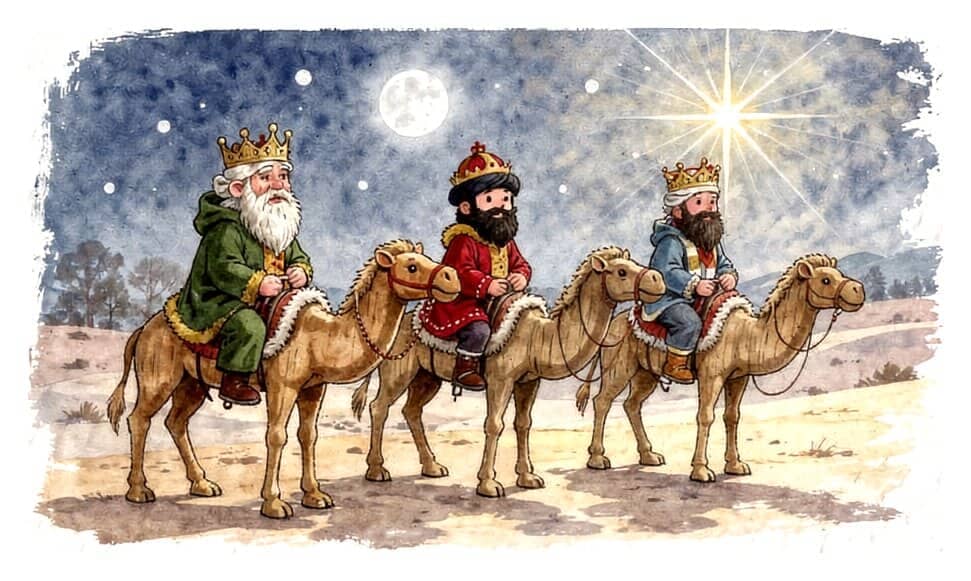
The wise men were visitors from the east who, the Gospel of Matthew says, followed a star to Bethlehem and brought the child Jesus gold, frankincense and myrrh. Matthew gives them no number, no names and no crowns; the three kings called Caspar, Melchior and Balthasar grew out of later church tradition.
At a glance
- In the Bible: Matthew 2:1–12
- What Matthew calls them: magi, “wise men from the east”
- Their gifts: gold, frankincense and myrrh
- How many: Matthew doesn’t say; three in Western tradition, twelve in some Eastern traditions
- Their names: Caspar, Melchior and Balthasar, in Western tradition
- Their feast: Epiphany, , in Western churches
What Matthew tells
Now when Jesus was born in Bethlehem of Judea in the days of King Herod, behold, wise men from the east came to Jerusalem, saying, “Where is he who is born King of the Jews? For we saw his star in the east, and have come to worship him.”
They had seen his star in the east, and they came to Jerusalem asking where the newborn king was. King Herod sent them on to Bethlehem and asked them to come back and tell him where the child was. The star went ahead of them until it stood still over the child. Matthew finds the family in a house, with “the young child,” and Herod’s cruel order reached boys up to two years old, so the visit may have come some time after the birth.
Opening their treasures, they gave him gold, frankincense and myrrh. Then a dream warned them, and they went home by another road.
What the word “magi” means
Matthew’s word for them is magi. The translation we quote notes that it can also mean teachers, scientists, physicians, astrologers, seers, interpreters of dreams or sorcerers.
 True story
Long before Matthew wrote, the Greek historian Herodotus described the magi as a priestly class among the Medes, and wrote that the Persians could offer no sacrifice without one. Matthew himself says only that the wise men came “from the east.”
How many were there?
The Bible never says how many wise men came.
As church tradition tells it · Western and Eastern church traditionsBecause they brought three gifts, Western Christians probably came to picture three, while some Eastern Christians, especially in Syria, told of twelve.
True storyEarly Christian art doesn’t settle it: one early painting shows two wise men, another three, another four.
Were they kings?
Matthew never calls them kings. In his telling, the only kings are Herod and the child the wise men are looking for.
As church tradition tells it · Western church traditionThe idea grew later, as Christians heard their story alongside a psalm that says kings will bring gifts and bow down before him.
The kings of Tarshish and of the islands will bring tribute. The kings of Sheba and Seba shall offer gifts. Yes, all kings shall fall down before him. All nations shall serve him.
The prophet Isaiah, too, pictures kings coming to the light and camels bringing gold and frankincense. Matthew mentions no camels.
Their names
The Bible gives no names.
As church tradition tells it · Western, Syriac and Armenian church traditionsThe earliest book known to give the names we know, oddly spelled, is a chronicle written in Greek, probably around the 500s, which has survived only in a rough Latin translation. In the West their names became Caspar (or Gaspar), Melchior and Balthasar. Christians in Syria and Armenia handed down quite different names: in Syria, Larvandad, Hormisdas and Gushnasaph, among others.
As church tradition tells it · Early church traditionJustin Martyr, a Christian teacher writing in the second century, said they came from Arabia.
Where they are remembered
True storyWestern churches remember the wise men on Epiphany, , a feast that began in the East, where it has long centered on the baptism of Jesus. In the United States, the Catholic bishops’ calendar keeps it on the Sunday between January 2 and 8: in , .
Cologne Cathedral, in Germany, keeps relics honored as those of the wise men. By the cathedral’s own account, they were brought there from Milan in 1164 by Cologne’s archbishop.
As church tradition tells it · Orthodox traditionIn Orthodox churches, the Gospel read at the Christmas liturgy is the visit of the wise men.
 Christmas magic
In Mexico, on the morning of , children find what the Three Kings left beside the nativity scene or under the tree.
Who else brings the presents, and when, is on the gift-bringers’ page.
Quick answers
How many wise men were there?
The Bible doesn’t say. Three is the usual number in the West, probably because of the three gifts; some Eastern Christians told of twelve.
What were the names of the three wise men?
The Bible gives none. Western tradition calls them Caspar, Melchior and Balthasar.
Were the wise men kings?
Matthew doesn’t call them kings. Christians came to picture them as kings later, reading a psalm about kings bringing gifts.
What gifts did the wise men bring?
Gold, frankincense and myrrh (Matthew 2:11).
When did the wise men visit Jesus?
Matthew doesn’t say. He finds the family in a house, and Herod’s order covered boys up to two, so the visit may have come some time after the birth.
More: where the story is in the Bible, Christmas in Mexico, the star of Bethlehem, Epiphany and the Three Kings.
Where our facts come from
- World English Bible, Matthew 2, Matthew 2:1–2 (wise men from the east; "his star"; quoted); 2:7–8 (Herod); 2:9–10 (the star went before them and stood over where the young child was); 2:11 ("They came into the house and saw the young child with Mary"; gold, frankincense and myrrh); 2:12 (warned in a dream, home "another way"); 2:16 (boys "from two years old and under, according to the exact time"); the whole passage (no number, no names; "King" used only of Herod and the child)
- World English Bible, Matthew 2, translator's footnote on 2:1, The note on "wise men" at 2:1 ("The word for 'wise men' (magoi) can also mean teachers, scientists, physicians, astrologers, seers, interpreters of dreams, or sorcerers")
- Walter Drum, "Magi", Catholic Encyclopedia, vol. 9 (1910), Section "Non-Biblical evidence" ("Herodotus (I, ci) is our authority for supposing that the Magi were the sacred caste of the Medes. They provided priests for Persia"); section "Patristic evidence" ("The Gospel narrative omits to mention the number of the Magi"; "Some Fathers speak of three Magi; they are very likely influenced by the number of gifts"; "In the Orient, tradition favours twelve"; early Christian art: paintings showing two, three and four; the liturgy applies the psalm of the kings' gifts to the Magi; "Among the Latins, from the seventh century… Gaspar, Melchior, and Balthasar"; "The Syrians have Larvandad, Hormisdas, Gushnasaph"; "the Armenians, Kagba, Badadilma")
- Herodotus, The Histories, book 1, tr. A. D. Godley (Harvard University Press, 1920), Perseus Digital Library, 1.101 ("The Median tribes are these: the Busae, the Paretaceni, the Struchates, the Arizanti, the Budii, the Magi"); 1.132.3, on Persian sacrifice ("a Magus comes near and chants over it the song of the birth of the gods … for no sacrifice can be offered without a Magus")
- Bruce M. Metzger, "Names for the Nameless in the New Testament: A Study in the Growth of Christian Tradition", in his New Testament Studies (Brill, 1980; first published 1970), p. 24 [80], first paragraph (three "probably because Matthew mentions that they presented three gifts"; twelve "rather widely held in the East, particularly in Syria"); second paragraph (the earliest literary reference to the names, the Excerpta Latina Barbari, from a Greek original "drawn up by an Alexandrian Christian who lived, it seems, in the sixth century"; § 86: "Bithisarea Melchior Gathaspa"); p. 25 [81], first paragraph (the Ravenna mosaic names them, but "the date of the legend supplying the names is not known"); p. 26 [82] ("in the West the three names which prevailed were Gaspar, Melchior, and Balthas(s)ar"); p. 29 [85] ("Gaspar (or Caspar, or Jasper)")
- World English Bible, Psalm 72, Psalm 72:10–11 (quoted)
- World English Bible, Isaiah 60, Isaiah 60:3 ("Nations will come to your light, and kings to the brightness of your rising"); 60:6 ("A multitude of camels… They will bring gold and frankincense")
- Justin Martyr, Dialogue with Trypho, chapter 78 (translation at Logos Virtual Library); his dates from J. Lebreton, "St. Justin Martyr", Catholic Encyclopedia, vol. 8 (1910), Dialogue 78 ("the Magi from Arabia came to Bethlehem and worshipped the Child"); Catholic Encyclopedia, opening paragraph (martyred about the year 165)
- C. C. Martindale, "Epiphany", Catholic Encyclopedia, vol. 5 (1909), Section "History" ("the Epiphany had its origin in the Eastern Church"; in the East "the Baptism was the event predominantly commemorated"; the West took up the January feast, "attaching overwhelming importance, as time went on, to the apparition of the Magi"; one of its names, "Festum trium regum")
- The Passionists of Holy Cross Province, "The Epiphany of the Lord, Solemnity" (the calendar's epiphany-us-catholic day), Event heading and Details (January 3, 2027; "Celebrated on the Sunday after January 1")
- United States Conference of Catholic Bishops, "Proper Calendar for the Dioceses of the United States of America" (approved by the USCCB and confirmed by the Apostolic See; last updated September 23, 2015), Final section, "In the Proper of Time" ("Sunday between January 2 and 8 — THE EPIPHANY OF THE LORD"; key: all caps = Solemnity)
- Orthodox Church in America, "Lives of the Saints", January 6, 2027, The feast's heading ("Feast of the Theophany of our Lord and Savior Jesus Christ") and its first sentence ("Theophany is the Feast which reveals the Most Holy Trinity to the world through the Baptism of the Lord")
- Orthodox Church in America, "Nativity of Christ", The paragraph beginning "The Gospel reading is the familiar Christmas story from Matthew (2.1–12)"
- Hohe Domkirche Köln, "Die Heiligen Drei Könige und der Kölner Dom", Introduction under "»Wir haben seinen Stern gesehen«" (relics venerated in the cathedral for over 850 years); section 04, "Translation nach Köln" (1164; Archbishop Rainald received the bodies of the Three Holy Kings from Milan)
- Gaceta UNAM, "Los Reyes Magos seguirán existiendo", January 5, 2021 (the calendar's epiphany day), Opening paragraph (January 6; gifts left by the Three Kings beside the nativity scene or under the tree)