
XI · Games
Who brings the presents?
 Christmas magicHow to read this bookReads aloud in 3 minutesAdded to the book
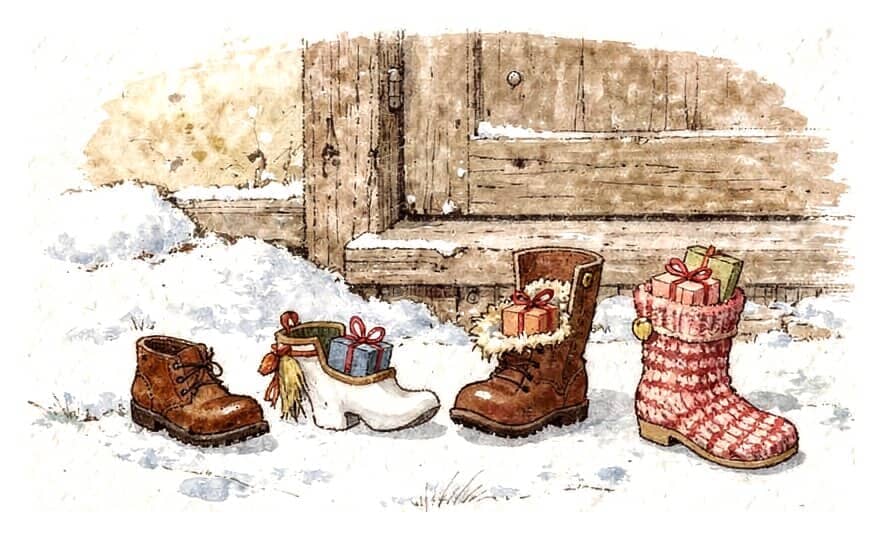


Children all over the world wait for presents at Christmas, but not everyone waits for the same visitor. Match each gift-bringer to the country where children look out for them. Some countries have more than one!
How to play: tap a gift-bringer, then tap the country where they come. When you match one, you’ll find out a little more about them. There is no timer and no score to beat, and nothing to type in. For ages about 6 and up, and grown-ups too.
The gift-bringers

Tap a gift-bringer to begin. Then tap the place that waits for them.
Gift-bringer
Country
Show me the answers
| Gift-bringer | Country | When you match it |
|---|---|---|
| Weihnachtsmann | Germany | In much of Germany, especially the north, the Weihnachtsmann brings the presents. His name means the “Christmas Man.” |
| Christkind | Germany | In other German homes the presents come from the Christkind, a child figure modeled on the Christ Child. |
| Babbo Natale | Italy | In Italy, Babbo Natale, a bearded old man dressed in red trimmed with white, brings children their presents. |
| La Befana | Italy | In Italy, La Befana, a kind old woman, comes down the chimney by night at Epiphany, January 6, with sweets for good children and a lump of coal for naughty ones. |
| Joulupukki | Finland | In Finland, Joulupukki visits children at home on Christmas Eve. His name means “Christmas goat,” and he lives on Korvatunturi, a fell in Lapland. |
| Święty Mikołaj | Poland | In Poland, Święty Mikołaj, which is Polish for Saint Nicholas, brings children their Christmas presents. |
| Gwiazdor | Poland | In some parts of Poland, the presents come from the Gwiazdor instead. |
| The Three Kings | Mexico | In Mexico the Kings leave presents on January 6, beside the nativity scene or under the tree. |
Read about it
Who comes to other countries, and when? Read who brings the presents around the world, meet the real Saint Nicholas, and visit Germany, Italy, Poland and Mexico.
Where our facts come from
- Wiktionary, "Weihnachtsmann", German, Etymology: from Weihnachten (Christmas) + Mann (man)
- Wiktionary, "joulupukki", Finnish, Etymology: joulu (Christmas, Yule) + pukki (buck, goat)
- Duden online, "Weihnachtsmann", Bedeutungen, sense 1 (usage: especially northern Germany)
- Duden online, "Christkind", Bedeutungen, sense 2
- Treccani, Vocabolario, "natale", Sense 2.b, "babbo Natale"
- Treccani, Vocabolario, "befana" and "epifania", "befana", main entry (the old woman who comes down the chimney at night with gifts and sweets for good children, coal for naughty ones); "epifania", main definition (January 6; "befana" its popular name)
- Yle News, "Watch: Santa and his reindeer set off from snowy Lapland", December 22, 2021, Lede paragraph (Joulupukki, Christmas goat, visits children at home on Christmas Eve); paragraph 3 (Korvatunturi)
- Słownik języka polskiego PWN, "Święty Mikołaj" and "gwiazdor", "Święty Mikołaj" entry (brings children presents at Christmas); "gwiazdor", sense 2, regional (a counterpart of Saint Nicholas)
- Gaceta UNAM, "Los Reyes Magos seguirán existiendo", January 5, 2021, Opening paragraph; section "Los regalos a los niños", paragraphs 1 and 3 (January 6, children wait for the gifts the Kings leave by the nativity scene or under the tree)