
VII · The World
How is Christmas celebrated in Italy?
 True storyHow to read this bookReads aloud in 5 minutesAdded to the book
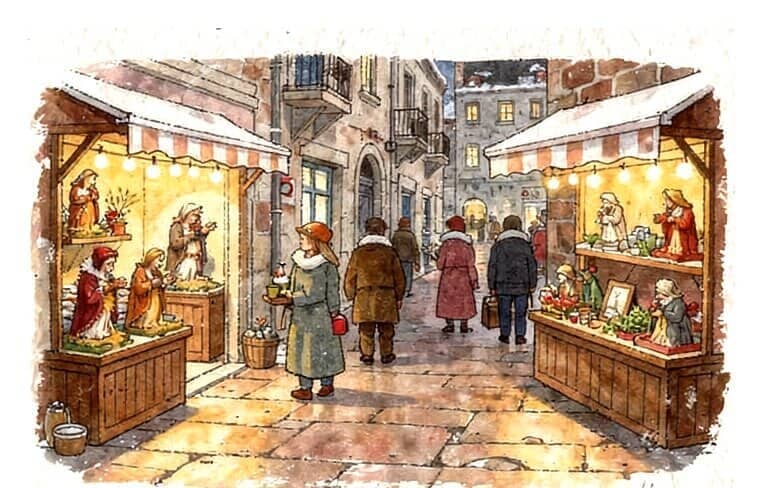
 Christmas magicLa Befana comes down the chimney by night at Epiphany, January 6, with sweets for good children and a lump of coal for naughty ones.


In Italy, Christmas is the season of the presepe, the nativity scene; the one often called the first was Saint Francis’s, at Greccio, at Christmas 1223. Christmas Eve is la vigilia, Christmas Day and December 26 are both holidays, and Epiphany, January 6, is La Befana’s day.
At a glance
- Christmas Eve: la vigilia, December 24
- Holidays: Christmas Day, December 25, and Santo Stefano, December 26
- Gift-bringers: Babbo Natale at Christmas; La Befana at Epiphany, January 6
- The Christmas bread: panettone, from Milan
- The nativity scene: the presepe
Christmas words
say it
Buon Natale
tap, and follow the star
- What it means
- good Christmas (buon means good; Natale means Christmas)
- The reply
- Grazie, altrettanto! (thanks, the same to you), the usual answer to any good wish
- When to say it
- at Christmas
/ˈbwɔn naˈtale/
The presepe
Over the centuries, Italian nativity scenes grew ever more elaborate, and the art reached its height in the 1700s, in cities such as Naples and Genoa. In Naples it is Christmas all year on Via San Gregorio Armeno, a narrow old street of workshops selling handmade nativity figures, including, for fun, little figures of famous people to add to the crowd around the manger. Saint Francis’s nativity scene at Greccio has its own page.
La vigilia
Italians call Christmas Eve, and its supper, la vigilia: the eve. What is on the table changes from region to region. In the south, Christmas Eve is a night for fish, and so it is in Rome. The Feast of the Seven Fishes grew up among Italian Americans; in Italy, nobody calls it that.
Panettone
Panettone, the tall domed Christmas bread with raisins and candied citron, comes from Milan and is now on Christmas tables all over Italy.
That much is history. Here is a tale people tell.
 A tale people tell
Milanese storytellers say panettone was first baked at the court of the Visconti lords in the 1300s.
The bread is probably older still.
Christmas Day and Santo Stefano
Christmas Day and December 26 are both public holidays in Italy. The 26th is Santo Stefano, the feast of Saint Stephen.
 As church tradition tells it · Western church tradition
The church remembers Stephen as the first Christian to die for his faith.
Babbo Natale and La Befana
Christmas magicAt Christmas, Babbo Natale, a bearded old man dressed in red trimmed with white, brings children their presents. Then, by night at Epiphany, January 6, La Befana, a kind old woman, comes down the chimney and fills good children’s stockings with sweets, and naughty ones’ with a lump of coal.
Her name comes from the word for Epiphany, and the presents children get that day are given in memory of the wise men.
Quick answers
How do you say Merry Christmas in Italian?
Buon Natale, said BWOHN nah-TAH-leh.
Who brings the presents in Italy?
Babbo Natale at Christmas, and La Befana at Epiphany, January 6.
What do Italians eat on Christmas Eve?
It changes from region to region. In the south, and in Rome, it is a night for fish. The Feast of the Seven Fishes is an Italian-American name.
What is panettone?
Panettone, the domed sweet bread from Milan, is eaten at Christmas all over Italy.
Read on: the first nativity scene, the twelve days of Christmas, who brings the presents around the world, La Befana and Italian Christmas words.
Where our facts come from
- Treccani, Enciclopedia on line, "presepe", "Origini ed evoluzione", paragraph 1 ("il presepe vivente ricostruito da S. Francesco a Greccio"; "raggiungendo nel sec. 18° il massimo sviluppo specie in alcuni centri, come Napoli o Genova"; "con composizioni sempre più complesse"); the definition line ("durante il periodo natalizio")
- Thomas of Celano, The Life of Saint Francis, 1C 84–85, as given in Noel Muscat OFM, Spirit+Life 146 (2023), 1C 84 ("at the town of Greccio"); Muscat p. 4 (25 December 1223); p. 19 (Admirabile signum: "this first Nativity scene"); p. 18 (Francis "could not have possibly invented the crib in the modern sense of the term")
- Italia.it (Italy's official tourism site, ENIT and the Ministry of Tourism), "San Gregorio Armeno", Main text, paragraphs 1–2 ("the street of the nativity scenes"; handmade nativity figurines popular "around the eighteenth century"; shops "open all year round" selling the statuettes of Nativity characters "together with the figurines of politicians, actors and well-known personalities")
- Allie Yang, "What is the Feast of the Seven Fishes?", National Geographic, updated December 13, 2023, Section "Italian origins", paragraphs 2–3 (Christmas Eve and its supper, la vigilia; fish in the south; the Feast of the Seven Fishes an Italian-American name); section "Tradition is always evolving", paragraph 1 ("Italian culture is very regional")
- Turismo Roma (Roma Capitale's tourism site), "Il Natale nella cucina romana", Paragraph 2 ("La tradizione del cenone della vigilia e del pranzo di Natale esigeva che a tavola ci fosse rigorosamente il pesce"); paragraph 3 (the custom "è rimasta viva nelle famiglie romane"; fish and seasonal vegetables "ancora oggi i protagonisti indiscussi a tavola")
- Treccani, Vocabolario, "vigìlia", Sense 2a (the day before a feast, the eve)
- Treccani, Vocabolario, "panettone", Sense 1 ("Tipico dolce milanese, a forma di cupola", with uva sultanina and cedro; "tradizionale in tutta Italia come dolce natalizio"; "attribuito dalla leggenda alla corte viscontea del '300, ma probabilmente di origine più antica")
- Legge 27 maggio 1949, n. 260, art. 2 (Normattiva), Art. 2, the list of "giorni festivi" ("il giorno di Natale; il giorno 26 dicembre")
- Treccani, Enciclopedia on line, "Stéfano, santo", Main paragraph ("ha il titolo di 'protomartire' perché fu il primo a versare il sangue in testimonianza della fede di Cristo"; "Festa nella Chiesa latina, 26 dic. (nella greca il 27)")
- Treccani, Vocabolario, "natale", Sense 2.b, "babbo Natale" (the bearded old man dressed in red trimmed with white who brings children their presents at Christmas)
- Treccani, Vocabolario, "befana" and "epifania", "befana", sense 2a (the old woman who, on the night of Epiphany, comes down the chimney with sweets for good children and coal for naughty ones); the etymology (from Latin epiphania); sense 1 ("Nome pop. dell'Epifania: la festa della b."; gifts to children that day in memory of the Magi); "epifania", main definition (January 6)