

V · Santa
Who was Saint Nicholas?
 True storyHow to read this bookReads aloud in 7 minutesRead it to a childAdded to the book
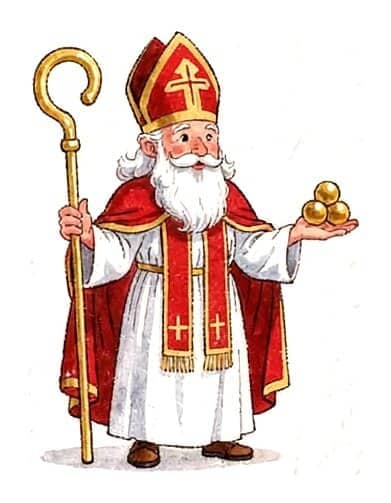

Saint Nicholas was a bishop of Myra, a city near the southern coast of what is now Turkey, who lived in the 300s. Historians can be sure of very little else about him, but stories of his kindness are still told, and his feast day, December 6, is still kept in many countries.
At a glance
- Who: Nicholas, bishop of Myra
- Where: Myra, in the old region of Lycia; its ruins lie at Demre, in today’s Turkey
- When: the 300s
- His day: December 6 (December 19 in churches that keep the old Julian calendar)
- Where his remains went: to Bari, in southern Italy, in 1087
What history can tell us
Here is the part we can be sure of: there was a bishop named Nicholas in the city of Myra, in the region of Lycia, in the 300s. That is close to all that historians will say for certain.
Tradition fills in a little more. It says he was born in Patara, then a Greek town and now on Turkey’s southern coast, and that he became bishop of nearby Myra while he was still young. By tradition he died on December 6, sometime in the middle of the 300s, and that is why his feast falls on December 6. Churches that follow the old Julian calendar keep his day on December 19.
People often say he was one of the bishops at the great Council of Nicaea in the year 325. Maybe he was. But the oldest lists of the council’s bishops leave him out, and no record we have puts him there until about two hundred years later, at the earliest. So nobody can be sure.
Myra itself is a ruin now, near the small town of Demre, and among the ruins stands a church of Saint Nicholas.
A long journey to Italy
In 1087, merchants from Italy carried his remains away from Myra and brought them to Bari, a port in southern Italy. That is why a saint from the coast of Turkey is so closely tied to an Italian city.
The stories people tell
 A tale people tell
One story about Nicholas, told and retold for well over a thousand years, is about three sisters. Their father was poor, and with no dowry to offer, no man of standing would take them as wives. In the oldest full telling of the saint’s life that survives, written in Greek more than a thousand years ago, Nicholas comes by night and throws a bag of gold through the family’s window, and then does it again, and again: three bags for three daughters. The third time, the father runs after the giver, catches up with him and sees that it is Nicholas.
That old telling has no stocking in it. In the way the story is usually told today, the gold lands in a stocking left by the fire to dry, and many people say that is why we hang up stockings at Christmas. In some tellings it lands in a shoe.
 Christmas magic
And on the night of December 5, the eve of his day, children in many countries still set out their shoes for Saint Nicholas, and in the morning they find small treats inside.
How Saint Nicholas’s name came to belong to Santa Claus is a story of its own: from Saint Nicholas to Santa Claus.
Read it to a child
Reads aloud in 2 minutes
Long, long ago, in a city called Myra by the sea, there lived a bishop named Nicholas.
A tale people tellPeople tell a story about him. Next door to Nicholas lived a man with three daughters. He had once been rich, but he had lost everything. Back then, when a girl married, her family gave money or goods with her, called a dowry, and he had none to give. So one night, when everyone was asleep, Nicholas tiptoed up to their house and tossed a bag of gold through the window. He came back a second night, and a third, until each sister had her gift. On the third night the father ran after him and saw that it was kind Nicholas, who liked to give in secret.
Christmas magicToday, on the night before his special day, December 6, children in many countries put out their shoes for Saint Nicholas. And in the morning? Small treats, tucked inside.
Quick answers
When is Saint Nicholas Day?
December 6. Churches that follow the old Julian calendar keep it on December 19.
Where was Saint Nicholas from?
He was bishop of Myra, near the southern coast of today’s Turkey. Tradition says he was born in nearby Patara.
Where did Saint Nicholas’s remains go?
In 1087 merchants carried his remains from Myra to Bari, in southern Italy.
Was Saint Nicholas at the Council of Nicaea?
Nobody can be sure. The oldest lists of the council’s bishops leave him out, and no record we have puts him there until about two hundred years later, at the earliest.
More: Saint Nicholas Day and why we hang stockings.
Where our facts come from
- Michael Ott, "St. Nicholas of Myra", Catholic Encyclopedia, vol. 11 (1911), Paragraph 1 (bishop of Myra in Lycia in the fourth century; scarcely anything else historically certain; died 6 December, 345 or 352)
- Ott, Catholic Encyclopedia, as above, Paragraph 3 (6 December, the day the Church celebrates his feast; his name in none of the old lists of the bishops at Nicaea)
- Ott, Catholic Encyclopedia, as above, Paragraph 2 (in 1087 Italian merchants took his body from Myra to Bari)
- S. Salaville, "Myra", Catholic Encyclopedia (1913), transcribed on Wikisource, Paragraph 1 (a see of Lycia in Asia Minor; the church Theodosius II is said to have built to St. Nicholas; the Index of Theodorus Lector the first document to name him at Nicaea); paragraph 2 (Myra now the village of Dembre, Adalia; the Church of St. Nicholas among its ruins)
- Republic of Türkiye, Ministry of Culture and Tourism, General Directorate for Cultural Assets and Museums, "St. Nicholas Memorial Museum" fact sheet, The leaflet's description of the Church of St. Nicholas at Demre
- St. Nicholas Center, "Around the World", The paragraph on customs from forty-two countries
- St. Nicholas Center, "Literary development of the 'Life' of St Nicholas of Myra" (Roger Pearse's English summary of A. Blom, 1998, appendix ii), Section A, "The oldest biographies and related texts" (the dating of the Nicaea entry disputed; Anrich's later date)
- St. Nicholas Center, "Who is St. Nicholas?", Main text, paragraph 1 (born in Patara, then Greek, now on Turkey's southern coast; made bishop of Myra while young); paragraph 2 (his feast, December 6; December 19 on the Julian calendar)
- Michael the Archimandrite, Life of Saint Nicholas, English translation on the St. Nicholas Center, Section "Impoverished Father" (§10: the neighbor, once well-off, now very poor); sections "The First Gift" (§12), "The Second Gift" (§14) and "The Third Gift" (§16–17, the father's run in §17); no stocking or shoe in the text
- St. Nicholas Center, "Three Impoverished Maidens", Story paragraph 1 (the man once rich; the dowry as something of value); paragraph 2 (the gold lands in a stocking); the note after the story (the origin people give for hanging stockings; in some versions a shoe)
- St. Nicholas Center, "St. Nicholas Customs Around the World", Opening section (December 6, early in Advent; parties on the eve, December 5; shoes or stockings left to fill; small treats; carrots and hay for his horse or donkey)