

V · Santa
How did Saint Nicholas become Santa Claus?
 True storyHow to read this bookReads aloud in 10 minutesRead it to a childAdded to the book


Santa Claus, as families picture him today, took shape in New York in the 1800s. His name probably comes from Sinterklaas, the Dutch name for Saint Nicholas, and New York writers gave him his sleigh, his reindeer and his bundle of toys. It happened a little at a time: in a magazine, a comic history, a picture book and a poem.
At a glance
- The saint: Saint Nicholas, bishop of Myra in the 300s
- The name: probably from Sante Klaas, a Dutch dialect form of Sinterklaas
- Where it happened: New York, in the 1800s
- Along the way: a magazine, 1808 · Washington Irving’s comic History of New York, 1809 · a picture book, 1821 · the poem, 1823 · Thomas Nast’s drawings, from the 1860s
A name from the Dutch?
In Dutch, Saint Nicholas is Sinterklaas, and the name Santa Claus probably comes from it. The Dutch word historian Nicoline van der Sijs traces it to Sante Klaas, a Dutch dialect form of Sinterklaas. Not every scholar agrees: in 1954 Charles W. Jones wrote that Santa Claus is not a typically Dutch form of the name, and that it had lasted from early times in Switzerland and southern Germany.
Many old books say that the Dutch families of New Amsterdam, the town that became New York, waited for Saint Nicholas every year. Jones went looking for proof in the old newspapers, magazines, diaries, books and songs, and in the same 1954 article he reported that he had found no evidence that the colony kept Saint Nicholas, or that New Yorkers did for a century after the English took over. In the Netherlands, town governments such as Amsterdam’s had even passed laws against Saint Nicholas customs. Van der Sijs disagrees: she writes that the Dutch settlers surely brought their Saint Nicholas custom with them, and points to a baker’s receipt from 1675 for Saint Nicholas goods, bought by Maria van Rensselaer. On one point Jones agreed with the old books: Santa Claus spread out from New York.
New York takes up the saint
In January 1808, a New York magazine called Salmagundi wrote of “the noted St. Nicholas” and the name people called him by: “Santaclaus.”
Then came Washington Irving. He chose Saint Nicholas Day, December 6, 1809, to publish his comic History of New York, and he filled it with the saint: Jones counted at least twenty-five mentions. In that first edition, Irving’s old New Amsterdam keeps Saint Nicholas Day with presents and a stocking hung in the chimney. For the second edition, in 1812, he added more: the saint rides over the treetops in the wagon that carries children’s yearly presents, drops presents down the chimneys of his favorites, and one night a year comes rattling down the chimneys with presents for the children. Many of the stories about Saint Nicholas in old New Amsterdam began in its pages, and Irving’s jokes helped make him New York’s own old Dutch saint.
John Pintard, who helped found the New-York Historical Society in 1804, promoted Saint Nicholas too. For the Society’s Saint Nicholas celebration in 1810, Pintard paid to print a broadside with a woodcut of the saint by Alexander Anderson.
A sleigh and a reindeer
In Irving’s book, and in other stories of those years, the saint rides in a wagon. But a little New York picture book of 1821, The Children’s Friend, has “Santeclaus” driving a sleigh behind a reindeer and coming “each Christmas eve”:
Old Santeclaus with much delight / His reindeer drives this frosty night,
The poem of 1823
On December 23, 1823, a newspaper in Troy, New York, printed the poem that begins “’Twas the night before Christmas.” The editor did not know who had written it, but he called its hero “Sante Claus.” The poem itself calls him St. Nicholas and St. Nick. It gives him a miniature sleigh and eight tiny reindeer, each called by name, and a bundle of toys on his back. He is dressed all in fur, with a beard as white as the snow and a little round belly that shakes when he laughs.
When Saint Nicholas first came into New York homes, Jones found, the night he visited usually depended on the family’s church: some families looked for him at New Year, others at Christmas. Some printings of the poem in the next twenty years even changed its line to “the night before New Years.” Jones thought the poem’s popularity helped settle the visit on Christmas.
The poem is usually credited to Clement Clarke Moore, a professor of Greek and Hebrew literature at a seminary in New York. It was printed under his name in 1837, and he put it in his own book of poems in 1844. Some believe Henry Livingston wrote it; the poem’s own page tells that story, and has the whole poem to read aloud.
Thomas Nast draws him
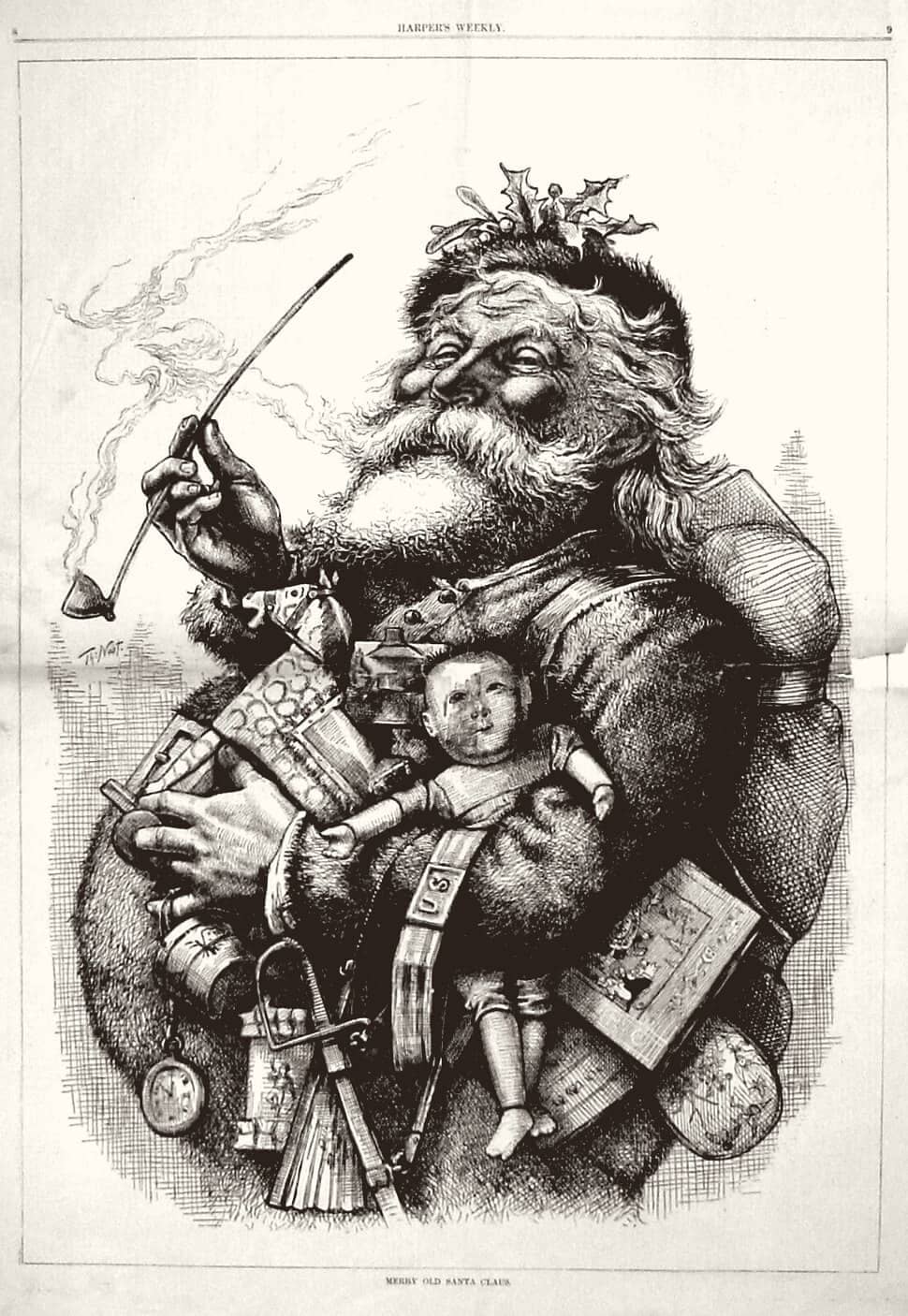
Forty years after the poem, the artist Thomas Nast, who was born in Germany, was drawing Santa Claus for the magazine Harper’s Weekly. His “Santa Claus in Camp” was on the front page of the issue of January 3, 1863, and Nast kept drawing Santa into the 1880s.
 Christmas magic
And every Christmas Eve Santa still comes, with his sleigh, his reindeer and his bundle of toys, just as the poem says.
Read it to a child
Reads aloud in a minute
Long ago, people in New York loved to tell about Saint Nicholas, the kind bishop. They gave him a name that probably came from the Dutch: Santa Claus. A little picture book gave him a reindeer and a sleigh. Then a poem gave him eight reindeer, a bundle of toys, and a round little tummy that wobbled when he laughed.
Christmas magicAnd on Christmas Eve, he still comes.
Quick answers
Where does the name Santa Claus come from?
Probably from Dutch. Saint Nicholas is Sinterklaas in Dutch, and the word historian Nicoline van der Sijs traces Santa Claus to Sante Klaas, a Dutch dialect form of that name. The scholar Charles W. Jones disagreed: he thought it was not a typically Dutch form.
Did the Dutch bring Santa Claus to America?
Scholars disagree. The name probably came from Dutch, and the word historian Nicoline van der Sijs writes that the Dutch settlers surely brought their Saint Nicholas custom with them. But when the scholar Charles W. Jones searched the old records (he published what he found in 1954), he found no evidence that the Dutch colony of New Amsterdam kept Saint Nicholas. Either way, the Santa Claus we know took shape in New York in the 1800s.
When did Santa get his reindeer?
A New York picture book of 1821, The Children’s Friend, already shows him with a reindeer and a sleigh. The poem of 1823 gave him eight, and named them all.
Who was Thomas Nast?
An artist born in Germany who drew Santa Claus for Harper’s Weekly. His “Santa Claus in Camp” was on the front page on January 3, 1863, and he kept drawing Santa into the 1880s.
More: who Saint Nicholas was, the whole poem of 1823, Christmas in the United States, who brings the presents around the world, Sinterklaas, Santa’s red suit and Christmas in America.
Where our facts come from
- Michael Ott, "St. Nicholas of Myra", Catholic Encyclopedia, vol. 11 (1911), Paragraph 1 (bishop of Myra in Lycia in the fourth century)
- The American Heritage Dictionary of the English Language, 5th ed., "Santa Claus", Etymology ("Probably alteration of Dutch Sinterklaas")
- Nicoline van der Sijs, Yankees, cookies en dollars (2009), entry "Santa Claus", at etymologiebank.nl (Instituut voor de Nederlandse Taal), "Sinterklaas", The Yankees, cookies en dollars entry: the etymology (American English Santa Claus, from Dutch Sante klaas, a dialect form of Sinterklaas, from Sint Nicolaas); the paragraph beginning "Hoe is Sinterklaas nu getransformeerd in Santa Claus?" (some town governments banned Sinterklaas in the seventeenth century; "Ook de Nieuw-Nederlanders hebben dit populaire gebruik met zekerheid meegenomen naar Amerika. Uit een bakkersbonnetje blijkt dat juffrouw Van Rensselaer uit 1675 sinterklaesgoet kocht.")
- New York State Parks and Historic Sites Blog, "Compliments of the Season" (December 25, 2018), on Crailo State Historic Site, The Crailo paragraph ("In 1675, Crailo's owner, Maria van Rensselaer, purchased suntterclaesgoet, or 'Sinterklaas goodies,'")
- St. Nicholas Center, "Flemish Sinterklaas Influence in 'Nieuw Nederland'", citing "Baker's account from Wouter de backer (Wouter Albertsz) March 1675", Van Rensselaer Manor Papers, New York State Library, The paragraph beginning "Maria and Jeremias van Rensselaer lived in Albany" (a 1675 baker's receipt "to Maria Van Rensselaer"; "suntterclaesgoet" (Sinterklaas goods)); the paragraph before it ("Maria, who married Jeremias van Rensselaer"); Sources
- Charles W. Jones, "Knickerbocker Santa Claus", The New-York Historical Society Quarterly 38, no. 4 (October 1954), reprinted by the St. Nicholas Center, The paragraph beginning "And by the way, Santa Claus is not a characteristically Dutch corruption" (it has survived from early times in Switzerland and southern Germany), just before "This, then, is our best current knowledge about the Sons of St. Nicholas"
- Jones, "Knickerbocker Santa Claus", as above, The paragraphs after the opening: the legend "repeated yearly in those Christmas books" (Mary L. Booth, 1859); the evidence ("newspapers, magazines, diaries, books, broadsides, music") does not bear it out; Booth right only that the cult of Santa Claus spread from New York; "no evidence that it existed in New Amsterdam or for a century after English occupation"; the laws against St. Nicholas, with an ordinance from Amsterdam
- Salmagundi, No. XX, Monday, January 25, 1808 (Internet Archive scan), Page 407 ("the noted St. Nicholas, vulgarly called Santaclaus")
- Salmagundi, vol. I (New-York: David Longworth, 1814), the collected edition, Title page (the New York imprint)
- Jones, "Knickerbocker Santa Claus", as above, "Washington Irving" section, paragraph 1 ("in January 1808 … Salmagundi noticed Santa Claus")
- Jones, "Knickerbocker Santa Claus", as above, "Washington Irving" section: the paragraph beginning "And so, when the History was published" (published on St. Nicholas Day, December 6, 1809, a comic work); the paragraph beginning "Without Irving there would be no Santa Claus" ("no less than twenty-five allusions"; the source of the legends about St. Nicholas in New Amsterdam); "Clement Clarke Moore" section ("In Irving's History, in Paulding's stories, and the like, Santa Claus drives a horse and wagon")
- Washington Irving (as Diedrich Knickerbocker), A History of New York, vol. II (New York: Inskeep & Bradford, 1809), archive.org scan, Book VII, ch. X, p. 252 ("nor was the day of St. Nicholas suffered to pass by, without making presents, hanging the stocking in the chimney")
- Washington Irving, A History of New-York, "The Second Edition with Alterations", vol. I (New-York: Inskeep and Bradford, 1812), archive.org scan, Book II, ch. V ("riding over the tops of the trees, in that self same waggon wherein he brings his yearly presents to children"); Book III, ch. II ("dropping them down the chimnies of his favourites"; "save one night in the year; when he rattles down the chimnies … confining his presents merely to the children")
- Jones, "Knickerbocker Santa Claus", as above, The section after Pintard's 1793 almanac (the founding of The New-York Historical Society in 1804; Pintard "would push the cult"); the paragraph on the Society's 1810 dinner (the broadside "which Pintard had Alexander Anderson engrave was published at his own expense"); the image caption ("St. Nicholas Broadside, New-York Historical Society, 1810, Woodcut: Alexander Anderson")
- Representative Poetry Online, University of Toronto Libraries, "Old Santeclaus", original text from The Children's Friend (William Gilley, 1821), published anonymously, Lines 1-2 ("Old SANTECLAUS with much delight / His reindeer drives this frosty night") and line 7 ("Each Christmas eve he joys to come")
- Jones, "Knickerbocker Santa Claus", as above, quoting The Children's Friend (New York, 1821), "Clement Clarke Moore" section, the paragraph beginning "At the Historical Society's St. Nicholas Day celebrated a dozen years ago" (published on Broadway the year before Moore wrote his poem; the first quatrain, illustrated by "a sprightly reindeer and sleigh")
- "Account of a Visit from St. Nicholas", Troy Sentinel (Troy, New York), December 23, 1823, Wikisource transcription with page scan, The editor's note above the poem ("We know not to whom we are indebted"; "Sante Claus, his costume and his equipage"); the poem: "St. Nicholas", "St. Nick", "a miniature sleigh, and eight tiny rein-deer", "call'd them by name", "dress'd all in fur", "A bundle of toys was flung on his back", "the beard of his chin was as white as the snow", "a little round belly / That shook when he laugh'd"
- Jones, "Knickerbocker Santa Claus", as above, Note 14 (the date of the visit "usually depended on the sect of the family": Anglican families not at the New Year, Reformed-Church families not at Christmas; printings in the next twenty years with the line changed to "The night before New Years"; "the popularity of Moore's verses helped to center the event on Christmas")
- Paul Hond, "The Story Behind the Most Famous Christmas Poem of All", Columbia Magazine, November 19, 2021, Paragraph 1 ("a newly minted professor of Greek and Hebrew literature at General Theological Seminary")
- Charles Fenno Hoffman (ed.), The New-York Book of Poetry (New York: George Dearborn, 1837), Title page (1837); contents, "A Visit from St. Nicholas … 217"; the poem headed "A VISIT FROM ST. NICHOLAS / BY CLEMENT C. MOORE"
- Clement C. Moore, Poems (New York: Bartlett & Welford, 1844), Title page (1844); contents, "A visit from St. Nicholas … 124"
- Stephen Nissenbaum, "There Arose Such a Clatter: Who Really Wrote 'The Night before Christmas'?", Common-place 1.2 (January 2001), Paragraphs 1–2 (Don Foster's case that Henry Livingston Jr. wrote it; Livingston never took credit himself)
- The Metropolitan Museum of Art, collection records for Thomas Nast: "Santa Claus in Camp (from 'Harper's Weekly,' vol. 7, p. 1)", 29.88.4(7); "Santa Claus – Merry Christmas", originally published 1884, Record 429261: title ("Harper's Weekly, vol. 7, p. 1"), objectDate ("January 3, 1863"), artistDisplayBio ("American (born Germany)"); record 852700: objectDate ("originally published 1884")
- Harper's Weekly, vol. 25, no. 1253, January 1, 1881 (Internet Archive scan, sim_harpers-weekly_1881-01-01_25_1253), Pages 8–9 (image n8): Nast's drawing, its printed title "MERRY OLD SANTA CLAUS"