
 True storyMoravian stars started out as a geometry exercise at the church's boarding schools in Germany, in the nineteenth century. The very first star's points were red and white, in turn.
VII · The World
How is Christmas celebrated in Germany?
True storyHow to read this bookReads aloud in 6 minutesAdded to the book
 Christmas magicIn the south of Germany the presents mostly come from the Christkind; in the north it is usually the Weihnachtsmann.

In Germany, the presents come on Christmas Eve, December 24, which Germans call Heiligabend, the holy evening. The weeks before it are Advent, with wreaths, calendars, baking and Christmas markets, and on the night before December 6 children set out their shoes for Saint Nicholas.
At a glance
- Presents: on Christmas Eve, December 24, Heiligabend
- Gift-bringers: the Christkind, mostly in the south; the Weihnachtsmann, mostly in the north
- Shoes for Saint Nicholas: the night of December 5
- Christmas markets: from late November
- In Bavaria, holidays: December 25 and 26, the First and Second Christmas Day
Christmas words
say it
Frohe Weihnachten
tap, and follow the star
- What it means
- joyful Christmas (froh means joyful or happy; Weihnachten means Christmas)
- When to say it
- at Christmas
/ˌfʁoːə ˈvaɪ̯naxtn̩/
Christmas Eve is Heiligabend, from the words for “holy” and “evening.” The Christkind is a child figure modeled on the Christ Child, and the Weihnachtsmann is the Christmas Man.
Advent
The Advent wreath began in Germany. The first one on record was hung in 1839 by Johann Hinrich Wichern, a theologian, in his home for poor children in Hamburg: a wooden ring as big as a cart wheel, with a candle for each day of Advent, big white ones for the Sundays and little red ones between. Fir branches came in 1860, and when families brought the wreath home in the early 1900s it shrank to four candles, one for each Sunday.
From December 1, children open one of 24 little doors each day until Christmas Eve.
December smells of baking: cinnamon stars and vanilla crescents, Stollen rich with butter, raisins and nuts, and spiced Lebkuchen, the most famous from Nuremberg.
On December 4, Saint Barbara’s Day, many people in the south bring fruit-tree twigs indoors, hoping they will flower by Christmas Eve for good luck.
The Christmas markets
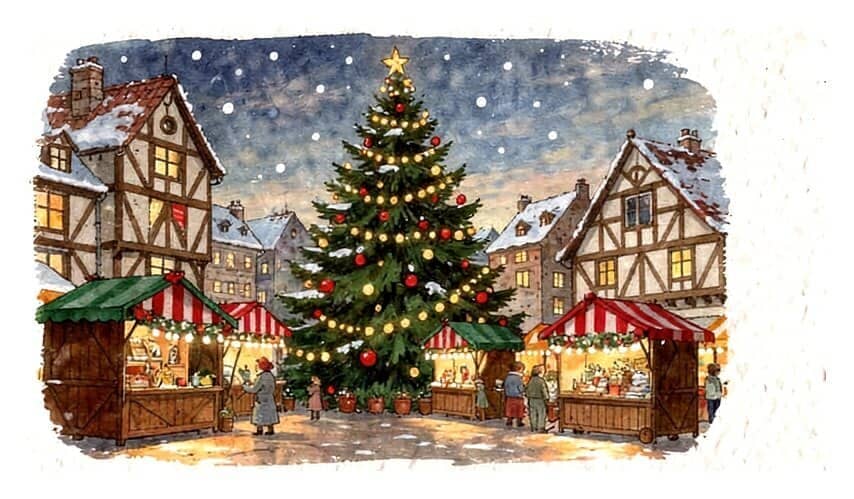
Christmas markets open in late November. Nuremberg’s is one of Germany’s oldest: its first written mention is from 1678, and each year a young woman chosen as the city’s Christkind opens it. Dresden says its Striezelmarkt, first held in 1434, is Germany’s oldest.
Saint Nicholas, December 6
Christmas magicOn the night before December 6, children put their shined-up shoes or boots by the door, and in the morning Saint Nicholas has filled them with sweets, nuts and tangerines.
In earlier centuries, Saint Nicholas, not the Weihnachtsmann, was the gift-bringer of German children. In Germany his rough helper is Knecht Ruprecht.
Christmas Eve
In Germany the presents come on Christmas Eve: the tree is traditionally trimmed that day, and the gifts appear beneath it by evening. Many families go to a Christmas Eve church service.
Christmas magicIn the south the presents are brought by the Christkind, the Christ Child, with golden curls; in the north it is usually the Weihnachtsmann.
The Christkind is usually credited to Martin Luther. In his household, it is said, the presents moved from Saint Nicholas Day to Christmas Eve and became gifts of the Holy Christ. In Bavaria, giving the children their presents on Christmas Eve was already the custom in Munich by about 1850, and it reached the villages around 1900.
Many families eat potato salad and sausages on Christmas Eve and save the roast goose, dumplings and red cabbage, or a carp, for the Christmas days that follow. In Bavaria, for example, the law names December 25 and 26 as public holidays, the First and Second Christmas Day.
Quick answers
When do Germans open their Christmas presents?
On Christmas Eve, December 24.
Who brings the presents in Germany?
The Christkind, mostly in the south, or the Weihnachtsmann, mostly in the north, on Christmas Eve.
How do you say Merry Christmas in German?
Frohe Weihnachten, said FROH-uh VY-nahkh-tuhn.
What is the oldest Christmas market in Germany?
Dresden says its Striezelmarkt, first held in 1434, is the oldest. Nuremberg’s market is first written about in 1678.
Read on: Advent, Saint Nicholas Day, why so many countries celebrate on Christmas Eve, the Christmas tree, the Christmas truce of 1914, the Christkind and German Christmas words.
Where our facts come from
- German National Tourist Board, "Christmas Eve: Christmas tree, Christ Child and Father Christmas", Introduction, sentence 4, and section "Glittering Christmas time…", paragraph 1 (presents on Christmas Eve; the tree traditionally put up and decorated that day; the gifts found under it in the afternoon or evening); section "Christmas Eve: Christ Child or Father Christmas?", paragraph 1 (the Christkind, with golden curls, mostly in the south; the Weihnachtsmann mostly in the north; many families go to church on Christmas Eve); section "Festive delights: Christmas dinner from goose to potato salad", paragraph 1 (potato salad and sausages on Christmas Eve; goose with dumplings and red cabbage, or carp, on the Christmas days)
- Duden online, "Weihnachtsmann" and "Christkind", "Weihnachtsmann", Bedeutungen, sense 1 (usage: especially northern Germany); "Christkind", Bedeutungen, sense 2 (a child figure, modeled on the Christ Child, who brings children presents at Christmas)
- DWDS (Digitales Wörterbuch der deutschen Sprache), "Weihnachtsmann", Wortzerlegung ("Weihnacht Mann")
- Nuremberg Christkindlesmarkt (city of Nuremberg), "A Symbol for Nuremberg: The Origin of the Christkind", Paragraphs 1–2 (Martin Luther credited with moving his household's gift-giving from Saint Nicholas Day to Christmas Eve and telling his children the "Holy Christ" had brought the presents)
- Sophie von Glinski, "Nikolaustag", Planet Wissen (WDR), Paragraph 2 (in earlier centuries Nikolaus, not the Weihnachtsmann, brought the children their presents); the section on his companions (Knecht Ruprecht)
- German National Tourist Board, "Romantic Advent: Christmas cookies, Advent calendars, Saint Nicholas and Christmas markets", Section "Advent calendar: 24 little doors until Christmas Eve", paragraph 1; section "Shoes outside the door: Saint Nicholas is bringing apples, nuts and sweets", paragraph 1; section "This is where things get Christmassy", paragraph 1 (markets from late November); section "December for foodies: cookies, stollen cake and gingerbread", paragraph 1
- Das Rauhe Haus, "Eine Hamburger Erfindung: 1839 hing im Rauhen Haus der erste Adventskranz der Welt" / "Der Wichernsche Adventskranz" (press sheet, PDF), Page 1, "Der Wichernsche Adventskranz", paragraph 1 (the first Advent wreath on record, 1839, at the Rauhes Haus in Hamburg; Johann Hinrich Wichern, "ein Hamburger Theologe (aber nicht Pastor)"); paragraph 2 ("wagenradgroßen Holzleuchter", a candle for each day of Advent; four large white candles for the Sundays, small red ones between); paragraphs 3–4 (fir greenery from 1860; four candles once it moved into homes in the early 1900s)
- Nuremberg Christkindlesmarkt, "History of the Christkindlesmarkt" and "A Symbol for Nuremberg: The Origin of the Christkind", History page, teasers "A Christmas Market with a Long Tradition" (sentences 1–3) and "The Chronicle of the Christmas Market" (sentences 2–3: the first explicit written mention in 1678); origin page, paragraph 3 (the market opened each year by the Nuremberg Christkind)
- City of Dresden (Landeshauptstadt Dresden), Dresdner Striezelmarkt, "Geschichte und Tradition" and the market's home page, "Geschichte und Tradition", section "Kleine Marktchronik", paragraph 2 ("Der erste Dresdner Striezelmarkt dauerte … einen einzigen Tag. Das war im Jahre 1434!") and the chronicle entry "1434"; home page (https://striezelmarkt.dresden.de/de/), section "Was den Dresdner Striezelmarkt einmalig macht", paragraph 1 ("der älteste Weihnachtsmarkt Deutschlands")
- Clara Krug, "Praising Christmas trees and sausage singers: regional Christmas customs", deutschland.de (Federal Foreign Office), December 15, 2025, Bullet 2 (Saint Barbara's Day, December 4: twigs cut from fruit trees; if the Barbara branch blooms by Christmas Eve, a good sign)
- DWDS (Digitales Wörterbuch der deutschen Sprache), "Heiligabend", Wortzerlegung ("heilig Abend"); Bedeutung, DWDS 2020 ("Vortag des Weihnachtsfestes mit traditioneller Bescherung im Familien- oder Freundeskreis"; "Das Kalenderdatum ist der 24. Dezember")
- Wiktionary, "Heiligabend", German, Etymology (from heilig, "holy", + Abend, "evening, eve"); Proper noun (Christmas Eve)
- Bayerisches Wörterbuch (Bavarian Academy of Sciences and Humanities), entry "[Heilig]abend", The ethnographic paragraph of the entry "[Heilig]äbend" (the giving of presents, above all to children, "schon um 1850 in Mchn Brauch", spread to the countryside "um 1900")
- Bavarian Public Holidays Act (Feiertagsgesetz, FTG), Bavarian law portal, Art. 1 Abs. 1 Nr. 1 (holidays "im ganzen Staatsgebiet": "Erster Weihnachtstag, Zweiter Weihnachtstag")