
III · The Season
What is Saint Nicholas Day?
 True storyHow to read this bookReads aloud in 6 minutesRead it to a childAdded to the book
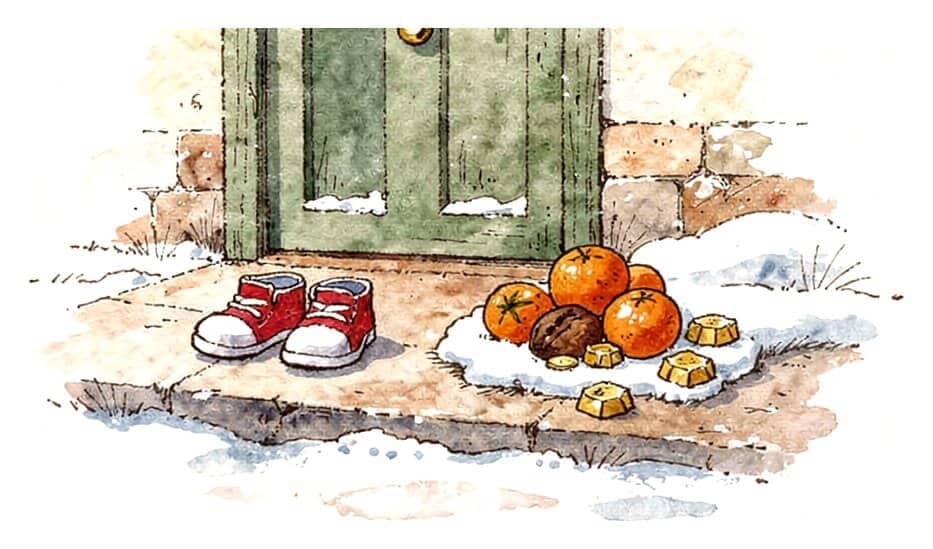


Saint Nicholas Day is December 6, the feast of Saint Nicholas, a bishop who lived in the 300s, and it falls early in Advent. In many countries the celebrating starts the night before, when children set out their shoes for Saint Nicholas and find small treats in them in the morning.
At a glance
- The day: December 6 (December 19 in churches that keep the old Julian calendar)
- The night of the shoes: December 5, the eve
- Whose day: Saint Nicholas, bishop of Myra in the 300s
- Kept above all in: Germany and the Netherlands, and also in Belgium, Austria and Poland
- His helpers: Knecht Ruprecht in Germany, the Krampus in Austria
Why December 6
Saint Nicholas was a bishop of Myra, in today’s Turkey, who died sometime in the middle of the 300s. By tradition he died on December 6, and the anniversary became his day. Churches that keep the old Julian calendar celebrate it on December 19. Who Saint Nicholas was has his own page.
The night of the shoes
 Christmas magic
The night before his day, December 5, is the night of the shoes. In Germany, children polish their shoes and set them outside the door, and by morning, with luck, Saint Nicholas has filled them with apples, nuts and sweets. In many places the small treats are how children know he has come. In some, they leave carrots and hay for his horse or donkey, with their wish lists.
In earlier centuries, Saint Nicholas, not the Weihnachtsmann, was the gift-bringer of German children. Today the Weihnachtsmann is the Christmas gift-bringer in much of Germany, especially the north.
Around Europe
The day is kept above all in Germany and the Netherlands. In England, by contrast, it is hardly marked. In France it is kept mainly in the east and north, in Alsace, Lorraine and the far north, and hardly at all elsewhere.
Christmas magicIn the Netherlands, the big evening is December 5, called pakjesavond, “parcels evening.” Families unwrap their presents from Sinterklaas and trade surprise gifts, each with a Sinterklaas poem. In Belgium, many children set out a shoe with a drawing and a carrot for Sinterklaas’s horse on the night of December 5, and find their presents in the morning.
In Poland, December 6 is mikołajki, when people give each other small presents.
In Austria, some families still invite Saint Nicholas home in early December, often with the Krampus at his side. The Salzburg tourist board traces the custom to the 1600s, and in the Gastein Valley 80 to 100 groups go door to door on December 5 and 6.
His helpers
Saint Nicholas has helpers. In Germany his rough helper is Knecht Ruprecht; in other places the helper goes by other names, the Krampus among them. In Austria the Krampus come in fur suits and carved, horned masks, with heavy bells and rattling chains.
Read it to a child
Reads aloud in a minute
On December 6 we remember Saint Nicholas, a bishop who lived long ago, and the stories of his kindness.
Christmas magicThe night before, children in many countries put their shoes by the door. In Germany they polish them first. And in the morning? Apples, nuts and sweets, tucked inside.
Quick answers
When is Saint Nicholas Day?
December 6. Churches that keep the old Julian calendar celebrate it on December 19.
What do children put out on Saint Nicholas’s Eve?
Their shoes, on the night of December 5. In some places they add carrots and hay for his horse or donkey, with their wish lists.
Where is Saint Nicholas Day celebrated?
Above all in Germany and the Netherlands, and also in Belgium, Austria and Poland, among other countries.
What is pakjesavond?
The Dutch name for the evening of December 5, when families unwrap their Sinterklaas presents. It means “parcels evening.”
More: why we hang stockings, how Saint Nicholas became Santa Claus, Sinterklaas, and Christmas in Germany, Poland and the Netherlands.
Where our facts come from
- St. Nicholas Center, "St. Nicholas Customs Around the World", Opening section: St. Nicholas Day is December 6, early in Advent; parties on the eve, December 5, and shoes or stockings left for him to fill during the night; small treats so the children know he has come; in other places carrots and hay for his horse or donkey, with the children's wish lists
- St. Nicholas Center, "Around the World", The paragraph on customs from forty-two countries
- St. Nicholas Center, "Who is St. Nicholas?", Main text, paragraph 2 (the anniversary of his death became St. Nicholas Day, December 6; December 19 on the Julian calendar); the story paragraphs (his kind and generous deeds done in secret)
- Michael Ott, "St. Nicholas of Myra", Catholic Encyclopedia (1913), Paragraph 1 (bishop of Myra in Lycia in the fourth century; died 6 December, 345 or 352)
- Republic of Türkiye, Ministry of Culture and Tourism, General Directorate for Cultural Assets and Museums, "St. Nicholas Memorial Museum" fact sheet, The leaflet's text on Saint Nicholas (the places where he was born and lived are within the borders of Türkiye; Myra, now called Demre)
- Sophie von Glinski, "Nikolaustag", Planet Wissen (WDR), Lead paragraph (above all in Germany and Holland; hardly kept in France and England); paragraph 2 (in earlier centuries Nikolaus, not the Weihnachtsmann, brought the presents); paragraph 4 (children set cleaned shoes outside the door on the night to December 6, filled with apples, nuts and sweets); paragraph 5 (his companions: Knecht Ruprecht; elsewhere Hans Muff, Hans Trapp, Krampus)
- Duden online, "Weihnachtsmann", Meaning 1 (a folk figure who, by an old custom, brings children presents at Christmas); its usage note (especially in northern Germany)
- St. Nicholas Center, "France" (St. Nicholas Customs Around the World), Paragraph 1 (Saint Nicolas comes mainly in the east and north: Alsace, Lorraine and Nord-Pas-de-Calais); the paragraphs on Nancy and Saint-Nicolas-de-Port
- Instituut voor de Nederlandse Taal, Algemeen Nederlands Woordenboek, "pakjesavond" and "sinterklaasavond", "pakjesavond", sense 1.0 (the evening of December 5); "sinterklaasavond", sense 1.0 (presents unwrapped for Sinterklaas; surprises exchanged with Sinterklaas poems)
- Yente Blancke, "De nacht van sinterklaas", Immaterieel erfgoed in Vlaanderen, Paragraphs 1, 2 and 4 (the night of December 5 to 6; a shoe with a drawing and a carrot for the horse; the presents found in the morning)
- St. Nicholas Center, "Belgium" (St. Nicholas Customs Around the World), The paragraph on St. Nicholas' Eve (shoes or small baskets set out on December 5 with carrots and hay for the saint's horse, sometimes with a drawing; filled by morning); the 2017 survey paragraph (94% of parents with children up to twelve give St. Nicolas gifts)
- SalzburgerLand Tourismus, "Krampus and Perchten", Opening section (the heavy cow bells, the rattling of chains); section "A tradition with a long history" (since the 17th century, St. Nicholas with these figures from house to house; home visits even today, with or without Krampus); section "Equipment" (a fur suit, large heavy bells, the carved mask, the horns); section "Jostling and Teasing" (80 to 100 groups door to door on December 5 and 6 in the Gastein Valley)
- St. Nicholas Center, "Austria" (St. Nicholas Customs Around the World), Paragraph 1 (honored throughout Austria; he comes on December 5 or 6); paragraph 2 (the Krampus, often seen with St. Nicholas, dressed in fur with a horned mask); the home-visits paragraph (Saint Nicholas, and Krampus, may visit homes; ten percent of families arrange home visits)
- Słownik języka polskiego PWN, "mikołajki", Entry "mikołajki": the custom of giving one another small presents on St. Nicholas's day (December 6)