
Light as a feather: I'm made of straw!
VII · The World
How is Christmas celebrated in Sweden?
 True storyHow to read this bookReads aloud in 4 minutesAdded to the book
 Christmas magicOn Christmas Eve the jultomten comes to the party and hands out the presents himself.


In Sweden the big day is Christmas Eve, December 24, the year’s great family holiday. Before that comes Lucia on December 13, by tradition a candlelit morning, and the four Sundays of Advent, each a reason to gather.
At a glance
- The big day: Christmas Eve, December 24
- Lucia: December 13
- The feast: the julbord, a Christmas buffet
- Christmas figure: the jultomte
Christmas words
say it
God jul
tap, and follow the star
- What it means
- good Yule (god means good; jul is Christmas, kept December 24 to 26)
- When to say it
- at Christmas
/ɡuː(d) jʉːl/
In Swedish, jul is the holiday of December 24 to 26, kept in memory of Jesus’ birth.
Advent
The four Sundays of Advent are each a reason to gather, and many families build a gingerbread house.
Lucia, December 13
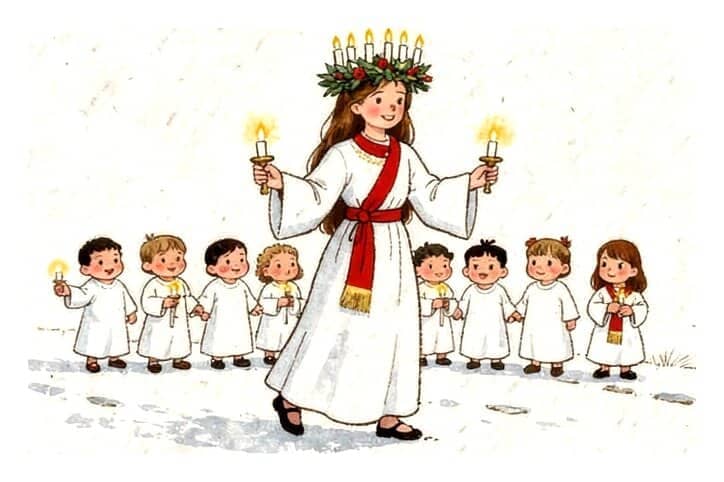
By tradition Lucia comes before dawn, though for practical reasons many celebrations are held at dusk. On Lucia Day, Lucia comes in dressed in white with a crown of candles, followed by attendants and star boys holding candles, all singing, and then they walk out the way they came. It happens in schools, workplaces, hospitals, care homes and homes, and on television.
On December 13 trays are piled with saffron buns called lussekatter and gingerbread cookies. The golden lussekatter, usually twisted into an S, are newer than they look: saffron came into them only in the late 1800s.
 As church tradition tells it · Western church tradition
The day belongs to Saint Lucy, a young Christian woman of Syracuse, in Sicily, who died for her faith in the year 304. She is remembered on the day she died, December 13.
The procession as Swedes know it grew from a custom of western Sweden in the 1800s and spread across the country in the 1900s, helped by a Stockholm newspaper’s Lucia contest in 1928.
Christmas Eve
The feast is the julbord, a Christmas buffet of ham, meatballs, pickled herring and more, with julmust, a Christmas soda a little like root beer. On Christmas Eve afternoon, Swedish families gather to watch Disney’s Donald Duck, Kalle Anka, on Swedish television, SVT, which has shown his Christmas program since 1960.
Christmas magicOn Christmas Eve the jultomten comes to the party and hands out the presents himself.
Sweden’s Christmas figure is the jultomte. His familiar look is credited to the artist Jenny Nyström, whose pictures for a Christmas Eve tale by Viktor Rydberg are thought to be the first to show him.
Quick answers
When do Swedes celebrate Christmas?
On Christmas Eve, December 24, the year’s great family holiday.
What is Lucia?
Sweden’s candlelit celebration of December 13, by tradition before dawn: Lucia, dressed in white with a crown of candles, leads a singing procession of attendants and star boys holding candles.
Who brings the presents in Sweden?
The jultomte, on Christmas Eve.
How do you say Merry Christmas in Swedish?
God jul, said goo YOOL.
Read on: Advent, why so many countries celebrate on Christmas Eve, who brings the presents around the world, Saint Lucia’s Day and Swedish Christmas words.
Where our facts come from
- Visit Sweden, "How to celebrate Christmas in Sweden – a guide to traditions and activities" (last updated October 15, 2025), Opening image caption and section "Christmas Eve – the highlight of the season", paragraph 1 (December 24 the main day, the most important family holiday); paragraphs 1–2 (the julbord: ham, meatballs, pickled herring; julmust, "a bit like root beer"); paragraph 4 (the jultomten hands out the presents on Christmas Eve); paragraph 5 ("When the clock strikes 3:00 pm": Donald Duck in the afternoon); opening section, paragraph 1 (each Advent Sunday a social occasion); section "Lucia – and other Swedish Christmas traditions", paragraphs 1–2 (lussekatter and gingerbread on December 13; gingerbread houses)
- SVT, "Därför ser svenska folket på Kalle Anka på julafton", December 23, 2017, Body paragraph 2 ("Kalle Ankas jul har visats på SVT sedan 1960")
- Nordiska museet (the Nordic Museum, Stockholm), "Lucia", Introduction, paragraph 2 ("en vitklädd gestalt med ljuskrona som högtidligt skrider fram, åtföljd av tärnor, stjärngossar och möjligen någon tomte"; lit candles, Christmas and Lucia songs; schools, workplaces, hospitals, care homes, homes and television); FAQ "Vem var Sankta Lucia?", paragraphs 1–2 (Lucia died "den 13 december år 304"; her name in the almanac on December 13); FAQ "Varför firar vi lucia?" (from western Sweden in the 1800s; the university towns by the mid-1800s; the whole country in the 1900s); the 1900s section (Stockholms Dagblad's Lucia contest, 1928); FAQ "Varför äter vi lussekatter?" (the S-shape most usual today; saffron from the late 1800s)
- Visit Sweden, "Lucia – bearer of light, hymns and Swedish treats" (last updated December 1, 2025), Section "The Lucia essentials – and what to expect on 13 December", paragraph 1 ("According to tradition, Lucia appears before dawn; however, for practical reasons, many events are held at dusk")
- Church of England, Common Worship, "The Calendar", December, the 13th: "Lucy, Martyr at Syracuse, 304"
- Nationalmuseum (Stockholm), "Julstämning kring sekelskiftet 1900", Paragraph 4 (Jenny Nyström is considered to have created the jultomte's look and character, in her pictures for Viktor Rydberg's "Lille Viggs äfventyr på julafton")
- Lexin (Swedish-Swedish dictionary, KTH), "jul", The definition ("helgen 24–26 december som firas till minne av Jesu födelse")