
III · The Season
When does Advent start in 2026? What Advent means
 True storyHow to read this bookReads aloud in 6 minutesAdded to the book


Advent is the church’s season of getting ready for Christmas, and it takes in the four Sundays before Christmas Day. In it begins on , and lasts until Christmas Eve.
At a glance
- Begins: the Sunday closest to November 30; in ,
- Ends: on the evening of December 24, when Christmas begins in the Catholic Church’s calendar
- The name: from the Latin for “coming”
- Its color: traditionally purple, with rose for the third Sunday
- Kept by: Western churches; many Orthodox Christians keep a fast of their own before Christmas
When Advent begins
Advent begins on the Sunday closest to November 30, so it always takes in the four Sundays before Christmas. That first Sunday can fall anywhere from November 27 to December 3. In the first Sunday of Advent is . Milan’s own Ambrosian rite keeps a longer Advent, of six weeks.
In the Catholic Church’s calendar, Advent lasts until the evening of December 24, when Christmas begins with evening prayer. When Christmas falls for each church has a page of its own.
What the word means
The name comes from adventus, Latin for “coming.”
 As church tradition tells it · Western church tradition
Churches keep it as a season of waiting and getting ready: to celebrate the coming of Christ at his birth, and to look ahead to his coming again at the end of time.
How old it is
The oldest records we have of Christians keeping a season to get ready for Christmas come from the end of the 300s; one is a church council held at Saragossa, in Spain, in 380, which asked Christians to come to church every day from December 17 to Epiphany. In the Greek church, by the 700s, the weeks from November 15 to Christmas were already a time of fasting. Today many Orthodox Christians keep the Nativity Fast, up to 40 days long: no meat or dairy, and on some days no fish, wine or oil either.
Purple, and one rose Sunday
Purple is Advent’s traditional color in church. Some churches use blue. The third Sunday is Gaudete Sunday, the Sunday of rejoicing, when the rose candle is lit and some priests wear rose. It is a brighter Sunday in a quiet season, as it already was in the Middle Ages.
Candles and little doors
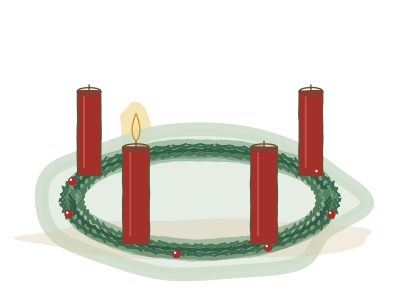
Most Advent wreaths hold four candles, one more lit each Sunday. Many have three purple candles and one rose-pink one for the third Sunday; others use red or blue, and some add a white candle in the middle for Christmas Day. The first Advent wreath on record was hung in 1839 in Hamburg, Germany, in a home for children from the city’s poorest streets; the Advent wreath has a page of its own.
In Germany, children open one of 24 little doors each day from December 1 until Christmas Eve. Parents in Germany were making their own countdowns by about 1850, and calendars with chocolate behind the doors have been made since 1925. Who printed the first Advent calendar is still argued over; the Advent calendar tells that story.
In Sweden, the four Sundays of Advent are each a reason to gather, and many families build a gingerbread house.
Quick answers
When does Advent start this year?
On , the Sunday closest to November 30.
When does Advent end?
On Christmas Eve. In the Catholic Church’s calendar, Christmas begins with evening prayer on December 24.
Why is one Advent candle pink?
It is rose, for the third Sunday, Gaudete Sunday, the Sunday of rejoicing. Not every wreath has one: some churches use four red or blue candles.
What do Orthodox Christians keep before Christmas?
Many keep the Nativity Fast, up to 40 days long: no meat or dairy, and on some days no fish, wine or oil either.
More: the whole Christmas season, the countdown to Christmas, and Advent in Germany and Sweden.
Where our facts come from
- United States Conference of Catholic Bishops, "Advent", "Liturgical Notes for Advent", Universal Norms no. 40 ("Advent begins with First Vespers (Evening Prayer I) of the Sunday that falls on or closest to November 30"; "it ends before First Vespers (Evening Prayer I) of Christmas"); the season as "the four Sundays (and weekdays) leading up to the celebration of Christmas" (the opening); the dated season line ("Sunday, November 29, 2026 - Thursday, December 24, 2026")
- United States Conference of Catholic Bishops, "Advent", as above, "Liturgical Notes for Advent", the color and Gaudete paragraphs ("The liturgical color for Advent is purple"; rose may be worn on the Third Sunday); "Advent Wreaths" ("The rose candle is lit on the third Sunday, Gaudete Sunday"; "Gaudete Sunday is the Sunday of rejoicing")
- Church of England, Common Worship, "Times and Seasons: Advent", "Introduction to the Season", first sentence ("a season of expectation and preparation, as the Church prepares to celebrate the coming (adventus) of Christ in his incarnation, and also looks ahead to his final advent as judge at the end of time"); the same section ("purple is the traditional liturgical colour"; the Third Sunday "observed in medieval times as a splash of colour in the restrained atmosphere of Advent (Gaudete or 'Rose Sunday')"); "The Advent Wreath" ("four red or blue candles in a ring around a white or gold candle"; or three purple candles with a pink candle for the Third Sunday; one more lit each Sunday, the white or gold one on Christmas Day)
- Francis Mershman, "Advent", Catholic Encyclopedia, vol. 1 (1907), "Historical origin", its one paragraph ("we find no evidence before the end of the fourth century"; the Acts of a synod held at Saragossa in 380, with its canon from December 17 to Epiphany; later in the paragraph, in the Greek church of the 700s, "a time of fast and abstinence, from 15 November to the Nativity"); the article's opening paragraphs, before "Symbolism" (the first Sunday "may be as early as 27 November" or "as late as 3 December"; "With Advent the ecclesiastical year begins in the Western churches")
- Erin Blakemore, "Why Orthodox Christians celebrate Christmas in January", National Geographic, December 26, 2019 (updated December 30, 2022), Section "Orthodox Christmas traditions", first paragraph (Orthodox Christians traditionally "fast for up to 40 days leading up to Christmas", without meat, dairy, fish, wine and olive oil)
- OrthoChristian.com (Sretensky Monastery), "The Nativity Fast, Advent", The rules paragraph under the dates line ("during the Fast we must abstain from meat and dairy products"; "on Mondays, Wednesdays and Fridays of the Nativity Fast consumption of fish, oil and wine is prohibited"; fish allowed on Saturdays, Sundays and great feasts)
- United Methodist Church, "Why are there different colored altar cloths?" (May 5, 2026), The colors list ("Purple … is traditionally used during Advent and Lent"; "Blue symbolizes hope and may also be used during Advent")
- The American Heritage Dictionary of the English Language, "advent", The etymology ("from Latin adventus, arrival, from past participle of advenīre, to come to")
- Charlton T. Lewis and Charles Short, A Latin Dictionary (1879), "adventus" (Perseus Digital Library), The headword ("a coming, an approach, arrival")
- Archdiocese of Milan, Gianantonio Borgonovo, "Letture domenicali: Prima domenica di Avvento (ciclo A)" (November 2022), Page 1, the paragraph beginning "Entriamo nell'Avvento" ("L'Avvento è di quattro settimane nel Rito Romano … di sei settimane nel Rito Ambrosiano")
- Das Rauhe Haus, "Eine Hamburger Erfindung: 1839 hing im Rauhen Haus der erste Adventskranz der Welt" / "Der Wichernsche Adventskranz" (press sheet, PDF), Page 1, "Der Wichernsche Adventskranz", paragraph 1 (on the first Sunday of Advent 1839 the first Advent wreath "dessen Existenz historisch belegt ist" hung in the Rauhes Haus in Hamburg, a home Johann Hinrich Wichern had founded for children from Hamburg's slums)
- German National Tourist Board, "Romantic Advent: Christmas cookies, Advent calendars, Saint Nicholas and Christmas markets", Section "Advent calendar: 24 little doors until Christmas Eve", paragraph 1
- Deutsches Hopfenmuseum, Wolnzach, press text "Adventskalender – Von den Anfängen bis zur Gegenwart" (the Esther Gajek collection), October 2008, Counting the opening paragraph on the collection: paragraph 2 ("Erste Exemplare bastelten Väter und Mütter bereits um 1850 in Eigenregie"; the first printed Advent calendars, 1902 in Hamburg and 1904 in Stuttgart); paragraph 3 ("Adventskalender mit Schokolade-Füllung, wie sie seit 1925 hergestellt werden")
- Bayerisches Wirtschaftsarchiv, "Aktuell" no. 15, December 2007, Page 1, the editorial letter, column 2 ("1908 brachte Gerhard Lang in München den ersten gedruckten Weihnachts-Kalender heraus: 'Im Lande des Christkinds'")
- Visit Sweden, "How to celebrate Christmas in Sweden – a guide to traditions and activities" (last updated October 15, 2025), Opening section, paragraph 1 (each of the four Advent Sundays a social occasion); section "Lucia – and other Swedish Christmas traditions", paragraph 2 (families build gingerbread houses together)