
IV · Traditions
Why do we have Christmas trees? Where the tradition began
 True storyHow to read this bookReads aloud in 7 minutesRead it to a childAdded to the book
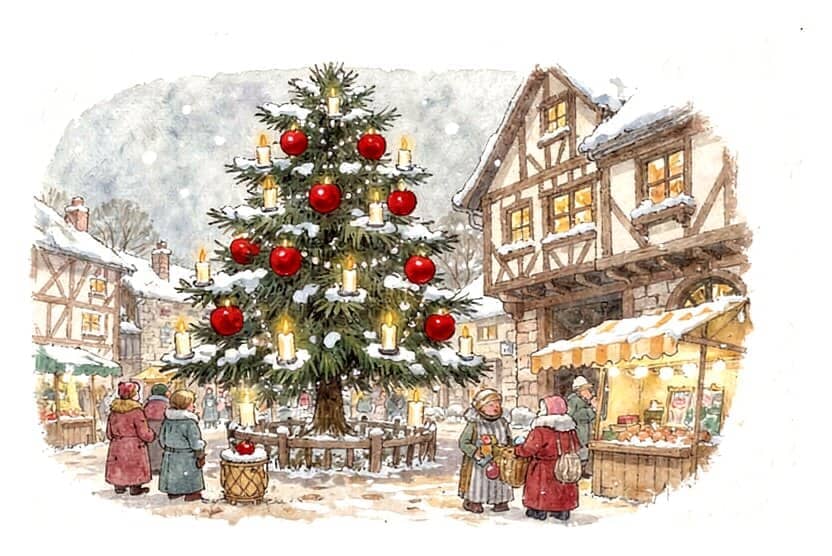


Nobody knows for sure who first brought a fir indoors for Christmas, or why. The oldest written description we know of a decorated Christmas tree comes from Strasbourg, in Alsace, in the early 1600s: a tree set up in a home and hung with paper roses, apples and wafers. Then, in the 1800s, pictures of Britain’s royal family around their tree caught on, and an American copy of one is thought to have helped spread the custom across the United States.
At a glance
- Oldest description of a decorated tree we know of: Strasbourg, around 1605
- Oldest written mention, as one town counts it: Sélestat, in Alsace, 1521
- Claimed by: Riga, 1510, and Tallinn, 1441
- To England: Queen Charlotte, Windsor, 1800
- Across America: in the 1850s and 1860s
The oldest records
The oldest written description of a decorated Christmas tree that we know of comes from Strasbourg, in Alsace, around 1605. It was a tree set up indoors, in a home, and hung with paper roses, with apples and with wafers.
In Sélestat, a small town in Alsace, the town’s account book for 1521 records a payment of 4 schillings to the forest wardens to guard the trees on Saint Thomas’s Day, December 21. The town counts it as the oldest written mention of the Christmas tree custom. The entry is about guarding trees in the forest, not about decorating one.
Two Baltic cities each say the first Christmas tree was theirs: Riga points to its merchants in 1510, and Tallinn to its Brotherhood of the Blackheads in 1441. A plaque outside the House of the Blackheads marks the spot Riga claims. But as Latvian Public Broadcasting (LSM) reported in 2015, even Riga’s mayor said nobody knows exactly when the city’s first tree was decorated.
Apples and wafers
In the Middle Ages, religious plays used a “paradise tree” hung with apples, for the story of Adam and Eve. Apples, and thin wafers too, turned up on the early Christmas trees.
The story people tell
That much is history. Here is a story people tell.
 A tale people tell
People tell that Martin Luther was out walking one night when he saw stars glittering among the branches. He wanted to bring that sight indoors, so he cut a tree and set candles on it. It is a lovely story, but nothing written in Luther’s own time tells it. A painting of 1845, later engraved for an American gift book, shows Luther and his family around a candlelit tree, and how popular the story had become.
How the tree traveled
In England, the first Christmas tree we know of was set up by Queen Charlotte, the German-born wife of King George III, at Queen’s Lodge in Windsor in December 1800. In 1840 Queen Victoria’s husband, Prince Albert, had spruce firs brought from his German home of Coburg.
The Illustrated London News pictured the royal trees year after year, famously in 1848, when it showed Queen Victoria, Prince Albert and their children around a decorated tree. The picture took hold, and families across Britain wanted a tree too.
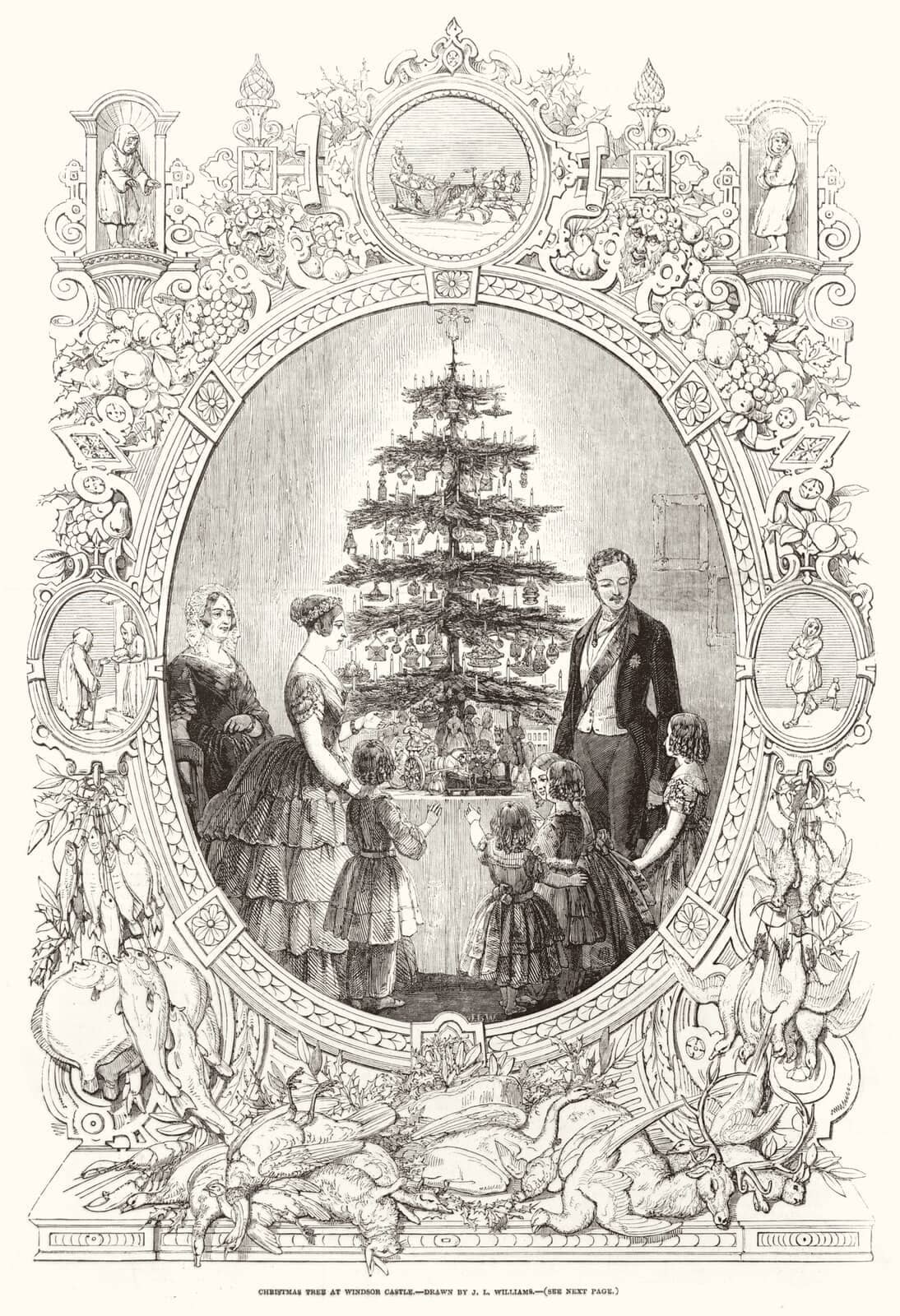
Two years later, in 1850, the American magazine Godey’s Lady’s Book printed the same scene, quietly turned into an American family: the engraver took off the Queen’s crown and Prince Albert’s mustache. Reprinted through the 1850s, the picture is thought to have helped persuade families across America to have a tree of their own.
Some Americans had trees already. German families in Pennsylvania were putting up Christmas trees in the early 1800s, but most of the country did not take up the custom until the 1850s and 1860s. A Boston gift book for children already pictured a Christmas tree glowing with candles in 1841, one of the earliest such pictures made in America.
In Germany the tree is traditionally trimmed on Christmas Eve itself.
Read it to a child
Reads aloud in a minute
Long ago, in the city of Strasbourg, a family set up a tree in their home. They hung it with roses made of paper, with apples and with thin wafers. It is the oldest decorated Christmas tree that anyone wrote down, as far as we know.
Quick answers
Where was the first Christmas tree?
Nobody can say for sure. Riga, in Latvia, and Tallinn, in Estonia, each claim it, for 1510 and 1441, but the claims are disputed. Sélestat, in Alsace, counts its account book of 1521 as the oldest written mention of the custom.
Did Martin Luther start the Christmas tree?
No. People tell that he set candles on a tree after seeing stars through the trees, but nothing written in his own time tells it.
Who brought the Christmas tree to England?
Queen Charlotte, the German-born wife of King George III, set up the first one we know of, at Windsor in December 1800.
When did Americans start having Christmas trees?
German families in Pennsylvania had trees in the early 1800s; most of the country took up the custom in the 1850s and 1860s.
More: Christmas in Germany, Christmas Eve, is Christmas pagan?, the legend of the Christmas spider, ornaments and when to put up the tree.
Where our facts come from
- Elesha Coffman, "O Christmas Tree", Christianity Today (Christian History), December 1, 2001, The paragraph beginning "If candles, apples, and wafers don't seem quite festive enough" (paper roses and shiny foil shapes; these "appeared on the first tree about a which a written description remains, a tree set up in a home in Strasbourg in 1605"); the paragraph beginning "Two more ornaments can be traced to the Middle Ages" (mystery plays' "paradise trees" decorated with apples; unconsecrated wafers; "Wafers appeared on early Christmas trees, too"); the paragraph beginning "To answer that question" ("at least two candidates vie for that distinction, not counting the many pagan tree customs that may or may not relate to modern practice"); the line "It's almost impossible for any one account of a folk custom like tree-decorating to be absolutely authoritative"
- Sélestat Haut-Koenigsbourg tourist office, "Arbre de Noël, 1ère mention écrite", The page's description of the account register in the Municipal Archives (the entry of December 21, 1521, quoted: "Item 4 schillings den förstern die meygen an sanct thomas tag zu hieten"; the town's claim that it is the oldest written mention of the custom); the town's claim is the entry's title in the copy of this address archived on June 16, 2021 ("The oldest written mention of the Christmas tree"), https://web.archive.org/web/20210616103907/https://www.selestat-haut-koenigsbourg.com/en/lei/detail/75/222004799/1913/arbre-de-noel-1ere-mention-ecrite-selestat.htm; the live page now redirects to the exhibition sheet, which describes the entry but no longer says "oldest"
- "Baltic states battle it out for Xmas tree supremacy", Eng.LSM.lv (Latvian Public Broadcasting), December 24, 2015, ¶2 (Riga: "Medieval documents suggest local merchants set up a decorated Christmas tree in 1510"); ¶3 (the plaque outside the House of the Blackheads); ¶5 (Tallinn: a tree "erected by the Brotherhood of Black Heads guild already in 1441"); ¶9 (Riga's mayor: "we have no idea when precisely the first Christmas tree was decorated in Riga")
- Christine Graham Ward, "Christmas trees!", Past is Present (American Antiquarian Society blog), December 22, 2010, ¶ under the image "Luther Amidst His Family at Wittenberg on Christmas Eve, 1536" (C. A. Schwerdgeburth's painting "done in 1845", engraved in Wheat Sheaf, Philadelphia, 1853, "illustrates the popular myth that Luther was the first to light a tree with candles"); ¶ under "The Christmas Tree from Godey's Lady's Book" (the royal family around their tree "in 1848"; Godey's, 1850, "one of the earliest recognized images of an 'American' Christmas scene"; "The engraver left out the Queen's crown, and Prince Albert's mustache"; re-printed through the 1850s, it is believed to have given households "the push"); ¶ beginning "Christmas trees were somewhat common" (Pennsylvania German communities in the early 19th century; the rest of the country in the 1850s and 1860s); ¶ beginning "Like periodicals such as Godey's" (the 1841 Youth's Keepsake, Boston, p. 71: a candle-lit, decorated tree; likely one of the earliest printed in the United States)
- English Heritage, "A Short History of Christmas Greenery", The section on Christmas trees (Queen Charlotte "who set up the first known tree at Queen's Lodge, Windsor, in December 1800"; in 1840 Prince Albert "imported several spruce firs from his native Coburg, in Germany"; periodicals including the Illustrated London News "began to depict and describe the royal Christmas trees every year")
- English Heritage, "Victorian Christmas Traditions", The section on Christmas trees (Victoria and Albert "were famously illustrated standing beside a decorated tree with their children"; "The engraving was published in the press in the 1840s and it quickly took hold of the national imagination")
- Library of Congress, Prints and Photographs, LCCN 96522234: J. L. Williams, the royal Christmas tree at Windsor Castle, The Illustrated London News, Christmas 1848 (via Wikimedia Commons), The print's record (title, artist, publication, date)
- German National Tourist Board, "Christmas Eve: Christmas tree, Christ Child and Father Christmas", Introduction, sentence 4 ("Traditionally, the Christmas tree is put up and decorated on this day")