
IV · Traditions
Why do we hang stockings at Christmas?
 True storyHow to read this bookReads aloud in 5 minutesAdded to the book
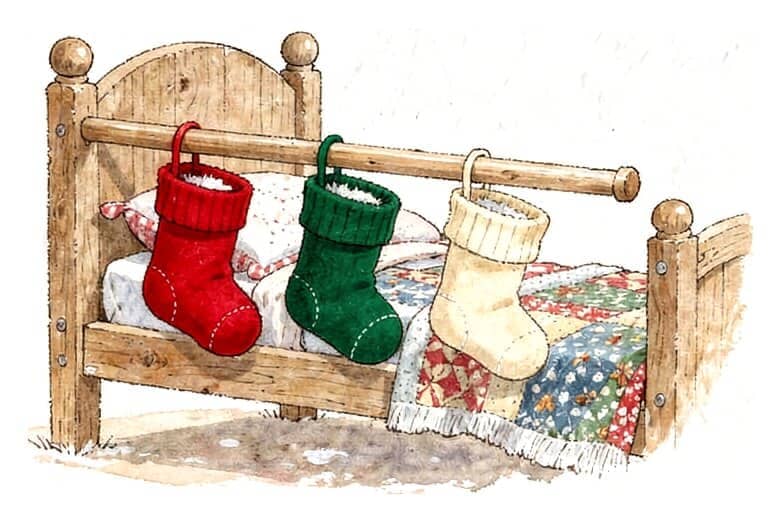


Nobody knows exactly when people began hanging stockings at Christmas: we have not found a record that says. What we can show is that a New York book of 1809 already mentions “hanging the stocking in the chimney” on Saint Nicholas’s day; that verses of 1821 and 1823 put the stockings on Christmas Eve, the later one with the stockings “hung by the chimney with care”; and that many families explain the custom with an old story about Saint Nicholas, a story told as a tale.
At a glance
- Early records: a stocking hung in the chimney on Saint Nicholas’s day, in a New York book of 1809; stockings on Christmas Eve, in verses of 1821 and 1823
- The story people tell: Saint Nicholas’s gold for three sisters (a tale)
- Shoes, too: set out for Saint Nicholas on December 5 in many countries
What the old books show
In 1809 Washington Irving published a comic history of old New York. Among the old Dutch feasts kept in Governor Stuyvesant’s house, it says, Saint Nicholas’s day never passed “without making presents, hanging the stocking in the chimney.” In 1821 a little New York picture book, The Children’s Friend, has “Old Santeclaus” coming “each Christmas eve” and seeing, in the houses he visits, “various beds and stockings.”
Then, on December 23, 1823, a newspaper in Troy, New York, printed a poem with no author’s name. It began “’Twas the night before Christmas,” and in its third line the stockings are already waiting:
The stockings were hung by the chimney with care,
Later in the poem, Saint Nick fills them all. The poem is usually credited to Clement Clarke Moore, who put it in his book of poems in 1844, though some believe Henry Livingston wrote it. How much further back the custom goes, no record we have found says.
The story people tell
 A tale people tell
Many people explain the stockings with a story about Saint Nicholas. In the oldest full telling of Saint Nicholas’s life that survives, written in Greek more than a thousand years ago, Nicholas comes to the house of a poor man with three daughters and throws a bag of gold through the window at night, so that a daughter can marry. He does it three times. There is no stocking in that telling, and no shoe.
In the way the story is usually told today, the gold sails in through an open window and lands in a stocking left by the fire to dry. Many people say that is why we hang stockings. In some tellings it lands in a shoe instead, like the shoes children in Europe set out for Saint Nicholas.
Shoes on Saint Nicholas’s Eve
 Christmas magic
In many countries children set out shoes as well, on the night of December 5, the eve of Saint Nicholas Day, and in the morning they find small treats inside.
Quick answers
Who started hanging Christmas stockings?
No record we have found says. A New York book of 1809 already mentions hanging the stocking in the chimney on Saint Nicholas’s day, and verses of 1821 and 1823 put the stockings on Christmas Eve.
Why do people say it comes from Saint Nicholas?
Because of a story about him: he threw three bags of gold through a poor man’s window at night for his daughters, and in today’s telling the gold lands in a stocking left by the fire to dry. The oldest full telling that survives has no stocking in it.
Do children put out shoes instead?
In many countries children set out their shoes for Saint Nicholas on the night of December 5, and find small treats in them in the morning.
More: who Saint Nicholas was, Saint Nicholas Day, the whole poem of 1823 and how Saint Nicholas became Santa Claus.
Where our facts come from
- Washington Irving (as Diedrich Knickerbocker), A History of New York, vol. II, New York: Inskeep & Bradford, 1809 (archive.org scan), Book VII, Chapter X, p. 252 (the old Dutch festivals "faithfully observed in the mansion of governor Stuyvesant"; "nor was the day of St. Nicholas suffered to pass by, without making presents, hanging the stocking in the chimney")
- Charles W. Jones, "Knickerbocker Santa Claus", The New-York Historical Society Quarterly, 1954 (St. Nicholas Center reprint), Section on Washington Irving (the History, published December 6, 1809, a comic work); section on The Children's Friend, 1821 (a juvenile "published on Broadway just the year before Clement Moore wrote his poem", illustrated)
- Representative Poetry Online, University of Toronto Libraries, "Old Santeclaus", original text from The Children's Friend (William Gilley, 1821), published anonymously, Lines 7 ("Each Christmas eve he joys to come") and 10 ("And various beds and stockings seen;"); note: published anonymously. RPO's "Original Text" line gives only the subtitle, "New-Year's Present to the Little Ones from Five to Twelve" (William Gilley, 1821); the name The Children's Friend comes from Jones
- "Account of a Visit from St. Nicholas", Troy Sentinel, December 23, 1823 (Wikisource transcription with page scan), The editor's preface (author unknown); lines 1, 3 ("The stockings were hung by the chimney with care,") and 50 ("And fill'd all the stockings")
- Academy of American Poets (poets.org), "A Visit from St. Nicholas" by Clement Clarke Moore, The page's note on first publication (anonymously, December 23, 1823, in the Sentinel of Troy, New York; many believe Henry Livingston wrote it); the biographical note (Moore's Poems, 1844)
- Michael the Archimandrite, Life of Saint Nicholas, English translation on the St. Nicholas Center, The introduction (believed to be the earliest surviving life, the first complete biography, written about 710–720); the credits (translated from the Greek); §10 (a poor man with three daughters); sections "The First Gift" (§12), "The Second Gift" (§14) and "The Third Gift" (§16); no stocking or shoe anywhere in the text
- St. Nicholas Center, "Three Impoverished Maidens", Story paragraph 2 (the gold sails in through an open window and lands in a stocking left before the fire to dry); the note after the story (the origin people give for hanging a stocking; in some versions a shoe, and the European custom of leaving shoes for St. Nicholas)
- St. Nicholas Center, "St. Nicholas Customs Around the World", Opening section (the eve, December 5; shoes or stockings left for St. Nicholas to fill during the night; small treats so the children know he has come)
- St. Nicholas Center, "Around the World", The paragraph on customs from forty-two countries