
IV · Traditions
Who sent the first Christmas card?
 True storyHow to read this bookReads aloud in 5 minutesAdded to the book
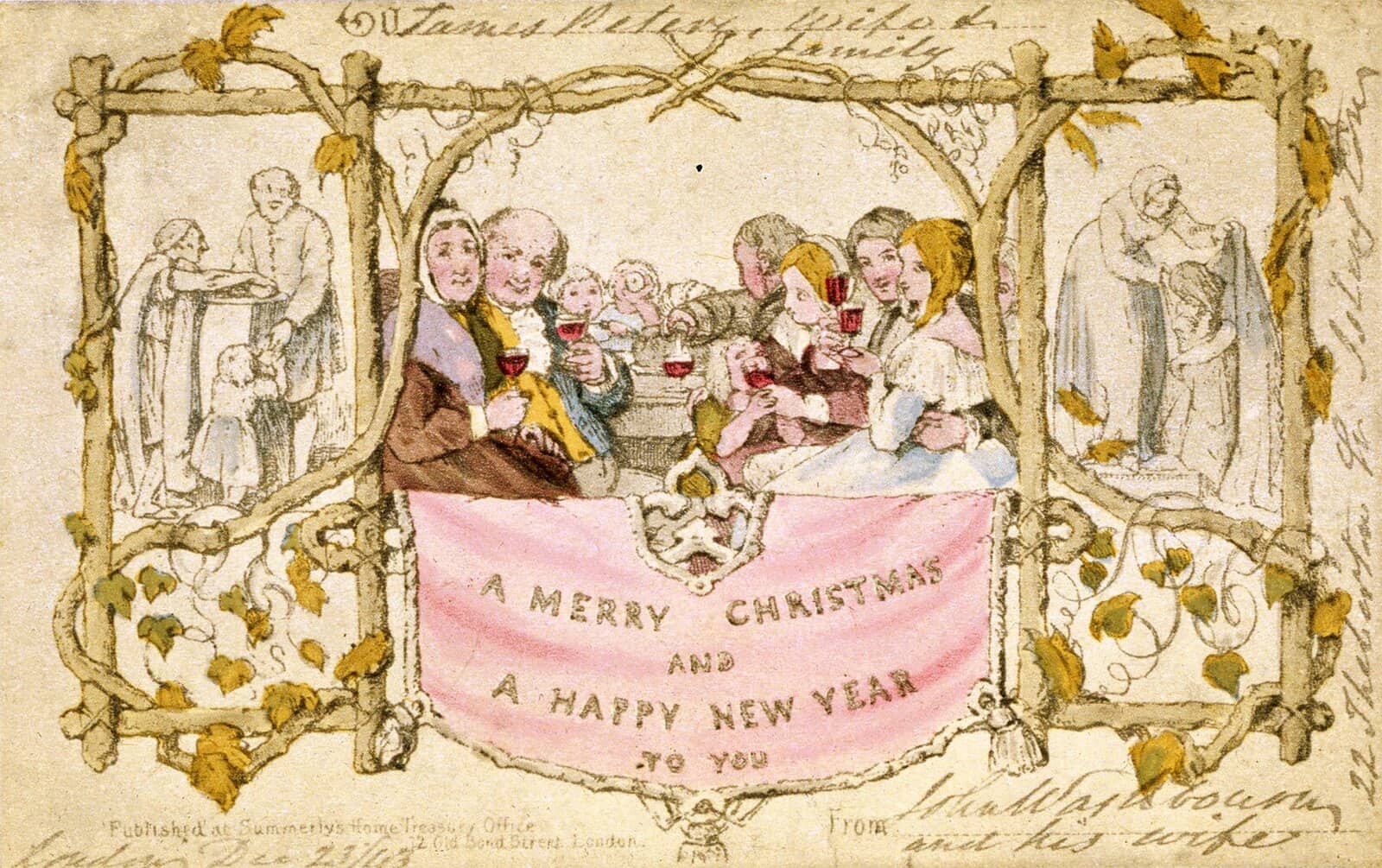


Henry Cole sent the first Christmas card, in London in 1843: that is how the Victoria and Albert Museum, which he went on to lead, tells it. He asked his friend the artist John Callcott Horsley to draw it, and a thousand copies were printed.
At a glance
- Who: Henry Cole, with the artist John Callcott Horsley
- Where and when: London, 1843
- How many: a thousand printed, at a shilling each
- In America: Louis Prang’s cards, from the 1870s
Henry Cole’s card
Henry Cole was a busy civil servant who later became the first director of the Victoria and Albert Museum. He had helped set up the Penny Post, and people were already mailing holiday wishes, on decorated letter paper and visiting cards.
In 1843 Cole asked his friend John Callcott Horsley, an artist, to draw a card, and on the evening of December 17, Horsley brought the design round. Cole’s diary for that day records it:
In the Evg Horsley came & brought his design for Christmas Cards
In the middle, three generations of the Cole family raise their glasses. Around them, small black-and-white pictures show people giving to those in need. Across the bottom runs its greeting:
A Merry Christmas and a Happy New Year to You
A thousand copies were printed, each with room to write your own greeting. They sold for a shilling apiece, a lot of money then, and did not sell well.
Why robins?
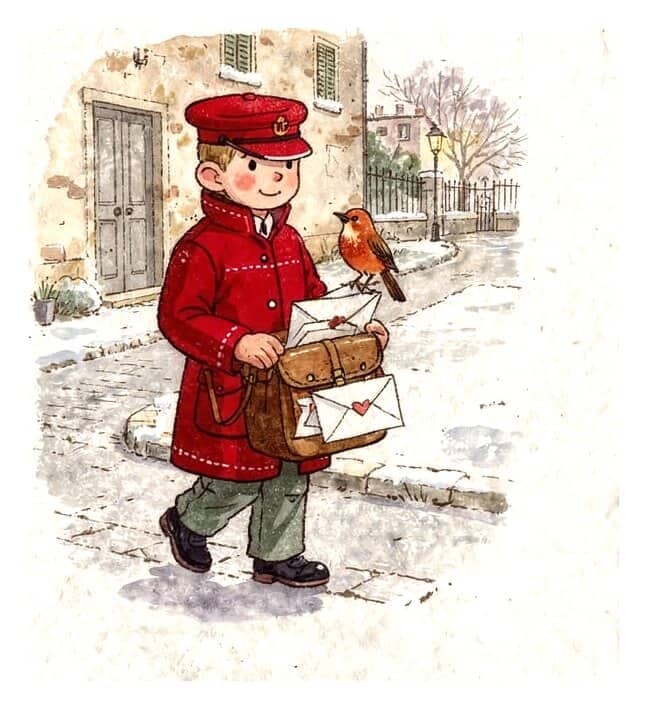
Why so many robins on Christmas cards? One theory is that Britain’s early postmen wore bright red waistcoats and were nicknamed “robins,” so a robin on a card stood for the postman who brought it. Not everyone is convinced: the bird may have belonged to Christmas even before the red coats.
Cards in America
In America, Christmas cards took off about thirty years later. Louis Prang, a German-born printer in Boston who made bright color prints, began producing them in the 1870s, and he is often called the father of the American Christmas card: before him, few Americans sent holiday cards.
In January 1910, an 18-year-old from Nebraska named Joyce Hall stepped off the train in Kansas City, Missouri, with two shoeboxes of picture postcards to sell. As people wanted more privacy than a postcard gave, he and his brother began selling Christmas cards that went in envelopes, and after a fire burned their office in January 1915, they bought printing presses and made cards of their own. In 1928 they began printing the name “Hallmark,” a goldsmith’s word for a mark of quality, on the back of every card.
Quick answers
Who sent the first Christmas card?
Henry Cole, in London in 1843, as the Victoria and Albert Museum tells it. The artist John Callcott Horsley drew it.
How many of the first Christmas cards were printed?
A thousand, with room to write your own greeting. They cost a shilling each, a lot of money then, and did not sell well.
Why are there robins on Christmas cards?
One theory is that Britain’s early postmen wore red waistcoats and were nicknamed “robins.” Others think the bird belonged to Christmas before that.
Who is called the father of the American Christmas card?
Louis Prang, a German-born printer in Boston. He began making Christmas cards in the 1870s, and before him few Americans sent them.
More: the Christmas tree, letters to Santa and a Victorian Christmas.
Where our facts come from
- Victoria and Albert Museum, "The first Christmas card", The opening paragraphs ("Our founding director, Henry Cole, sent the first Christmas card in 1843"; Cole, 1808–1882, "civil-servant, educator, inventor and the first director of the V&A"; "helping to set up the Uniform Penny Post which encouraged the sending of seasonal greetings on decorated letterheads and visiting cards"; Henry "turned to his friend, artist John Callcott Horsley"); the paragraph beginning "Cole's diary entry" ("In the Evg Horsley came & brought his design for Christmas Cards"; "three generations of the Cole family raising a toast in a central, hand-coloured panel"; "black and white scenes depicting acts of giving"; "printing a thousand copies that could be personalised with a hand-written greeting"); the paragraph beginning "Cole's Christmas card was also published" ("offered for sale at a shilling a piece, which was expensive at the time"; "judged a commercial flop")
- Victoria and Albert Museum, collections record O1370293 (MSL/1987/3293), "Christmas card : to Henry Cole / sent by John Callcott Horsley, 'Xmasse 1843'", Place of origin ("London", published); date ("[1843]", published); maker note ("'Published at Summerly's Home Treasury Office, 12 Bond Street'"); brief description ("Hand-coloured lithograph"; "Commonly recognised as 'the first Christmas card'")
- Victoria and Albert Museum, "Building the V&A", ¶1 ("It was founded in 1852"); the paragraph beginning "One of the brains behind the Great Exhibition" ("a young civil servant named Henry Cole"; "a new Museum of Manufactures, which opened its doors in 1852. This was to be the first incarnation of the V&A. Its Director was none other than Henry Cole.")
- John Callcott Horsley for Henry Cole, the first Christmas card, London, 1843 (via Wikimedia Commons; the British Library's "first Christmas card" page as Commons' source), The card itself (the central panel, the side panels, the printed greeting "A Merry Christmas and a Happy New Year to You")
- Horniman Museum and Gardens, "Specimen of the Month: The Robin", November 5, 2017, Body ¶5 ("the association comes from the first postmen in the UK, who used to wear bright red waistcoats"; "nicknamed 'Robins'"; "there are some suggestions that the association preceded their red coats"); ¶6 (the link "somewhat tenuous")
- Boston Public Library, Print Department, "Prang, Louis & Company Collection", Collection description ¶1 (Louis Prang, 1824–1909, "a German immigrant", ran a printing firm in Boston; greeting cards by chromolithography; "often referred to as the 'Father of the American Christmas Card' because holiday cards were rarely exchanged in America until his factory began producing them in the 1870s")
- Hallmark Cards, Inc., "Founding: 1910s" and "History", "Founding: 1910s" ¶1 ("Our story begins in 1910, when 18-year-old Joyce Clyde Hall stepped off a train in Kansas City, Mo., with nothing but two shoeboxes of postcards under his arm"); ¶2 (valentines and Christmas cards mailed in envelopes, for privacy; "On Jan. 11, 1915, a fire destroyed their office and inventory"; printing presses bought, their own cards from 1915); "History" ("On January 10 of 1910, a determined teenager from Nebraska stepped off a train")
- Hallmark Cards, Inc., "Early Innovation: 1910s – 30s", ¶2 ("in 1928, the company began marketing its brand by using the Hallmark name on the back of every card", from the goldsmiths' hallmark, a mark of quality)
