
VI · Legends
Who wrote “’Twas the Night Before Christmas”?
 True storyHow to read this bookReads aloud in 7 minutesRead it to a childAdded to the book


The poem is usually credited to Clement Clarke Moore, a New York professor, who put it in his own book of poems in 1844. It first appeared in a newspaper in Troy, New York, on December 23, 1823, with no author’s name, and some argue that another New Yorker, Henry Livingston Jr., wrote it.
At a glance
- First printed: in the Troy Sentinel, Troy, New York, December 23, 1823, with no author’s name
- Its first title: “Account of a Visit from St. Nicholas”
- Usually credited to: Clement Clarke Moore, who put it in his Poems in 1844
- Also claimed for: Henry Livingston Jr., by his family
- Length: 56 lines, in rhyming pairs
- Free to share: in the public domain in the United States
The poem
Here is the poem as the Troy Sentinel printed it on December 23, 1823, with its old spellings and its punctuation just as they were.
Read it to a child
Reads aloud in 5 minutes
 Christmas magic
’Twas the night before Christmas, when all thro’ the house,Not a creature was stirring, not even a mouse;The stockings were hung by the chimney with care,In hopes that St. Nicholas soon would be there;The children were nestled all snug in their beds,While visions of sugar plums danc’d in their heads,And Mama in her ‘kerchief, and I in my cap,Had just settled our brains for a long winter’s nap—When out on the lawn there arose such a clatter,I sprung from the bed to see what was the matter,Away to the window I flew like a flash,Tore open the shutters, and threw up the sash.The moon on the breast of the new fallen snow,Gave the lustre of mid-day to objects below;When, what to my wondering eyes should appear,But a miniature sleigh, and eight tiny rein-deer,With a little old driver, so lively and quick,I knew in a moment it must be St. Nick.More rapid than eagles his coursers they came,And he whistled, and shouted, and call’d them by name:“Now! Dasher, now! Dancer, now! Prancer, and Vixen,“On! Comet, on! Cupid, on! Dunder and Blixem;“To the top of the porch! to the top of the wall!“Now dash away! dash away! dash away all!”As dry leaves before the wild hurricane fly,When they meet with an obstacle, mount to the sky;So up to the house-top the coursers they flew,With the sleigh full of Toys—and St. Nicholas too:And then in a twinkling, I heard on the roofThe prancing and pawing of each little hoof.As I drew in my head, and was turning around,Down the chimney St. Nicholas came with a bound:He was dress’d all in fur, from his head to his foot,And his clothes were all tarnish’d with ashes and soot;A bundle of toys was flung on his back,And he look’d like a peddler just opening his pack:His eyes—how they twinkled! his dimples how merry,His cheeks were like roses, his nose like a cherry;His droll little mouth was drawn up like a bow,And the beard of his chin was as white as the snow;The stump of a pipe he held tight in his teeth,And the smoke it encircled his head like a wreath.He had a broad face, and a little round bellyThat shook when he laugh’d, like a bowl full of jelly:He was chubby and plump, a right jolly old elf,And I laugh’d when I saw him in spite of myself;A wink of his eye and a twist of his headSoon gave me to know I had nothing to dread.He spoke not a word, but went straight to his work,And fill’d all the stockings; then turn’d with a jirk,And laying his finger aside of his noseAnd giving a nod, up the chimney he rose.He sprung to his sleigh, to his team gave a whistle,And away they all flew like the down of a thistle:But I heard him exclaim, ere he drove out of sight—Happy Christmas to all, and to all a good night.
How the poem reached the world
On December 23, 1823, the Troy Sentinel, a newspaper in Troy, New York, printed the poem under the title “Account of a Visit from St. Nicholas.” It carried no author’s name. Above it, the editor wrote that he did not know whom to thank for it:
We know not to whom we are indebted for the following description of that unwearied patron of children…
In the same note he called the poem’s hero “Sante Claus.” How the poem reached the newspaper is not known for certain.
Fourteen years later, in 1837, a New York collection, The New-York Book of Poetry, printed it as “A Visit from St. Nicholas,” with Clement C. Moore’s name on it. Moore did not claim it himself in print until 1844, when he included it in his own book, Poems, published in New York.
Who was Clement Clarke Moore?
Clement Clarke Moore was a New Yorker and a professor of Greek and Hebrew literature at the General Theological Seminary in New York. He is said to have written the poem for his children at Christmas 1822.
The case for Henry Livingston
Some argue that the poem was written by Henry Livingston Jr., a gentleman farmer from Poughkeepsie, New York, who lived from 1748 to 1828. The claim comes from his family: one of his daughters made it, in the late 1840s at the earliest. Livingston never claimed the poem himself, and no document links him to it.
In 2000 Don Foster, an English professor at Vassar College, argued the family’s case in his book Author Unknown. He pointed to the poem’s bouncing rhythm, which Livingston used in his own verses, to the way it uses “all” to mean “completely,” as in “all snug in their beds,” and to the reindeer names Dunder and Blixem, which come from Dutch.
Others who have studied the poem answered him. Patterns in the words prove nothing on their own, replied the historian Stephen Nissenbaum, and Moore himself claimed the poem in 1844. The poem is still usually credited to Clement Clarke Moore.
Eight reindeer, and two new names
The poem gave Santa eight reindeer, each called by name. In 1823 the last two were Dunder and Blixem, after a Dutch oath meaning thunder and lightning; in copies Moore wrote out by hand late in life, they became Donder and Blitzen. The reindeer page has the whole team.
Free to read and share
The poem was first published in 1823, so in the United States its words are in the public domain: anyone may print them, read them aloud or share them. Newer illustrated editions and recordings can still be under copyright.
Quick answers
When was “’Twas the Night Before Christmas” written?
It was first printed on December 23, 1823. Moore is said to have written it for his children at Christmas 1822.
What was the poem first called?
“Account of a Visit from St. Nicholas,” in the Troy Sentinel in 1823. The books of 1837 and 1844 call it “A Visit from St. Nicholas.”
Did Henry Livingston write it?
His family said so, and in 2000 a scholar argued their case. But Livingston never claimed the poem, no document links him to it, and it is still usually credited to Clement Clarke Moore.
How does the poem end?
In the first printing of 1823, its last line wishes everyone a “Happy Christmas” and a good night.
May I print the poem or read it aloud?
Yes. The words of 1823 are in the public domain in the United States. Newer illustrated editions and recordings can still be under copyright.
More: Christmas legends and the stories to read aloud, Santa’s reindeer, how Saint Nicholas became Santa Claus, why we hang stockings and the Christmas story for children.
Where our facts come from
- "Account of a Visit from St. Nicholas", Troy Sentinel (Troy, New York), December 23, 1823, Wikisource transcription with page scan, The editor's note above the poem ("We know not to whom we are indebted for the following description of that unwearied patron of children… Sante Claus"); "For the Sentinel."; the title "ACCOUNT OF A VISIT FROM ST. NICHOLAS."; the 56 lines, from "'Twas the night before Christmas, when all thro' the house," to "Happy Christmas to all, and to all a good night."; line 2 ("not even a mouse"), line 5 ("all snug in their beds"), lines 21–22 (the reindeer called by name, "Dunder and Blixem"); no author's name anywhere on the page
- Charles Fenno Hoffman, ed., The New-York Book of Poetry (New-York: George Dearborn, 1837), scan of the original at the Internet Archive, Title page ("George Dearborn, Publisher … 1837"); contents ("A Visit from St. Nicholas … 217"); p. 217, the poem headed "A VISIT FROM ST. NICHOLAS / BY CLEMENT C. MOORE."
- Clement C. Moore, Poems (New York: Bartlett & Welford, 1844), Library of Congress copy, scan at the Internet Archive, Title page ("POEMS / BY CLEMENT C. MOORE, LL.D. / NEW YORK: BARTLETT & WELFORD … 1844"); contents ("A visit from St. Nicholas … 124"); p. 124, the poem headed "A VISIT FROM ST. NICHOLAS"
- Paul Hond, "The Story Behind the Most Famous Christmas Poem of All", Columbia Magazine (Columbia University), November 19, 2021, Paragraph 1 ("a newly minted professor of Greek and Hebrew literature at General Theological Seminary"); the paragraph beginning "As the story goes" (the Christmas Eve 1822 reading as family story; Moore "did not explicitly claim credit until 1844"); "And that would have been the end…" (Livingston "a gentleman farmer from Poughkeepsie", "died in 1828"; in 1999 a descendant "enlisted the services of Don Foster, a Vassar English professor"); "Apart from his speculations…" (Foster's evidence: the anapestic meter of Livingston's verse, the use of "all", "Dunder and Blixem"; no record of Livingston's claiming it and no physical evidence; "Dunder and Blixem" "after the Dutch oath meaning 'thunder and lightning'", "the German 'Donder and Blitzen' in the four copies of the poem that Moore, late in life, wrote out and distributed as gifts")
- Stephen Nissenbaum, "There Arose Such a Clatter: Who Really Wrote 'The Night before Christmas'? (And Why Does It Matter?)", Common-place 1.2 (January 2001), Paragraphs 1–2 (Foster's chapter in Author Unknown; Livingston, 1748–1828, "never took credit for the poem himself"; "no actual historical evidence"; the claim "first made in the late 1840s at the earliest … by one of his daughters"); paragraph 4 ("By itself, of course, textual analysis doesn't prove anything"); the section on "the curmudgeon question" (Moore's "professorship–of Oriental and Greek literature"); "Further Reading" (Author Unknown: On the Trail of Anonymous, New York, 2000, chapter 6)
- Peter B. Hirtle, "Copyright Term and the Public Domain in the United States", Cornell University Library, updated January 1, 2026, Table "Works Registered or First Published in the U.S.", first row ("Before 1931 | None | None. In the public domain due to copyright expiration")
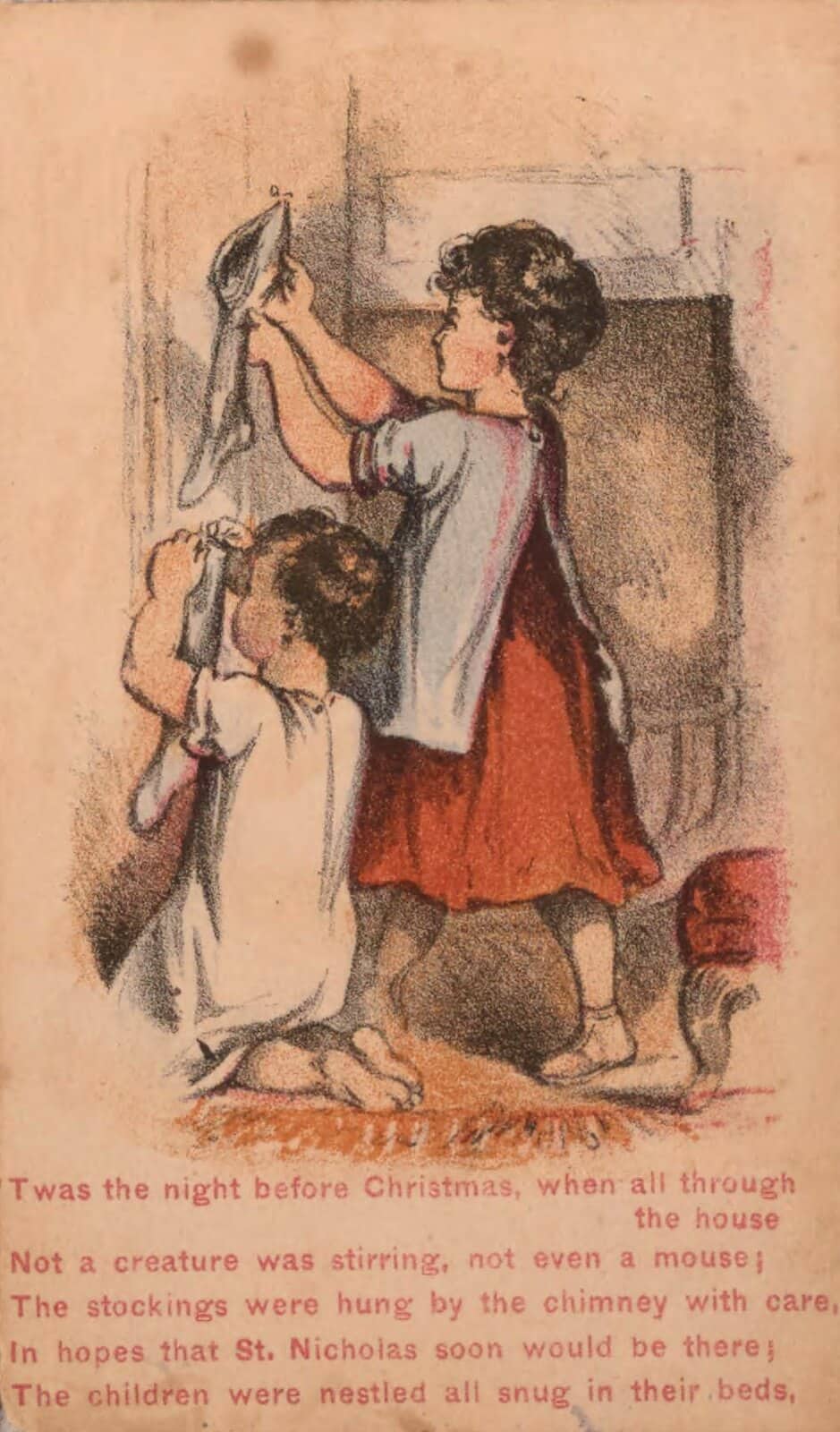
- Library of Congress, Rare Book and Special Collections: A Visit from St. Nicholas (Boston: L. Prang & Co., 1864), panel 3 (the picture's record in design/assets/manifest.json), The plate: credit "A Visit from St. Nicholas (Boston: L. Prang & Co., 1864). Library of Congress"; the alt text (two children hang up their stockings by the fireplace)