
IV · Traditions
Who made the first nativity scene? Crèches around the world
 True storyHow to read this bookReads aloud in 8 minutesRead it to a childAdded to the book
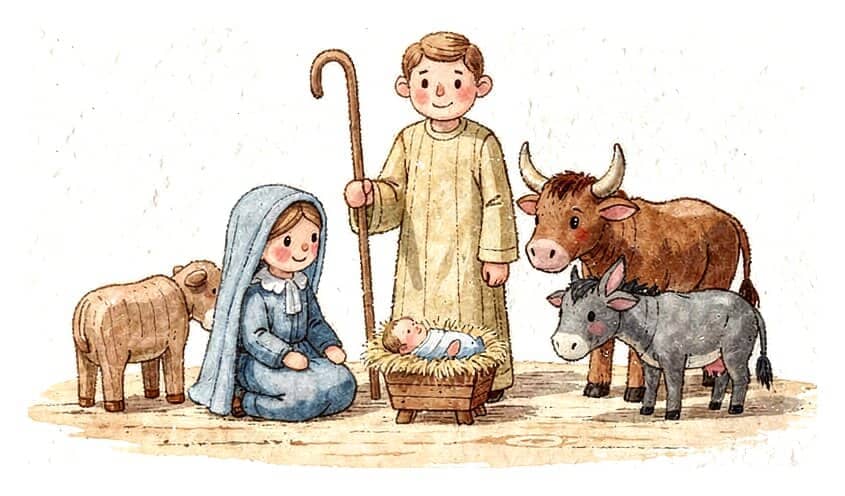


The scene often called the first was made by Saint Francis of Assisi. At Christmas in 1223, in the little hill town of Greccio, in Italy, he had a manger made ready, with hay and with an ox and a donkey standing by, and Mass was said over it. There were no figures of Mary, Joseph or the baby: just the manger, the hay and the animals.
At a glance
- Who: Saint Francis of Assisi (the scene often called the first)
- Where and when: Greccio, Italy, Christmas 1223
- What was there: a manger, hay, an ox and a donkey
- Nativity scenes to see: Naples, Provence, Catalonia and Kraków, among many
Christmas at Greccio
In 1223, Francis wished to see with his own eyes how the baby Jesus had been born: laid in a manger, on hay, with an ox and a donkey standing by. About two weeks before Christmas, he asked a friend named John to get things ready in Greccio.
On Christmas night, men and women from all around came with candles and torches. Mass was said over the manger, and Francis, dressed as a deacon, sang the Gospel and spoke to the people about the baby born in Bethlehem. His first biographer, Thomas of Celano, writing a few years later, said that out of Greccio a new Bethlehem was made.
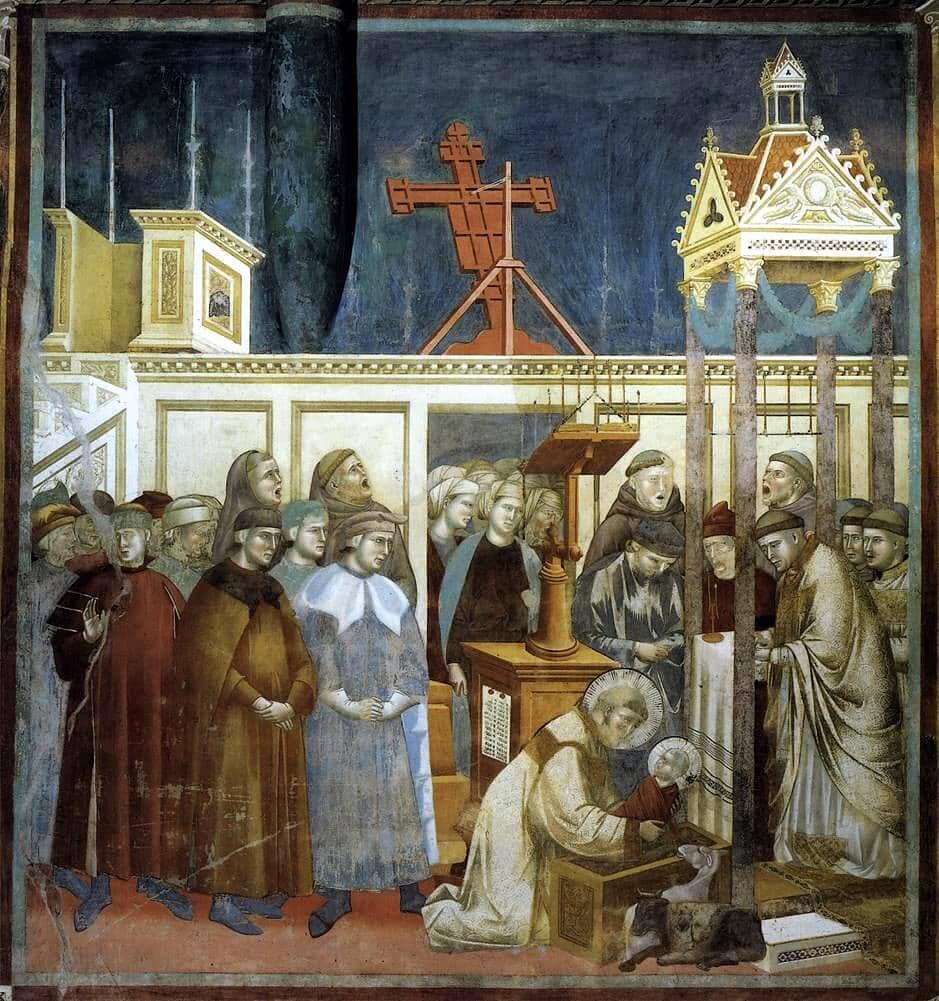
A later biographer, Saint Bonaventure, says Francis first asked the Pope’s permission, so that no one would think it a strange new thing.
 As church tradition tells it · Franciscan tradition
Francis’s first biographer adds that one man there saw a vision: the baby lying in the manger, and Francis going to him and waking him, as if from a deep sleep.
It was not quite what we picture today. The Italian encyclopedia Treccani calls Greccio’s scene a presepe vivente, a living crib. A Franciscan scholar, Noel Muscat, points out that it was the setting for a Mass, not a play with people taking the parts. And it was far from the first time the Nativity had been shown. Muscat notes that it already appears on stone coffins from the 300s, and that by Francis’s day it was common in art and in plays; what was new at Greccio, he says, was bringing the scene to life in the Christmas Mass itself.
Nativity scenes around the world
In Italy the nativity scene is the presepe, and the art reached its height in the 1700s, in cities such as Naples and Genoa. In Naples, one old street, Via San Gregorio Armeno, is known as the street of the nativity scenes. Its workshops sell the figures all year round, and alongside the shepherds you can buy little figures of famous actors and politicians to add to the crowd.
In Provence, in the south of France, the nativity scene is filled with santons: small clay figures from everyday village life. Families there were already setting up nativity scenes at home in the last years before the French Revolution. A Marseille figure-maker of that time, Jean-Louis Lagnel (1764–1822), is credited with making them in clay, cast in molds, so they could be made in great numbers for families’ homes. Marseille was the first city in France to hold a santon fair, in 1803, and its fair still opens every November.
In Catalonia, in northeast Spain, the BBC reported from Barcelona in 2010, nativity scenes hide one cheeky extra figure: the caganer, a little peasant in a floppy red cap, squatting with his trousers down to do his business. He is always tucked away, behind a tree or under a bridge, and every morning the children hunt for him. He has been part of Catalan nativity scenes for at least two hundred years.
In Kraków, Poland, people build szopki: nativity scenes set among little models of the city’s own houses and monuments, a custom born in the 1800s. On the first Thursday of December the makers bring them to the Main Square, and in 2018 UNESCO added the tradition to its list of the world’s living heritage.
 Christmas magic
In Mexico, on the morning of January 6, children find what the Three Kings left beside the nativity scene or under the tree.
Read it to a child
Reads aloud in a minute
Long ago, Saint Francis wanted to see for himself how Jesus was born. So in a little town in Italy, he had a manger set up, full of hay, with an ox and a donkey beside it. On Christmas night people came with candles and torches.
Quick answers
Who made the first nativity scene?
The one often called the first was Saint Francis of Assisi’s, at Greccio, in Italy, at Christmas 1223. He had a manger set up with hay, an ox and a donkey, and Mass was said over it. The Nativity itself had been shown in art since the 300s.
Did Saint Francis’s nativity scene have figures of Mary and Joseph?
No. It was a manger with hay and two live animals, an ox and a donkey; no figures of Mary, Joseph or the baby are in the first account of it.
What is a caganer?
A little figure hidden in Catalan nativity scenes, a peasant in a red cap doing his business. Children hunt for him.
What are santons?
Small clay figures from everyday village life, made in Provence for the nativity scene.
More: the Christmas story, Christmas in Italy, Christmas in Poland, Christmas in Mexico, nativity plays and the Tió de Nadal.
Where our facts come from
- Thomas of Celano, The Life of Saint Francis (the First Life, 1228–1229), 1C 84–86, in Francis of Assisi: Early Documents, vol. I, as given in Noel Muscat OFM, "'Quasi nova Bethlehem de Graecio facta est': Greccio and the Nativity scene in the Franciscan Sources [Part 2]", Spirit+Life 146 (Franciscan Friars OFM Malta, 2023), 1C 84 ("some fifteen days prior to the birthday of the Lord" Francis summons John: "I wish to enact the memory of that babe who was born in Bethlehem … how he lay in a manger, and how, with an ox and an ass standing by, he rested on hay"; "at the town of Greccio"); 1C 85 ("the manger is prepared, the hay is carried in, and the ox and the ass are led to the spot"; "the men and women of that land with exultant hearts prepare candles and torches"; "Over the manger the solemnities of the Mass are celebrated"; "out of Greccio is made a new Bethlehem"); 1C 86 (Francis "dressed in the vestments of the Levites … with full voice sings the holy gospel … Then he preaches to the people" of "the babe from Bethlehem"; a man's vision of a child lying in the manger, whom Francis seems to waken "from a deep sleep"); Muscat p. 4 (25 December 1223); p. 3 (1C 84; written 1228–1229); p. 9 ("not meant to be a living crib"; the vision, 1C 86); p. 12 ("not a question of drama or a mystery play"); p. 19 ("the first biographer"; "At Greccio there were no statues"); Muscat on the scene as "the setting for a liturgical celebration", "not meant to be a living crib" in today's sense
- Noel Muscat OFM, "'Quasi nova Bethlehem de Graecio facta est': Greccio and the Nativity scene in the Franciscan Sources [Part 2]", Spirit+Life 146 (Franciscan Friars OFM Malta, 2023), Conclusion, p. 18 ("The Nativity scene in art is very ancient. It is found in sarcophagi dating back to the 4th century"; Francis "could not have possibly invented the crib in the modern sense of the term, since the representations of the Nativity scene in art and drama were already common in his days"; "a true inventor of a new way of celebrating the Nativity liturgy, since he succeeded in making the Nativity scene alive in a liturgical celebration")
- Bonaventure, Legenda Maior 10.7, in Francis of Assisi: Early Documents, vol. II, as quoted in Muscat, Spirit+Life 146 (above), Muscat p. 8 ("So that this would not be considered a type of novelty, he petitioned for and obtained permission from the Supreme Pontiff")
- The Crib at Greccio, fresco in the Upper Church of San Francesco, Assisi, about 1297–1300, long attributed to Giotto (via Wikimedia Commons; photograph from the Web Gallery of Art), The fresco's record (title, place, date; the attribution to Giotto disputed); the scene it shows, the vision as Bonaventure tells it (LMj 10.7: "a beautiful little child asleep in that manger, whom the blessed father Francis embraced in both of his arms", via Muscat p. 10, note 12)
- Treccani, Enciclopedia on line, "presepe", "Origini ed evoluzione", paragraph 1 ("il presepe vivente ricostruito da S. Francesco a Greccio"; "raggiungendo nel sec. 18° il massimo sviluppo specie in alcuni centri, come Napoli o Genova")
- Italia.it (Italy's official tourism site, ENIT and the Ministry of Tourism), "San Gregorio Armeno", Subtitle ("The street of the nativity scenes, one of the most beautiful in the center of Naples"); body ¶1 (handmade nativity figurines "only became popular around the eighteenth century"); ¶2 (shops "open all year round" selling the statuettes of Nativity characters, "together with the figurines of politicians, actors and well-known personalities")
- Office de Tourisme de Marseille, "Santon fair and santon-makers in Marseille" (updated October 7, 2026), "A bit of history" ¶4 ("The santons depict figures from everyday life"); "The Santon Fair today" ("The Fair begins every year on the third weekend of November"; "made in Provence, from clay")
- Ministère de la Culture, Inventaire du patrimoine culturel immatériel en France, "Les savoir-faire des santonniers de Provence (Bouches-du-Rhône)", fiche by Antonin Chabert (IDEMEC, CNRS–Aix-Marseille Université), included 2021, I.4, p. 2 (Marseille, "la première ville de France à organiser une foire aux santons, dès 1803"); III.1 "Repères historiques", p. 10 ("Dans les dernières années de l'Ancien Régime … de véritables crèches domestiques"; "On attribue au figuriste marseillais Jean-Louis Lagnel (1764-1822) l'utilisation de l'argile dans le santon, favorisant la fabrication en série par moulage"; "une multitude de santons reproduits, accessibles, à usage domestique")
- Larousse, Dictionnaire de français, "santon", The definition ("Petite figurine en terre cuite peinte servant, en Provence, à décorer les crèches de Noël")
- Sarah Rainsford, "A traditional Nativity scene, Catalan-style", BBC News, Barcelona, December 23, 2010, ¶3 (the caganer, "squatting under a tree with his trousers down"); "Fertility symbol" section ("a feature of the Catalan nativity scene for at least two centuries"; "He's always hidden in a corner, under a bridge or behind a tree and every morning the children play a game, hunting for the caganer"); "Celebrity spin-offs" ("the traditional peasant figure in his floppy red Catalan cap")
- Gran Enciclopèdia Catalana (enciclopedia.cat), "Caganer" (Folklore), The entry ("Figura popular del pessebre en actitud de fer de cos"; "El caganer aparegué als pessebres catalans al final del segle XVII, però no es popularitzà fins el segle XIX")
- UNESCO Intangible Cultural Heritage, "Nativity scene (szopka) tradition in Krakow", Description ("Born in the nineteenth century"; the nativity scene surrounded by representations of houses and monuments of Krakow; "On the first Thursday of every December, makers gather on Krakow Main Square to present their work"); inscribed 2018 on the Representative List
- Wielki słownik języka polskiego PAN (Instytut Języka Polskiego PAN), "szopka", Odmiana, liczba mnoga, M. "szopki"; sense 1, "bożonarodzeniowa" ("model przedstawiający wyobrażone miejsce narodzin Chrystusa, ze żłobkiem, zwierzętami i różnymi postaciami")
- Gaceta UNAM, "Los Reyes Magos seguirán existiendo", January 5, 2021, Opening paragraph (January 6, the day children wait for the gifts the Santos Reyes leave "junto al Nacimiento o al pie del árbol de Navidad")
