
IV · Traditions
Why do we kiss under the mistletoe?
 True storyHow to read this bookReads aloud in 6 minutesRead it to a childAdded to the book
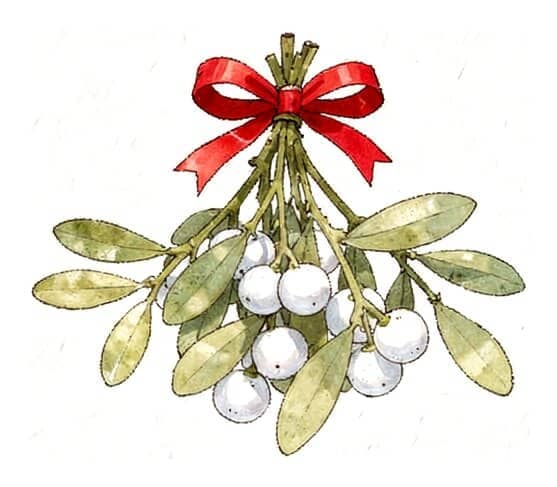


Nobody knows exactly how the kiss under the mistletoe began. As far as anyone has found, it first turns up in writing in an English comic opera of 1784, and an old rule goes with it: a berry for every kiss. The plant itself had starred in stories long before that, from the Druids to an old Norse tale.
At a glance
- The kiss, first in writing: an English comic opera, 1784, as far as anyone has found
- The old rule: one berry for each kiss
- The plant: lives in the branches of other trees
- Take care: it is poisonous to eat; in the US, your poison center is 1-800-222-1222
The kiss and the berries
As far as anyone has found, the kiss under the mistletoe first turns up in writing in England in 1784, in a comic opera called Two to One.
About two hundred years ago, in The Sketch Book of 1819–20, the American writer Washington Irving described an English country Christmas and explained the rule in a footnote: each kiss under the mistletoe meant picking one berry, and when the berries were gone, so were the kisses.
When the berries are all plucked the privilege ceases.
Older stories
Long before the first kiss we know of, the Roman writer Pliny the Elder described how the Druids of Gaul prized mistletoe growing on an oak. A priest dressed in white climbed the tree and cut it with a golden sickle, and two white bulls were sacrificed. Pliny’s account is about Gaul, and it says nothing of Christmas or of kissing.
That much is history. Here is a tale people tell.
 A tale people tell
In an old Norse tale, written down by the Icelandic chieftain Snorri Sturluson about eight hundred years ago, the goddess Frigg asked everything in the world to promise never to harm Baldr, Odin’s bright son, whom everyone loved: fire and water, metal and stones, trees, beasts and birds. Only one little sprout of mistletoe, growing alone, she thought too young to ask. And in the tale, that sprout was the one thing that could harm him. It is a sad tale, and there is no kiss in it.
A plant that lives in the trees
Mistletoe is a plant that lives up in the branches of other trees. America’s own mistletoe grows wild across the central and eastern states, often on oaks and maples: it takes water and nutrients from its host tree, but its green leaves still make food of their own from sunlight. Its genus name, Phoradendron, means “tree thief” in Greek.
Mistletoe needs no soil. Birds eat its sticky white berries, and the seeds end up on another tree’s branch, glued in place by the sticky pulp, where a new plant sprouts. The mistletoe hung in American homes at Christmas is often this native kind, standing in for the European mistletoe of the old stories.
Keep it out of reach
Is mistletoe poisonous? It can be. The American kind is milder than the European kind, and a nibble of the American kind usually causes at most an upset stomach, but no one should eat it. Keep it high, out of reach of small children and pets, and pick up any berries or leaves that fall. If someone swallows some, call your poison center (in the US, 1-800-222-1222).
Read it to a child
Reads aloud in a minute
Mistletoe is a plant that grows high up in the branches of trees. Birds eat its sticky white berries, and that is how new mistletoe gets planted, on another tree. The berries are for the birds, not for people.
Quick answers
Why do people kiss under the mistletoe?
Nobody knows how it began. As far as anyone has found, the kiss first turns up in writing in an English comic opera of 1784.
What is the mistletoe berry rule?
One berry is picked for each kiss, and when the berries are gone, so are the kisses. Washington Irving explained the rule in 1819–20.
Did the Druids use mistletoe?
The Roman writer Pliny the Elder said the Druids of Gaul held nothing more sacred, and cut it from oaks with a golden sickle.
Is mistletoe poisonous?
It can be. The American kind is milder than the European kind, but no one should eat it. If someone swallows some, call your poison center (in the US, 1-800-222-1222).
Where does mistletoe grow?
High in the branches of other trees, never in the ground. America’s own mistletoe grows wild in the central and eastern states, often on oaks and maples.
More: is Christmas pagan?, the Christmas tree and holly, ivy and greenery.
Where our facts come from
- English Heritage, "A Short History of Christmas Greenery", The mistletoe section (kissing under mistletoe "is thought to have been first recorded in the comic-opera Two to One, written in 1784"; Pliny mentions neither Britain nor the season)
- Washington Irving, The Sketch-Book of Geoffrey Crayon, Project Gutenberg eBook #2048, Essay "Christmas Eve", footnote ("The mistletoe is still hung up in farm-houses and kitchens at Christmas, and the young men have the privilege of kissing the girls under it, plucking each time a berry from the bush. When the berries are all plucked the privilege ceases.")
- Library of America, "Story of the Week: Christmas Eve", December 19, 2014, Headnote ¶ beginning "Washington Irving has been widely" (his Christmas stories in The Sketch Book of Geoffrey Crayon (1819–20), alongside "Rip Van Winkle" and "The Legend of Sleepy Hollow")
- Pliny the Elder, Natural History XVI.95, translated by John Bostock and H. T. Riley (1855), Perseus Digital Library, Book XVI, chapter 95, "Historical facts connected with the mistletoe" (the Druids "held nothing more sacred than the mistletoe and the tree that bears it"; "Clad in a white robe the priest ascends the tree, and cuts the mistletoe with a golden sickle"; "two white bulls")
- Snorri Sturluson, The Prose Edda, translated by Arthur Gilchrist Brodeur (The American-Scandinavian Foundation, 1916), Gylfaginning (Wikisource), Chapter XXII (Baldr, the second son of Odin: "He is best, and all praise him"); chapter XLIX (Frigg's oaths from fire, water, metals, stones, earth, trees, beasts and birds; "There grows a tree-sprout alone westward of Valhall: it is called Mistletoe; I thought it too young to ask the oath of"; Loki and the blind Hödr); the Introduction, its own Wikisource page, https://en.wikisource.org/wiki/The_Prose_Edda_(1916_translation_by_Arthur_Gilchrist_Brodeur)/Introduction (Snorri of Hvamm in western Iceland; his life, to 1241)
- North Carolina Extension Gardener Plant Toolbox (NC State University and N.C. A&T), "Phoradendron leucarpum", "Description" ¶1 (an evergreen shrub native to the central and eastern United States; "a hemiparasitic epiphyte" on the branches of trees, typically maples and oaks, for support, water and nutrients, but making its own food by photosynthesis; the genus name from the Greek for "a thief" and "tree"); ¶2 (no soil needed; white berries with sticky pulp eaten by birds, the seeds left on hardwood trees, where the pulp holds them until they sprout); "Description" ¶3 ("often used to replace the European variety of mistletoe (Viscum album) as the mistletoe hung at Christmastime"); the "Fruit" line ("The pulp is poisonous to humans")
- Henry George Liddell and Robert Scott, A Greek-English Lexicon, revised by Henry Stuart Jones (1940), "φώρ" (Perseus Digital Library), The headword ("thief")
- Henry George Liddell and Robert Scott, A Greek-English Lexicon, revised by Henry Stuart Jones (1940), "δένδρεον, δένδρον" (Perseus Digital Library), The headword ("tree")
- Poison Control (National Capital Poison Center), "Is mistletoe poisonous?", "The bottom line" and "The full story" ("American Phoradendron mistletoe is less toxic than the European species Viscum album"; swallowing American mistletoe can cause gastrointestinal upset; most patients had no symptoms); "Prevention tips" (keep berries and leaves from pets and small children); "call your poison center at 1-800-222-1222"; the site menu ("Calls to poison centers (US)")