

V · Santa
What are the names of Santa’s reindeer?
 Christmas magicHow to read this bookReads aloud in 6 minutesRead it to a childAdded to the book
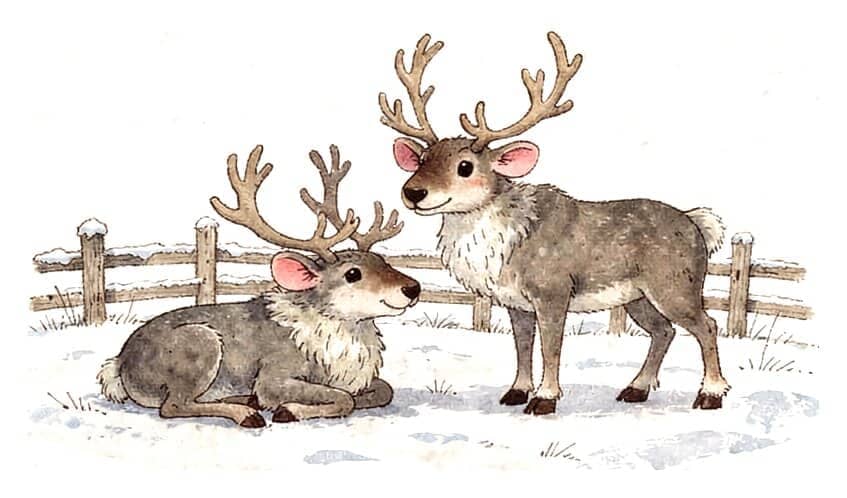


Santa’s reindeer are Dasher, Dancer, Prancer, Vixen, Comet, Cupid, Donner and Blitzen. And when Christmas Eve is foggy, Rudolph, with his shining red nose, leads the way.
 True story
The eight names come from a poem printed in 1823, where the last two were Dunder and Blixem. Rudolph joined the team in 1939, in a story written for a chain of stores.
True storyAt a glance
- The eight: Dasher, Dancer, Prancer, Vixen, Comet, Cupid, Donner and Blitzen
- Named in: the poem that begins “’Twas the night before Christmas,” printed December 23, 1823, in Troy, New York
- Spelled then: Dunder and Blixem, for the last two
- Rudolph: a story by Robert L. May, 1939
- Reindeer and caribou: the same animal
The eight in the poem
True storyWhen the poem was first printed, in a newspaper in Troy, New York, on December 23, 1823, Saint Nick calls his team by name:
Now! Dasher, now! Dancer, now! Prancer, and Vixen, / On! Comet, on! Cupid, on! Dunder and Blixem;
Dunder and Blixem echo the Dutch donder en bliksem, “thunder and lightning,” which is also an exclamation in Dutch. The poem is usually credited to Clement Clarke Moore, and in copies of it that Moore wrote out by hand late in life, the two became Donder and Blitzen. Our list says Donner; no source we have found says when that spelling began.
Rudolph
True storyRudolph is not in the poem. He began in 1939, when the Montgomery Ward stores, which had been giving away coloring books at Christmas, asked Robert L. May, a 34-year-old copywriter in Chicago, for a story of their own to hand out instead. May wrote it in rhyme, in the bouncing style of the 1823 poem, and the stores gave away more than two million free copies. Later, May’s brother-in-law, Johnny Marks, turned the story into a song, and Gene Autry’s recording of 1949 made it a hit.
And ever since, on foggy nights, the reindeer with the red nose has had his place at the front of the team.
Reindeer and caribou
True storyReindeer and caribou are the same animal. Scientists put them all in one species, Rangifer tarandus. In Europe they are all called reindeer. In Alaska and Canada the wild herds are called caribou, and only the herded, semi-tame animals are called reindeer.
Reindeer are the only deer in which the females grow antlers as well as the males. The biggest males drop their antlers in late October, but females and young males keep theirs all winter, into the spring. Their big, cupped hooves spread wide, like snowshoes, to hold them up on snow and soft ground, and the same feet work as paddles when they swim. In Alaska, a grown male caribou weighs about 350 to 400 pounds, and a female about 175 to 225.
Read it to a child
Reads aloud in a minute
Santa has eight reindeer: Dasher, Dancer, Prancer, Vixen, Comet, Cupid, Donner and Blitzen. Can you say them all in one breath? And at the front, on a foggy night, flies Rudolph, with his nose glowing red.
True storyReindeer have wide hooves that work like snowshoes, and the girls grow antlers too.
True storyQuick answers
How many reindeer pull Santa’s sleigh?
Eight in the poem of 1823. Rudolph joined them in a story of 1939, which makes nine.
What were the reindeer called in the original poem?
Dasher, Dancer, Prancer, Vixen, Comet, Cupid, Dunder and Blixem.
Is Rudolph in “’Twas the Night Before Christmas”?
No. Rudolph began as a story that Robert L. May wrote in 1939 for the Montgomery Ward stores.
Is it Donner or Donder?
Both have been used. The poem of 1823 says Dunder, Moore’s later handwritten copies say Donder, and our list says Donner.
Are reindeer and caribou the same animal?
Yes, one species, Rangifer tarandus. In Alaska and Canada the wild ones are called caribou and the herded ones reindeer.
Do female reindeer have antlers?
Yes. Reindeer are the only deer in which the females grow antlers as well as the males.
More: the whole poem of 1823, how to write a letter to Santa, the Santa chapter, Rudolph and the North Pole.
Where our facts come from
- "Account of a Visit from St. Nicholas", Troy Sentinel (Troy, New York), December 23, 1823, Wikisource transcription with page scan, The reindeer lines, 21-22 ("Now! Dasher, now! Dancer, now! Prancer, and Vixen, / On! Comet, on! Cupid, on! Dunder and Blixem;"); line 16 ("eight tiny rein-deer"); no Rudolph anywhere in the poem
- M. Philippa et al., Etymologisch Woordenboek van het Nederlands (2003-2009), "donder" and "bliksem", with P.G.J. van Sterkenburg, Vloeken (2001), at etymologiebank.nl (Instituut voor de Nederlandse Taal), "donder": "dreunend geluid bij onweer" (the sound in a thunderstorm), cognate of English thunder; "bliksem": "elektrische ontlading bij onweer" (the flash in a thunderstorm); van Sterkenburg, under donder: "Wij kennen ook nog donder en bliksem!" (an exclamation)
- Paul Hond, "The Story Behind the Most Famous Christmas Poem of All", Columbia Magazine, November 19, 2021, Paragraph beginning "Then there is the question about the names of two reindeer" ("originally published as 'Dunder and Blixem' (after the Dutch oath meaning 'thunder and lightning') but which became the German 'Donder and Blitzen' in the four copies of the poem that Moore, late in life, wrote out and distributed as gifts")
- Bonnie Barber, "Rudolph the Red-Nosed Reindeer Shines on at Dartmouth", Dartmouth News, December 15, 2011, Paragraphs 3-4 (a holiday giveaway for the 1939 season; May "crafted the story while working as a copywriter in Ward's retails sales department in Chicago", as a poem in the style of 'Twas the Night Before Christmas); paragraphs 6-7 ("more than two million copies were printed and distributed", free); paragraph 11 (the song by his brother-in-law Johnny Marks; "Recorded by Gene Autry in 1949, the record sold 2 million copies")
- Smithsonian Institution, "Smithsonian Snapshot: Rudolph the Red-Nosed Reindeer", December 21, 2010 (Internet Archive copy of November 26, 2024), Paragraph 1 (Montgomery Ward "asked one of its copywriters, 34-year-old Robert L. May" in 1939; it "had been buying and giving away coloring books"); paragraph 3 ("recorded by Gene Autry in 1949")
- Alaska Department of Fish and Game, "Caribou (Rangifer tarandus granti) Species Profile", "General Description" (all caribou and reindeer one species; reindeer in Europe, caribou in Alaska and Canada except the semi-domesticated form; the only member of the deer family in which both sexes grow antlers; large concave hooves that spread to support them in snow and soft tundra and work as paddles when they swim; adult bulls 350-400 pounds, mature females 175-225); "Life History" (the largest bulls shed antlers in late October; small bulls and non-pregnant cows in April; pregnant cows when calves are born in late May or early June)