
VI · Legends
The Yule Cat and Grýla, Iceland’s Christmas tales
 A tale people tellHow to read this bookReads aloud in 8 minutesRead it to a childAdded to the book
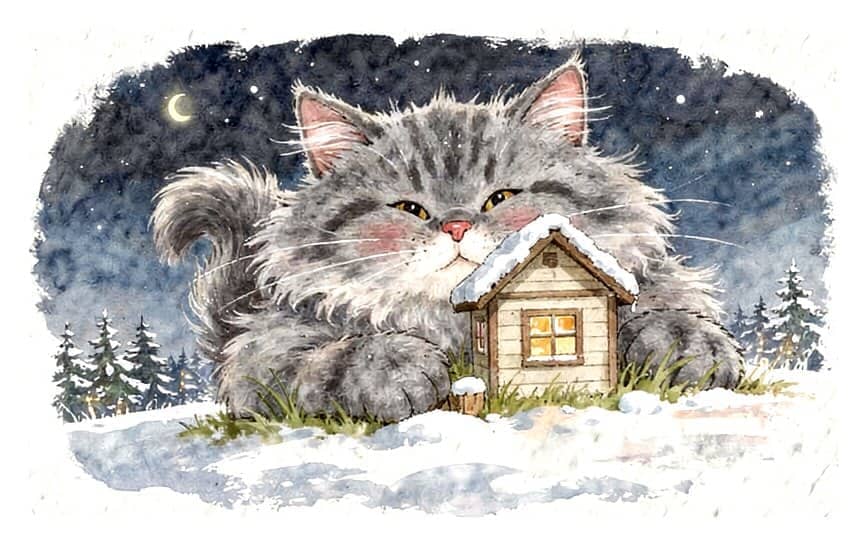


The Yule Cat is a creature of Icelandic folk tales, a cat said to prowl at Christmas and to come for anyone who had nothing new to wear on Christmas Eve. It belongs to a family of Iceland’s Christmas tales, with the troll-woman Grýla and her sons, the thirteen Yule Lads.
At a glance
- From: Iceland
- The Yule Cat: comes for anyone with nothing new to wear on Christmas Eve
- Grýla: a troll-woman of the old tales, with a taste for children who whined
- The Yule Lads: thirteen, Grýla’s sons in the old tales
- Oldest writing found: the Yule Cat, the mid-1800s; the Yule Lads, the late 1600s; Grýla’s name, the Middle Ages
The Yule Cat
Icelandic folk belief told of a Yule Cat that prowled at Christmas. It left alone anyone who had a new piece of clothing to wear on Christmas Eve. Anyone with nothing new was in trouble: the cat took them, the tellings say, or at the very least their Christmas share.
In the account Jón Árnason wrote down, everyone, children and farmhands alike, worked hard before Christmas to earn something new to wear, and so keep clear of the cat. The new shoes that everyone was given for Christmas did not count.
Where does this story come from?
The Yule Cat is younger than you might think: the oldest mention in the Icelandic university dictionary’s archive of written Icelandic is in the folktales Jón Árnason gathered in the mid-1800s. Norway tells a similar tale, with a Christmas goat instead of a cat. One theory is that both creatures grew out of Saint Nicholas’s little devil.
Grýla
In the old tales, Grýla is an old troll-woman who married twice, the second time to an old man called Leppalúði, and had twenty children with him. She had a terrible appetite for children who whined.
 True story
Grýla’s name is very old: it already appears in a medieval Icelandic list of names for troll-women.
The Yule Lads
The old tales say the first Lad comes about two weeks before Christmas, and one more every day after, until all thirteen have arrived; then they leave one by one. In other tellings there were nine.
True storyThe Yule Lads first appear in writing in the late 1600s, in a poem about Grýla that calls some of them her children with Leppalúði. They may well be older than that poem. A Grýla poem from the second half of the 1700s already counted thirteen of them, though for a long time people disagreed on the number. In 1746 a law on household discipline in Iceland forbade using them, or ghosts, to scare children. Names for the Lads first appear in writing in 1862, when Jón Árnason published the first volume of his great collection of Icelandic folktales. The names Icelanders know today were all but fixed by the poet Jóhannes úr Kötlum, whose Yule Lad verses, with Tryggvi Magnússon’s pictures, came out in the early 1930s.
His little book Jólin koma, Christmas Is Coming, holds poems about the Yule Lads, Grýla and the Yule Cat, and it is still reprinted today.
 Christmas magic
Icelandic children put a shoe in the bedroom window from December 11 to Christmas Eve, hoping for a small present from a Yule Lad. Each day from December 12, one Lad leaves a little something in the shoe. The first, Sheep-Cot Clod, comes on December 12, and the last, Candle Beggar, on Christmas Eve.
| The Yule Lad | English nickname (National Museum of Iceland) | His day |
|---|---|---|
| Stekkjastaur | Sheep-Cot Clod | December 12 |
| Giljagaur | Gully Gawk | December 13 |
| Stúfur | Stubby | December 14 |
| Þvörusleikir | Spoon Licker | December 15 |
| Pottaskefill | Pot Scraper | December 16 |
| Askasleikir | Bowl Licker | December 17 |
| Hurðaskellir | Door Slammer | December 18 |
| Skyrgámur | Skyr Gobbler | December 19 |
| Bjúgnakrækir | Sausage Swiper | December 20 |
| Gluggagægir | Window Peeper | December 21 |
| Gáttaþefur | Doorway Sniffer | December 22 |
| Ketkrókur | Meat Hook | December 23 |
| Kertasníkir | Candle Beggar | December 24 |
Who else brings the presents around the world is on the gift-bringers’ page.
Read it to a child
Reads aloud in a minute
In Iceland, people tell of a Yule Cat who prowls about at Christmastime. The cat only bothers people who have nothing new to wear on Christmas Eve. So long ago, everyone worked hard to earn something new to wear in time, and kept well clear of the cat. And for thirteen days before Christmas, Icelandic children put a shoe in the window, waiting for the Yule Lads.
Quick answers
Who is the Yule Cat?
A cat of Icelandic folk tales, said to prowl at Christmas and to come for anyone with nothing new to wear on Christmas Eve.
Is the Yule Cat real?
No: it is a creature of Icelandic folk tales, and told as a tale. Its oldest written mention in the Icelandic university dictionary’s archive is from the mid-1800s.
Who is Grýla?
A troll-woman of the old Icelandic tales, married to Leppalúði, with a terrible appetite for children who whined. Her name is very old: it already appears in a medieval list of names for troll-women.
How many Yule Lads are there?
Thirteen today. The oldest sources don’t give a number; a Grýla poem from the second half of the 1700s says thirteen, and people went on disagreeing for a long time.
When do the Yule Lads come?
Their days run from December 12 for the first to Christmas Eve for the last.
More: Christmas legends and folk tales, the Yule Lads and Christmas in Iceland.
Where our facts come from
- Guðrún Kvaran, "jólaköttur", Árnastofnun (the Árni Magnússon Institute for Icelandic Studies), June 19, 2018, quoting Jón Árnason, Íslenzkar þjóðsögur og ævintýri (new ed. 1966) II:570, Paragraph 1 ("Sagnir um jólaköttinn eru ekki gamlar"; the earliest source in the dictionary's written-language archive, Jón Árnason's collection, gathered about the middle of the 19th century; the quotation beginning "Var það trú að sú óvættur væri þá á ferð sem var kallaður jólaköttur": those who got a new garment for Christmas Eve were safe, the rest "fóru í jólaköttinn", which took ("tók (át?)") them or their Christmas portion); paragraph 3 (the Christmas portion, jólarefur); paragraph 4 ("Af þessu kepptust allir við, bæði börn og hjú"); paragraph 5 (the new Christmas shoes, jólaskór, did not count); paragraph 6 (Árni Björnsson: similar stories in Norway, a Christmas goat; "Sú tilgáta hefur verið sett fram": the goat and the cat split off from Saint Nicholas's devil companion)
- Jón Árnason, Þjóðsagnasafn Jóns Árnasonar, "Grýla og bændur hennar" (Netútgáfan, January 2000), Paragraph 1 ("Grýla hét norn ein gömul; hún var tvígift. Fyrri maður hennar hét Boli"; both "mannætur", who liked best to eat young ones; the verse of children who whine, to their mother's sorrow); paragraph 3 (after Boli's death she married "gamlan mann er hét Leppalúði"; their twenty children)
- Edda Snorra Sturlusonar, ed. Guðni Jónsson, Viðauki I, "Nafnaþulur" (heimskringla.no), Section "Tröllkonur", stanza 12, line 4 ("Grýla, Brýja")
- William Sayers, "Snorri's Trollwives", Scandinavian-Canadian Studies 18 (2009), The opening paragraphs ("At the conclusion of Skaldskaparmál Snorri Sturluson has a versified list of the names of female trolls"; "The list by Snorri or incorporated in his work"; "The catalogue was a popular medieval subgenre"); the paragraph on Grýla ("The Grýla figure has been extensively studied by Terry Gunnell, from medieval references down to the folklore of the Faroes, Orkney, and Shetland")
- Árni Björnsson, "Nöfn jólasveina", Árnastofnun, January 23, 2019 (last modified October 24, 2023), Paragraph 1 (the word jólasveinn first in writing in a Grýla poem of the late 1600s attributed to the Rev. Stefán Ólafsson, the Lads as Grýla and Leppalúði's children; the word may be older); paragraph 2 (the 1746 Household Discipline Ordinance: "bannað að hræða börn með jólasveinum eður vofum"); paragraphs 3–4 (a Grýla poem of the second half of the 1700s, "þrettán saman"; the number long varied); paragraph 5 (names first in Jón Árnason's collection, 1862, I:219); the paragraph beginning "Nú er líklega orðið tímabært" (Jóhannes úr Kötlum and Tryggvi Magnússon; the names best known since; the text gives 1932, the reference list 1931)
- Forlagið (Mál og menning), "Jólin koma", "Um bókina", paragraphs 1–3 (the book reprinted again and again; its poems "Jólin koma", "Jólasveinarnir", "Grýlukvæði", "Jólakötturinn" and "Jólabarnið")
- Jón Árnason, Þjóðsagnasafn Jóns Árnasonar, "Um jólasveina" (Netútgáfan), Paragraph 1 ("Jólasveinar eru taldir þrettán og kemur sá fyrsti hálfum mánuði fyrir jól og síðan einn hvern dag til jóla og eins haga þeir brottferð sinni eftir jólin"); the same entry's other tellings, with nine Lads
- National Museum of Iceland, "The Yule lads visit the museum!" and "Jólasveinarnir heimsækja safnið!" (event pages, December 12–24, 2025), The dated list under the event description (Stekkjastaur December 12 … Kertasníkir December 24; the English nicknames); the Icelandic description ("hver á þeim degi sem þeir gefa í skóinn")
- Visit Iceland (Iceland's official tourism board), "Christmas in Iceland", Introduction ("children put shoes in their bedroom window for 13 days"); list item 1 (the shoe in the window from the 11th to the 24th of December, for a small present from the Yule Lads)