
I · The Story
The Christmas story for children
 As the Bible tells itHow to read this bookReads aloud in 4 minutesRead it to a childAdded to the book
This is the Christmas story as the Gospels of Matthew and Luke tell it, told simply, to read aloud. It keeps to what the Bible says: the wise men aren’t counted, for instance, because Matthew never counts them.
Read it to a child
Reads aloud in 3 minutes
Long ago, in the little town of Nazareth, there lived a young woman named Mary. She was going to marry a man named Joseph.
One day an angel named Gabriel came to Mary. “Don’t be afraid,” he said. He told her that she would have a baby boy, and that she would call him Jesus.
Joseph had a dream. An angel told him to take care of Mary and her baby, and he did.
The emperor wanted everyone counted in their family’s hometown, so Mary and Joseph traveled all the way to Bethlehem. There was no room for them in the inn. So when baby Jesus was born, Mary wrapped him snugly in cloth and laid him in a manger, the box where animals eat their hay.
Out in the fields that night, shepherds were watching their sheep. Suddenly an angel stood beside them, and all around them shone the glory of the Lord. The shepherds were terrified.
“Don’t be afraid,” said the angel. He told them he had good news, news of great joy: a Savior had been born that day, in Bethlehem. They would find him in a manger, wrapped up in cloth.
Then the sky was full of angels, praising God and saying:
“Glory to God in the highest, on earth peace, good will toward men.”
The shepherds hurried to Bethlehem and found the baby, just as the angel had said. Mary kept all these things in her heart and thought about them.
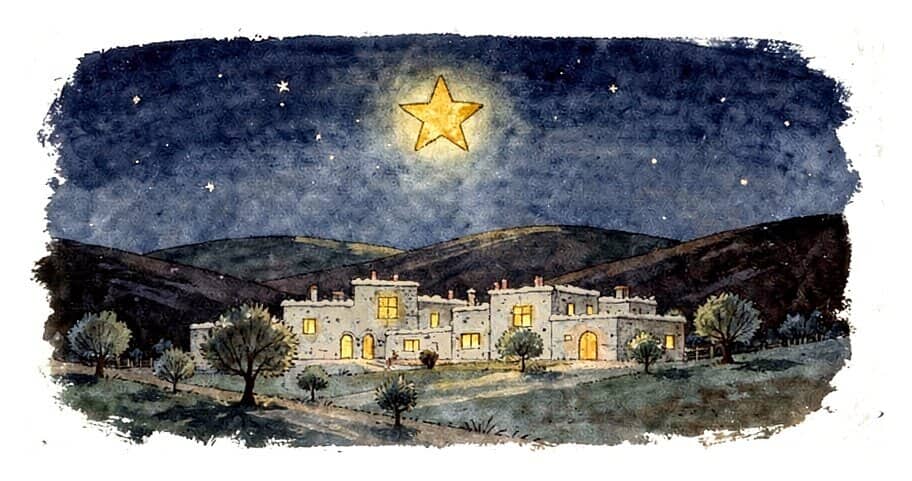
Far away in the east, wise men saw his star. They followed it until it stood still over the house where the child was, and they gave him gifts: gold, frankincense and myrrh.
A dream told the wise men to go home a different way. An angel warned Joseph that the family was in danger, so they went to Egypt for a while, and later they came home to Nazareth.
For grown-ups: what the Bible says, and what came later
You may notice there is no stable here, and no ox or donkey.
As church tradition tells it · Western and Eastern church traditionsLuke says only that Mary laid her baby in a manger. The ox and the donkey that so many pictures put beside it come from a line in the prophet Isaiah: “The ox knows his owner, and the donkey his master’s crib.” Much later, a writing outside the Bible, the Gospel of Pseudo-Matthew, probably from the 600s or 700s, put them beside the manger in its story.
The whole story, with where each part is found, is on the Bible page, and who the wise men were has its own page.
More: the Christmas story, told short and ’Twas the Night Before Christmas, to read aloud.
Where our facts come from
- World English Bible, Luke 1, Luke 1:26–38 (Gabriel sent to Nazareth, 1:26; Mary "pledged to be married" to Joseph, 1:27; "Don't be afraid, Mary", 1:30; a son, to be named Jesus, 1:31)
- World English Bible, Matthew 1, Matthew 1:20–24 (the angel in Joseph's dream: "don't be afraid to take to yourself Mary as your wife"; Joseph did as the angel commanded)
- World English Bible, Luke 2, Luke 2:1–5 (the enrollment; Nazareth to Bethlehem); 2:6–7 (the birth; bands of cloth; a feeding trough; no room in the inn); 2:8–13 (shepherds in the field by night; an angel; "the glory of the Lord shone around them"; "Don't be afraid"; good news; a Savior born in David's city; the sign of the baby in a feeding trough; the heavenly army "praising God"); 2:14 (quoted); 2:15–16 (the shepherds hurry to Bethlehem and find the baby); 2:19 (Mary "pondering them in her heart"); 2:20 ("just as it was told them")
- World English Bible, Matthew 2, Matthew 2:1–2 (wise men from the east; "his star"); 2:9–11 (the star went before them and stood over where the young child was; "the house"; gold, frankincense and myrrh); 2:12 (warned in a dream, home another way); 2:13–15 and 2:19–23 (warned in a dream, Joseph takes the family to Egypt; later they settle in Nazareth); the whole passage (no number)
- World English Bible, Isaiah 1; the Gospel of Pseudo-Matthew, chapter 14 (Ante-Nicene Fathers, vol. 8, at New Advent); Brandon W. Hawk, "An Ox, an Ass, and Three Kings: A History of Apocryphal Christmas Traditions" (December 18, 2014), Isaiah 1:3 ("The ox knows his owner, and the donkey his master's crib"); Pseudo-Matthew 14 (the child placed in the stall, "and the ox and the ass adored Him"); Hawk, "Ox and Ass" section, the paragraph after the Isaiah 1:3 quotation ("a Christian appropriation of Isaiah's prophecy") and final paragraph (Pseudo-Matthew "probably compiled in the late seventh or eighth century")
- Priest Seraphim Holland, "Explanation of the icon of the Nativity of the Savior" (orthodox.net), page 1, second paragraph (the child "in the manger with the ox and the donkey") and third paragraph ("The ox and the donkey reference to the prophecy from Isaiah 1:3")