

II · History
Is Christmas pagan? What historians say
 True storyHow to read this bookReads aloud in 8 minutesAdded to the book
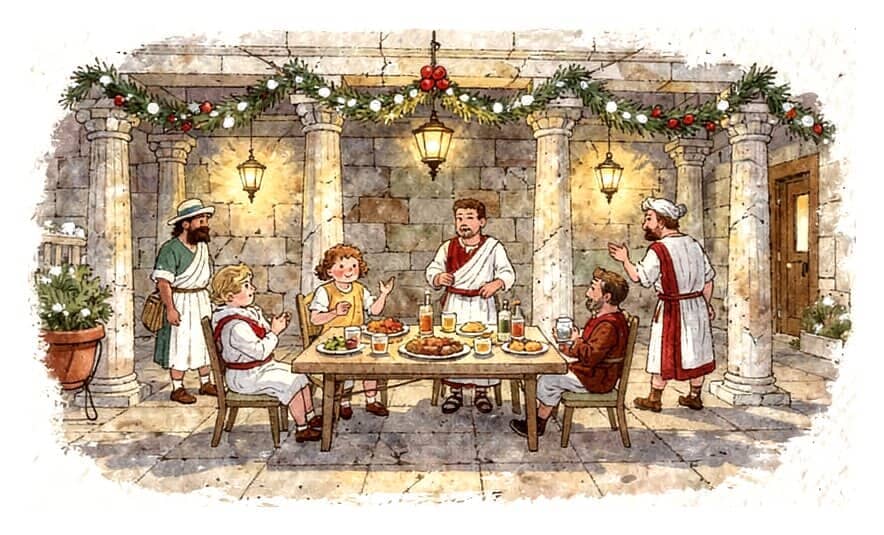


Christmas is a Christian feast, the celebration of Jesus’ birth. What people argue about is how much of it came from older, pre-Christian festivals: its date, and some of its customs. The evidence points both ways, and historians still weigh it differently.
At a glance
- What it celebrates: the birth of Jesus
- Its date: December 25; whether it was chosen to match a pagan festival is still debated
- Saturnalia: a Roman feast of the god Saturn, beginning on December 17
- The word Yule: an Old English word for Christmas
- Its customs: some may be older than Christianity; the tree and the mistletoe kiss first appear in the record many centuries later
Rome’s midwinter
Saturnalia, the Roman feast of the god Saturn, began on December 17, and Rome’s calendar still listed it in 354. The same calendar marks December 25 as the birthday of the Unconquered One, usually taken to be the Sun.
Under the Roman republic, Saturnalia’s sacred rites took up a single day; the emperor Augustus fixed the festival at three days, December 17 to 19, and in time the merrymaking ran to about a week. Friends exchanged presents, and wax candles were a common gift from humbler Romans to those above them. Little clay figures were sold for the festival and given to children as toys. Slaves were given unusual freedom, and were sometimes even served at table by their masters. At private parties, guests chose a mock king.
The case that Christmas borrowed
The best-known version of the pagan idea is that the church set Christmas on a date when Romans already held a midwinter festival, to draw people to the new faith. Scholars took the idea up in the 1700s and 1800s, and it is still the one most often repeated today.
What the argument has going for it is Rome’s own calendar. The oldest record we have of December 25 as the day Christ was born sits in the same Roman almanac of 354 that marks the day as the birthday of the Unconquered One. The argument is not new, either. A Catholic encyclopedia of 1908 rejected Saturnalia as the origin of Christmas, yet said that Rome’s feast of the Unconquered Sun, kept on December 25, “has a strong claim on the responsibility for our December date.”
The case against
No early Christian writer says the date was borrowed. Some did link Jesus’ birth with the winter sun: in the 300s the church father Ambrose called Christ the true sun. But they saw the match as a sign from God, not as something the church had arranged. Christians were also already debating the day of Jesus’ birth around the year 200, though the days they named were not December 25, and the church is not known to have taken over pagan festivals until the middle of the 300s. And the first writer we know of to say that Christmas was moved to match a pagan feast is an unnamed reader who added a note to a Syriac manuscript in the 1100s, some eight hundred years after the fact.
There is another explanation for the date, worked out from March 25, and why Christmas is on December 25 sets the two side by side.
What came later
Later, things changed. From the middle of the 300s, after the emperor Constantine, Christians did set out to turn pagan festivals into Christian ones. So while the date itself may not be borrowed, some of what grew up around Christmas over the centuries may well be older than Christianity.
In 601 Pope Gregory the Great advised missionaries in England to keep the old temples, remove the idols, and let people feast on church holidays as they once had on pagan ones. The letter is about temples and feast days in general; it does not mention Christmas.
In Old English, geol, our word Yule, was a word for Christmas, and the months either side of midwinter were called the earlier Yule, December, and the later Yule, January.
The tree and the mistletoe
Nobody knows for sure who first brought a fir indoors for Christmas. One history of the tree leaves older pagan customs with trees to one side, unsure whether they have anything to do with ours, and the oldest written description we know of a decorated Christmas tree comes from Strasbourg, in Alsace, around 1605. The Christmas tree has its own page.
Nearly two thousand years ago, the Roman writer Pliny the Elder described how the Druids of Gaul prized mistletoe growing on an oak. He says nothing about Christmas, or about kissing. The kiss under the mistletoe first turns up in writing, as far as anyone has found, in an English comic opera of 1784. The mistletoe has its own page too.
So, is Christmas pagan?
Christmas itself is a Christian feast. Whether its date was chosen with a Roman festival in mind is still argued over. Some of its customs may well be older than Christianity; others, like the tree and the kiss under the mistletoe, first turn up in the record much later.
Quick answers
Is Christmas a pagan holiday?
Christmas is the Christian feast of Jesus’ birth. What historians debate is whether its date, and some of its customs, came from older festivals.
Did Christmas come from Saturnalia?
Saturnalia began on December 17 and was a time of presents and parties. So it is easy to see why people link the two. But no early Christian writer says Christmas came from it, and even a 1908 Catholic encyclopedia said Christmas should not be traced to Saturnalia.
Is the Christmas tree pagan?
The oldest written description we know of a decorated Christmas tree is from Strasbourg, around 1605. Older tree customs may or may not be related to it.
What does Yule mean?
In Old English it was a word for Christmas, and the months either side of midwinter were the earlier Yule, December, and the later Yule, January.
More: when people started celebrating Christmas, Saturnalia, Yule and holly, ivy and greenery.
Where our facts come from
- Andrew McGowan, "How December 25 Became Christmas", Bible Review, December 2002 (Bible History Daily, Biblical Archaeology Society), Paragraph beginning "The most loudly touted theory" (the date "borrowed from pagan celebrations"; Saturnalia; Aurelian's feast of the Unconquered Sun, 274); paragraphs beginning "Despite its popularity today" ("It is not found in any ancient Christian writings") and "There are problems with this popular theory" (dates for Christmas established before Christians are known to have adopted pagan festivals); paragraph beginning "This would change only after Constantine" (Christians later deliberately Christianized pagan festivals); paragraph beginning "It's not until the 12th century" (the marginal note; the 18th and 19th centuries); paragraph beginning "The earliest mention of December 25" ("The earliest mention of December 25 as Jesus' birthday comes from a mid-fourth-century Roman almanac"; note 3, "The Philocalian Calendar"); the paragraph on Ambrose ("Christian authors of the time do note a connection between the solstice and Jesus' birth: the church father Ambrose (c. 339–397), for example, described Christ as the true sun"; "they see the coincidence as a providential sign"); paragraph beginning "Finally, in about 200 C.E." ("several different days had been proposed by various Christian groups"; "Clement doesn't mention December 25 at all"); "From the mid-fourth century on, we do find Christians deliberately adapting and Christianizing pagan festivals"; final paragraph ("We cannot be entirely sure"; "Elements of the festival that developed from the fourth century until modern times may well derive from pagan traditions")
- The Chronography of 354, Part 6, the calendar, edition at tertullian.org, "MENSIS DECEMBER": XVI KAL IAN, "SATVRNALIA" (with games); VIII KAL, "N·INVICTI·CM·XXX" (N = Natalis, birthday; CM = Circenses missus, games ordered)
- William Ramsay, "Saturnalia", in William Smith, ed., A Dictionary of Greek and Roman Antiquities (John Murray, 1875), p. 1009 (LacusCurtius), Paragraph 1 ("Special indulgences were granted to the slaves"; they "were waited upon by them at table"); paragraph 2 ("presents were exchanged among friends, cerei or wax tapers being the common offering of the more humble to their superiors"); paragraph 3 ("the election of a mock king"); paragraph 5 ("During the republic … only one day … was set apart for the sacred rites"; Augustus: three days, the 17th, 18th and 19th of December); paragraph 6 ("little earthenware figures (sigilla, oscilla) exposed for sale at this season"; "it would seem that the merry-making lasted during seven days")
- C. C. Martindale, "Christmas", Catholic Encyclopedia, vol. 3 (1908), Section on the date ("The origin of Christmas should not be sought in the Saturnalia"; "The well-known solar feast, however, of Natalis Invicti, celebrated on 25 December, has a strong claim on the responsibility for our December date"); section on Rome ("The Philocalian Calendar … compiled in 354, … contains three important entries. In the civil calendar 25 December is marked 'Natalis Invicti'. In the 'Depositio Martyrum' … under 25 December is found 'VIII kal. ian. natus Christus in Betleem Iudeae'")
- Pope Gregory I, Letter to Abbot Mellitus (about 601), Internet Medieval Sourcebook, Fordham University, The letter (Epistola 76): do "in no means destroy the temples of the gods but rather the idols within those temples"; on feast days the people should "build themselves huts around their one-time temples and celebrate the occasion with religious feasting"; no mention of Christmas, December or winter
- Joseph Bosworth and T. Northcote Toller, An Anglo-Saxon Dictionary Online (Charles University, 2014), "Geól" and "Geóla", Geól: "YULE, Christmas; festum nativitatis Domini"; Geóla: "The YULE or Christmas month, that is, December"; "Se ǽrra geóla … December"; "Se æftera géóla … January"
- Elesha Coffman, "O Christmas Tree", Christianity Today (Christian History), December 1, 2001, The paragraph beginning "To answer that question" ("at least two candidates vie for that distinction, not counting the many pagan tree customs that may or may not relate to modern practice"); the paragraph beginning "If candles, apples, and wafers don't seem quite festive enough" (a tree set up in a home in Strasbourg in 1605, with paper roses, apples and wafers)
- Pliny the Elder, Natural History XVI.95, tr. John Bostock and H. T. Riley (1855), Perseus Digital Library, Book XVI, chapter 95, "Historical facts connected with the mistletoe" (the Druids "held nothing more sacred than the mistletoe and the tree that bears it, supposing always that tree to be the oak")
- English Heritage, "A Short History of Christmas Greenery", Mistletoe section ("is thought to have been first recorded in the comic-opera Two to One, written in 1784"; Pliny mentions neither Britain nor the season)