

II · History
Why is Christmas on December 25?
 True storyHow to read this bookReads aloud in 8 minutesRead it to a childAdded to the book
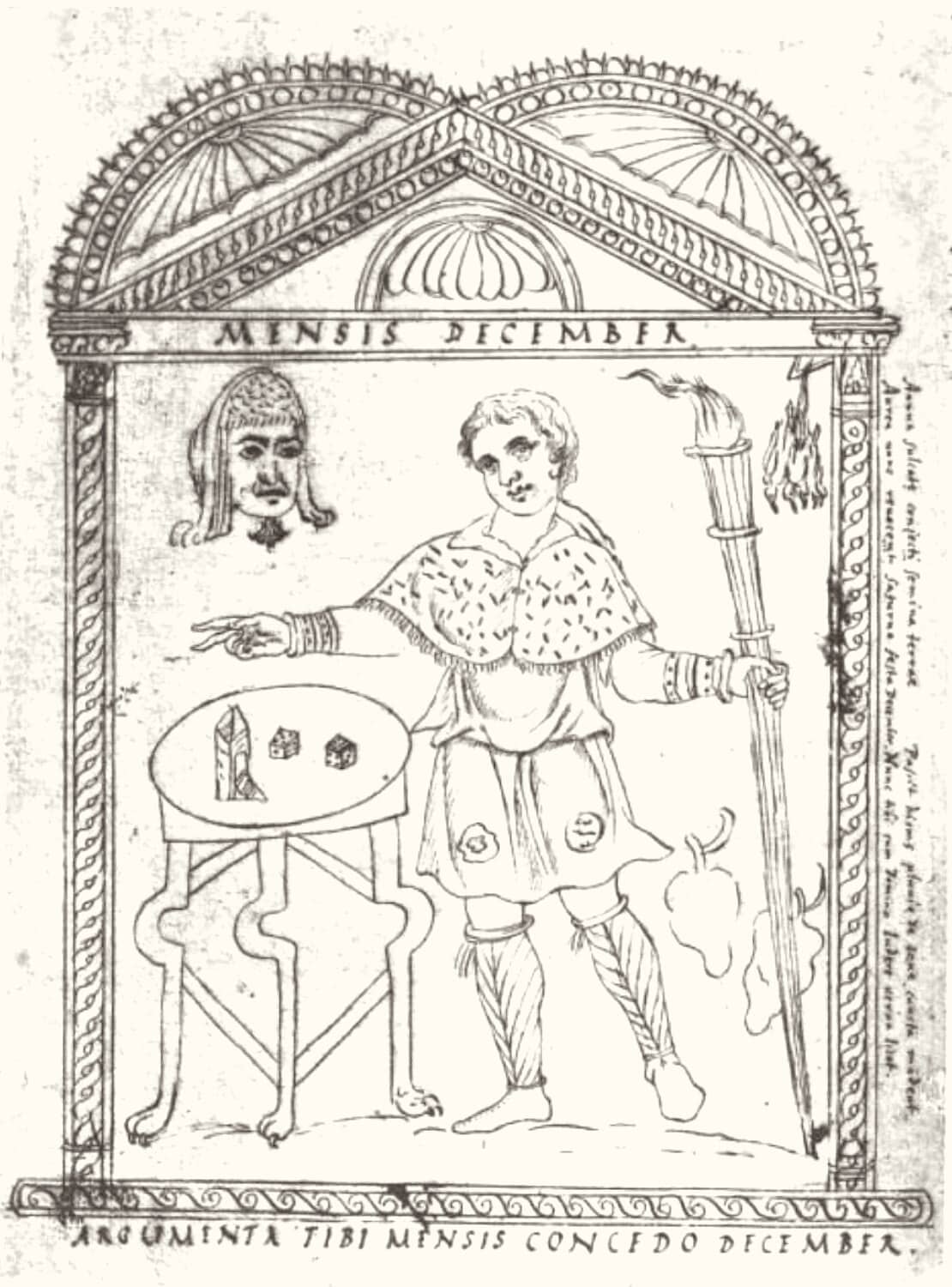


Nobody knows the day Jesus was born: the Bible doesn’t give one. The oldest record we have of Christmas on December 25 comes from Rome, from a list of feast days probably drawn up by about the year 336. Why Christians chose that day is still debated. Historians give two main explanations: that the church took over a date when Romans already held a midwinter festival, the birthday of the Unconquered Sun; or that early Christians worked the date out for themselves, counting nine months from March 25.
At a glance
- In the Bible: no day or season
- Oldest record of December 25: a Roman list of feast days, probably drawn up by about 336
- Explanation one: a Roman festival of the Sun on the same day
- Explanation two: nine months after March 25, the day some early Christians believed Jesus was conceived
- Which is right: historians still debate it
What the Bible says
Neither Gospel gives a day or a season for the birth; both set it in the days of King Herod. Where the story is in the Bible has every part of it.
For roughly the first two hundred years, we find no sign that Christians kept a feast for Jesus’ birth. Around the year 200, Clement of Alexandria noted that some Christians in Egypt reckoned the birth to May 20; he never mentions December 25.
The oldest record
The list’s first line, set against December 25, reads:
VIII kal. Ian. natus Christus in Betleem Iudeae.
In our translation: “December 25: Christ born in Bethlehem of Judea.”
The list, probably drawn up by about 336, was copied into a Roman almanac in 354. The almanac was an illustrated book made for Valentinus, a wealthy Christian in Rome, and lettered by the most famous calligrapher of the day, Filocalus.
Explanation one: a festival of the Sun
The same almanac has a calendar of Rome’s public festivals. Against December 25 it marks the birthday of the Unconquered One, usually taken to be the Sun, with thirty chariot races.
In 274, by the usual account, the emperor Aurelian set up a feast of the Unconquered Sun’s birth on that day. The best-known explanation is that the church placed Christmas on a date Romans already celebrated, near midwinter, to draw people to the new faith. The idea became popular with scholars in the 1700s and 1800s, and it is still the explanation most people have heard.
Explanation two: counting from March 25
The other explanation starts with an old Christian belief that Jesus was conceived on the same day of the year that he died, which some early writers put at March 25. Count nine months on from that spring day, and you reach December 25. The French scholar Louis Duchesne first put this explanation forward in modern times, and the American scholar Thomas Talley worked it out in full.
An anonymous Christian booklet, probably from North Africa in the 300s, works the dates out this way and places the birth at midwinter. Around 400, Augustine wrote that Jesus was believed to have been conceived and to have died on March 25, and born, by tradition, on December 25.
The same reckoning may explain the date that Christians in the East kept at first: some of them dated the crucifixion to April 6, and January 6 is nine months later.
Weighing the two
Critics of the first view, among them the historian of early Christianity Andrew McGowan, point out that no early Christian writer says the date was borrowed, and that Christians were already working out Jesus’ birthday around 200, before the church is known to have taken over pagan festivals. The first writer we know of to say that Christians moved Christmas to match a pagan festival is an unnamed reader who added a note in the margin of a Syriac manuscript in the 1100s, some eight hundred years after the fact. The second view has critics too. The Catholic Encyclopedia of 1908 pointed out that no one is known to have kept a feast of Jesus’ conception on March 25 in the 300s, and it judged that the Sun’s birthday “has a strong claim” on the date.
Historians still debate which explanation is right. Recent studies have questioned both, and a 2012 survey of the research, in the journal Church History, argued that each may hold part of the truth. Whether the rest of Christmas, its customs and its greenery, owes anything to older festivals is a different question, taken up in is Christmas pagan?
Christmas in January
Churches that keep the old Julian calendar still celebrate on December 25, but on their calendar, which today runs 13 days behind the one most of the world uses, so their Christmas falls on January 7. Why some Orthodox churches celebrate on January 7 has the whole story, church by church.
Read it to a child
Reads aloud in a minute
Nobody knows the day Jesus was born. The Bible doesn’t say. But long ago, in the city of Rome, Christians were already keeping his birthday on December 25. Why that day? Some people think it was because the Romans already had a big winter festival then. Others think early Christians worked the date out by counting. Nobody knows for sure which is right.
Quick answers
Was Jesus born on December 25?
Nobody knows. The Bible gives no day or season for the birth, and December 25 was chosen later.
Who chose December 25 for Christmas?
No one person we know of. Christians in Rome were probably keeping it by about 336. Historians still debate how the day was chosen.
Was December 25 a pagan festival?
Rome’s almanac of 354 marks it as the birthday of the Unconquered One, usually taken to be the Sun. Whether Christians chose the day because of that festival is one of the two explanations historians argue over.
Why do some Christians celebrate Christmas on January 7?
Their December 25 is counted on the old Julian calendar, which today runs 13 days behind the calendar most of the world uses, so it falls on January 7.
More: when people started celebrating Christmas, when Christmas is this year, for the main churches, when Jesus was born and Saturnalia.
Where our facts come from
- World English Bible, Matthew 1–2 and Luke 1–2, Matthew 2:1 ("in the days of King Herod"); Luke 1:5 ("in the days of Herod, the king of Judea"); no day, month or season in either account
- The Chronography of 354, Part 12, "Commemorations of the Martyrs" (Depositio Martyrum), MGH Chronica Minora I (1892), pp. 71–72, edition at tertullian.org, Heading "ITEM DEPOSITIO MARTIRVM", first entry ("VIII kal. Ian. natus Christus in Betleem Iudeae"; quoted; the translation is ours)
- C. C. Martindale, "Christmas", Catholic Encyclopedia, vol. 3 (1908), Section on Rome ("even if the 'Depositio Martyrum' dates, as is probable, from 336"); section on the date ("The well-known solar feast, however, of Natalis Invicti, celebrated on 25 December"; the same paragraph: "has a strong claim on the responsibility for our December date"); the Duchesne paragraph ("Unfortunately, there is no contemporary evidence for the celebration in the fourth century of Christ's conception on 25 March"); section on Alexandria (Clement: "certain Egyptian theologians")
- The Chronography of 354, introduction, edition at tertullian.org, Opening introduction ("a wealthy Christian aristocrat named Valentinus received a codex"; "an illustrated calendar for the year 354"; "the work of the most famous calligrapher of the century, Furius Dionysius Filocalus")
- The Chronography of 354, Part 6, the calendar, edition at tertullian.org, "MENSIS DECEMBER", entry VIII KAL ("N·INVICTI·CM·XXX"; the page's key: N = Natalis, "birthday"; CM = Circenses missus, "games ordered"); the December picture (the plate, from a later copy: Strzygowski 1888, plate XXXII)
- Andrew McGowan, "How December 25 Became Christmas", Bible Review, December 2002 (Bible History Daily, Biblical Archaeology Society), Paragraph beginning "The extrabiblical evidence" ("As far as we can tell, Christmas was not celebrated at all at this point"); paragraph beginning "Finally, in about 200 C.E." (Clement of Alexandria: 25 Pachon, May 20; "Clement doesn't mention December 25 at all"); paragraph beginning "The most loudly touted theory" (borrowed from pagan celebrations; in 274 Aurelian established a feast of the birth of the Unconquered Sun); paragraphs beginning "Despite its popularity today", "There are problems with this popular theory" and "This would change only after Constantine" (not found in any ancient Christian writings; dates for Christmas established before Christians are known to have adopted pagan festivals); paragraph beginning "There is another way to account for the origins" ("first suggested to the modern world by French scholar Louis Duchesne … and fully developed by American Thomas Talley in more recent years"); paragraph beginning "Around 200 C.E. Tertullian of Carthage" and the next (March 25; conceived and crucified on the same day of the year); paragraph beginning "This idea appears in an anonymous Christian treatise" (On Solstices and Equinoxes, "appears to come from fourth-century North Africa"; the birth at the winter solstice); paragraph beginning "Augustine, too, was familiar"; paragraph beginning "In the East, too" (April 6 and January 6); paragraph beginning "It's not until the 12th century" (a marginal note on a manuscript of Dionysius bar-Salibi; the 18th and 19th centuries); final paragraph ("We cannot be entirely sure"); the author's biography ("His work on early Christian thought and history")
- Mathew Lyons, "The First Christmas Celebration", History Today 75:12 (December 2025), Standfirst ("On 25 December 336 Rome's believers celebrated Christmas Day – the earliest recorded use of that date"); paragraph 1 ("The first recorded celebration of 25 December doesn't arrive until 336 in an almanac")
- C. P. E. Nothaft, "The Origins of the Christmas Date: Some Recent Trends in Historical Research", Church History 81:4 (December 2012), pp. 903–11, Abstract ("two competing approaches, known as the 'History of Religions Theory' and the 'Calculation Theory'"; "the challenges that have been brought against them by the recent work of Steven Hijmans and Hans Förster"; "a more nuanced approach … which retains the aspect of inter-religious influence, but also pays some overdue attention to the importance of chronological thought")
- Erin Blakemore, "Why Orthodox Christians celebrate Christmas in January", National Geographic (December 26, 2019; updated December 30, 2022), Section "Christianity's great calendar schism", final paragraph ("a 13-day difference between the two calendars")