
IX · Faiths
What is Hanukkah, and is it “Jewish Christmas”?
 True storyHow to read this bookReads aloud in 7 minutesAdded to the book
Hanukkah is the Jewish festival of lights. For eight nights, Jewish families light one more flame each night, remembering how the Temple in Jerusalem was won back and dedicated again more than 2,100 years ago. It is not “Jewish Christmas”: it is a festival of its own, with its own story, and it is much older than Christmas.
At a glance
- What it remembers: the rededication of the Temple in Jerusalem, in about 164 BC (BCE)
- The name: Hanukkah means “dedication”
- Also called: the Festival of Lights
- How long: eight nights, from the 25th of the Hebrew month of Kislev
- This season: from sundown on ,
- At home: lighting the menorah, foods fried in oil, the dreidel
The story behind the festival
More than 2,100 years ago, Judea was ruled by Greek-speaking kings of the Seleucid Empire. One of them, King Antiochus IV Epiphanes, tried to stamp out Jewish worship, and the Temple in Jerusalem was turned into a shrine to other gods. Beginning in 167 BC, the Jews of Judea rose up in revolt. Their leader in the first years of the fight was Judah the Maccabee, the eldest son of a priest named Mattathias.
In the autumn of 164 BC, Judah and his followers took back the Temple. They cleansed it and dedicated it to God again. Sources differ by a year here, and some count 165.
The first book of Maccabees tells that the people kept the Temple’s new dedication for eight days, starting on the 25th of the month of Kislev, and that it should be kept every year. The eight days followed the pattern of Sukkot, the autumn festival of huts. That is where the name comes from: Hanukkah means “dedication.”
The story of the oil
That much is history. The story of the oil, which has come to belong to Hanukkah, is not in the books of Maccabees. It was first written down in the Talmud, hundreds of years later.
 As the Talmud tells it
The Talmud tells that when the Temple was taken back, only one small jar of pure oil was found, still sealed by the High Priest, enough to burn for a single day. It burned for eight. The next year the sages made those eight days a festival.
How Hanukkah is kept
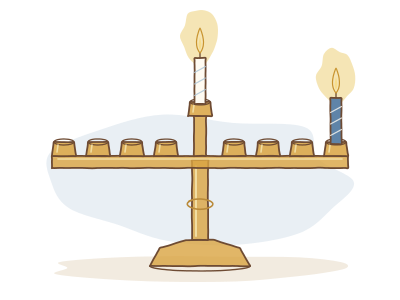
Much of Hanukkah happens at home. Each night the family lights the menorah, called the hanukkiah, which holds a light for each of the eight nights. On the first night one flame burns, and one more is added each night, until all eight burn on the last night.
Families eat foods fried in oil, to remember the oil: potato pancakes called latkes, a favorite of Jews whose families came from Europe, and jelly doughnuts, sufganiyot, a favorite in Israel. Children spin the dreidel, a four-sided top whose Hebrew letters stand for “a great miracle happened there.” In Europe a custom grew of giving children a little money, with nuts and raisins.
Hanukkah is kept together, too. Jewish communities often gather for candle lightings in public places, with songs and games of dreidel.
By Jewish custom Hanukkah is a minor festival. It is not one of the holy days set out in the Torah, though it has become one of the best loved, along with Passover and Purim.
Is Hanukkah “Jewish Christmas”?
No. Hanukkah is a Jewish festival with its own story and meaning, kept on the Hebrew calendar. People make the comparison because the two often fall close together in December, and because of gifts.
In North America, Jewish families added gift-giving to their Hanukkah celebrations in growing numbers by the 1920s, and that led some people to call Hanukkah the “Jewish Christmas.” The Reform Jewish movement, for one, says it would be wrong to see Hanukkah as an imitation of Christmas with an emphasis on exchanging presents. Under the influence of Christmas, Hanukkah has become the main time for gifts in the Jewish year in Western countries, but the festival itself is far older.
It was first kept in about 164 BC, roughly five hundred years before the oldest record we have of Christmas on December 25, a list of Roman feast days probably drawn up by about the year 336.
When is Hanukkah?
Hanukkah keeps its date on the Hebrew calendar, the 25th of Kislev, so on the everyday calendar it moves each year, usually landing in December, sometimes right on Christmas. This season it begins at sundown on , , when the first candle is lit.
Quick answers
What does Hanukkah mean?
“Dedication.” It remembers the day the Temple in Jerusalem was dedicated to God again, in about 164 BC.
Why is Hanukkah eight nights long?
The first book of Maccabees says the Temple’s new dedication was kept for eight days, and Jewish sources say those days followed the pattern of Sukkot. The Talmud tells that a single day’s oil burned for eight days.
When does Hanukkah start this year?
At sundown on , , when the first candle is lit.
Is Hanukkah a major Jewish holiday?
By Jewish custom it is a minor festival, not one of the Torah’s holy days. It is also one of the best-loved festivals of the Jewish year.
What is a dreidel?
A four-sided spinning top. Its Hebrew letters stand for “a great miracle happened there.”
More: Christmas and the world’s faiths, why Christmas is on December 25, Jewish families at Christmas and the winter festivals of the world.
Where our facts come from
- Chabad.org, "What Is Hanukkah?", Introduction under "Info you need about Chanukah" ("means 'dedication'"); "What Chanukah Celebrates" ("reclaimed the Holy Temple in Jerusalem and rededicated it"; "second century BCE"; "led by Judah the Maccabee"); "How Chanukah Is Observed" ("On the first night, we light just one flame"; "By the eighth night of Chanukah, all eight lights are kindled"); "When Is Chanukah?" ("begins on the eve of Kislev 25 and continues for eight days"); "Chanukah Foods" ("customary to eat foods fried in oil"); "Dreidel: the Chanukah Game" ("a four-sided spinning top bearing the Hebrew letters"; "a great miracle happened there")
- My Jewish Learning, "Hanukkah 101", Opening ("also known as the Festival of Lights and usually takes place in December"); "Historical Origins of Hanukkah" ("Beginning in 167 BCE, the Jews of Judea rose up in revolt against the oppression of King Antiochus IV Epiphanes of the Seleucid Empire"; "The military leader of the first phase of the revolt was Judah the Maccabee, the eldest son of the priest Mattityahu (Mattathias)"; "In the autumn of 164 … capture the Temple in Jerusalem, which had been turned into a pagan shrine. They cleansed it and rededicated it to Israel's God"; the eight-day celebration "patterned on Sukkot, the autumn festival of huts"); "How to Celebrate Hanukkah at Home" ("Much of the activity of Hanukkah takes place at home"; "the hanukkiah or menorah, an eight-branched candelabrum to which one candle is added on each night"; the European (Ashkenazi) latkes and the Israeli sufganiyot; small amounts of money, nuts and raisins for children, a tradition developed in Europe; "Under the influence of Christmas … the central gift-giving holiday in the Jewish calendar in the Western world"); "Celebrating Hanukkah in the Community" ("not biblically ordained"; "a quite minor festival"; "one of the most beloved"; "Jews will often gather for communal celebrations and public candle lighting", with songs and dreidel)
- ReformJudaism.org (Union for Reform Judaism), "The History of Hanukkah", Opening ("according to Jewish custom Hanukkah is considered a 'minor' Jewish festival, today it ranks—along with Passover and Purim—as one of the most beloved"); "Modern Observance" ("By the 1920s, however, Jews increasingly added gift-giving to their Hanukkah celebrations, prompting some people to refer to Hanukkah as the 'Jewish Christmas'"; "it would be incorrect to regard it as an imitation of Christmas"); "The Miracle of the Oil" ("intended to parallel the eight-day festival of Sukkot"; "The books of the Maccabees made no mention of the legend concerning a small jar of oil"; "Only centuries after … appear in the Talmud"); its holiday page, "What is Hanukkah?" (the victory dated 165 B.C.E.)
- 1 Maccabees 4:52–59, Brenton's translation of the Septuagint (1851), via Sefaria, 4:54 ("kept the dedication of the altar eight days"); 4:57 ("from year to year by the space of eight days, from the five and twentieth day of the month Casleu"), as numbered on the Sefaria page
- Babylonian Talmud, Shabbat 21b, William Davidson Edition (Koren-Steinsaltz), via Sefaria, The passage beginning "What is Hanukkah?" ("only one cruse of oil that was placed with the seal of the High Priest"; enough for one day; "they lit the candelabrum from it eight days"; "The next year the Sages instituted those days and made them holidays")
- Hebcal, "Chanukah 2026", Page header ("begins at sundown on Friday, 4 December 2026"); the dates table (25 Kislev 5787); the years table (2027: Friday, December 24 – Saturday, January 1)
- C. C. Martindale, "Christmas", Catholic Encyclopedia, vol. 3 (1908), Section on Rome ("even if the 'Depositio Martyrum' dates, as is probable, from 336")