
VII · The World
How is Christmas (Genna) celebrated in Ethiopia?
 True storyHow to read this bookReads aloud in 6 minutesAdded to the book
True storyGenna, Ethiopian Christmas, is kept on January 7.


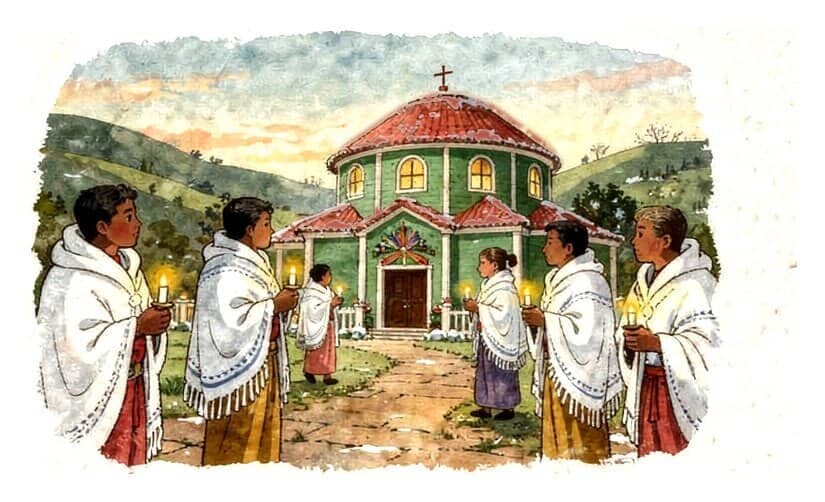
In Ethiopia, Christmas is Genna, and it comes on January 7, after a long fast. On Christmas Eve, families put on traditional white clothes and go to church for a service that runs through the night, until Christmas morning.
At a glance
- Genna: January 7
- Before it: a fast of about six weeks, from late November
- Christmas Eve: a night of prayer in church, in white
- Kept as: a national holiday, and one of the Ethiopian Orthodox Tewahedo Church’s nine great feasts of Christ
- The pilgrimage: to the rock churches of Lalibela
Christmas words
One way to wish someone a happy Christmas in Amharic is to write መልካም ገና, Melkam Genna: good Christmas. Genna, ገና, is the word for Christmas, from the Greek for “birth.”
Genna, January 7
Ethiopians call Christmas Genna, or Liddet, and keep it on January 7, usually Tahsas 29 in Ethiopia’s own calendar. For the Ethiopian Orthodox Tewahedo Church it is one of the nine great feasts of Christ, and it is a national holiday as well as a church feast. Many Catholics and Protestants in Ethiopia keep Genna on January 7 too. Why some churches keep Christmas in January has its own page.
The Fast of the Prophets
For about six weeks before Genna, from late November, Orthodox Christians traditionally fast: one meal a day, with no meat, eggs or dairy. It is called the Fast of the Prophets, Tsome Nebiyat. The church counts the fast as 40 days; many people call it 43.
A night in white
On Christmas Eve, families put on traditional white clothes and go to church for a service that runs through the night, until Christmas morning. People say the white stands for purity. Drums and chanting carry the night along.
Lalibela
In the Ethiopian highlands, the town of Lalibela has eleven churches cut down into the solid rock about 800 years ago. Tradition credits King Lalibela, who wanted a “New Jerusalem.” They have been a World Heritage site since 1978, and pilgrims come for the great feasts. Thousands of pilgrims dressed in white travel to Lalibela to spend Christmas night in prayer among its rock churches.
 As church tradition tells it · Ethiopian Orthodox tradition
At Lalibela, priests in white line the top of a rock church while others stand below, and they sing in Ge’ez, the church’s old language of worship, that the Savior of the world is born today. The ones above, the church there says, are the angels; the ones below are the people of the world.
 A tale people tell
In Lalibela, people say their king was born on Christmas Day too, so the town keeps the feast with double joy.
The feast and the game
After weeks of fasting, Christmas Day brings the feast: doro wat, a spicy chicken stew with hard-boiled eggs, eaten with injera, a big, slightly sour flatbread. Then families often go visiting neighbors and friends.
Genna is a game too. On Christmas afternoon, mostly in the countryside, men and boys play a kind of field hockey with curved wooden sticks, each one a genna, and a small wooden ball called a rur, until the sun goes down.
A tale people tellEthiopians tell a lovely story about where the game came from: when the shepherds heard that Jesus was born, they were so happy they leapt about with their shepherd’s sticks.
Quick answers
When is Christmas in Ethiopia?
On January 7. It falls on the same day each year.
What is Genna?
The Ethiopian name for Christmas, and also the name of a hockey-like game played that day.
How do Ethiopians celebrate Christmas?
With a long fast, a night of prayer in church dressed in white, a feast of doro wat and injera, and visits to neighbors and friends.
Read on: why some churches keep Christmas in January, when Christmas is, church by church, the Oriental Orthodox churches and Amharic Christmas words.
Where our facts come from
- Ethiopian Orthodox Tewahedo Church, "Religious Holidays and Calendar: The Liturgical Year", Section "5. CHRISTMAS" ("Liddet or Gena is the Ethiopian name for Christmas… It is celebrated on 7th January (Tahsas 29 E.C)"; the last sentence: Gena also the name of a Christmas game played by boys and grown men, like hockey); section 2 ("The feasts of our Lord are divided into 9 major and 9 minor feasts", Christmas among the major; feasts "national and religious at the same time": "Christmas – Tahsas 29th E.C (7th January)"); section 3, item 5 ("The fast preceding Christmas, 40 days. It begins with Sibket on 15th Hedar and ends on Christmas eve"), with its definition of a fast day ("one meal a day… with total abstention from meat, fats, eggs and diary products"); section 1 (the leap-year rule)
- Fana Broadcasting Corporate, "Ethiopian Christians celebrate Christmas colorfully", January 7, 2024; Ethiopian News Agency (ENA), Genna reports of January 6, 2025 and January 6, 2026, Fana, paragraphs 1–2 (Genna celebrated across the country on January 7, 2024, the year whose Tahsas 29 fell on January 8 by the church's leap-year rule); ENA eng_5755633 and eng_8073270 (the celebration on January 7 of each year)
- Ethiopian News Agency, "Ethiopian Christians Celebrating Christmas (Genna) Colorfully", January 7, 2023; Temesgen Assefa, "Ethiopia's Christmas (Genna): Embodiment of Collective Festivity", ENA, January 6, 2026, First paragraph (Genna celebrated by followers of various churches, including the Ethiopian Orthodox Church, Catholics and Protestants); ENA, January 6, 2026 (eng_8073270), paragraph 3 (also kept by "some Protestant, and Catholic denominations")
- Desta Kahsay, "Ethiopia Cherishes Peculiar Celebration of Gena", ENA, January 7, 2018 (Internet Archive capture), Paragraph 2 (Christmas in Lalibela kept in a special way because King Lalibela's birthday falls on the same day); paragraph 3 (the "Fast of the Prophets" (tsome Nebiyat), 43 days; the feast that breaks the fast: injera and spicy stews, doro wot with boiled eggs); paragraphs 4–7 (Ye-Gena Chewata, played by youth and adult men in the Christmas season, mainly in rural areas, from afternoon till sunset, with a crude hockey stick, "Gena", and a small wooden ball, "rur")
- Fenet Hailu, "Unique Features of Ethiopian Christmas 'Genna'", ENA, Paragraph 2 ("In the eve of Gena, the faithful, dressing white traditional cloths, gathered at churches for the mass church services that start after midnight and lasts in the morning of Christmas day"; the 43-day fast); section "Genna in Lalibela", paragraphs 2–3 (priests in white at the top and bottom of the rock churches sing in Ge'ez that the Savior of the world is born today; Abune Aregawi: those above represent the angels, those below the people of this world; King Lalibela born on the same day as Jesus); section "'Ye Genna Chewata'", paragraph 3 (the legend of the shepherds' joy)
- Encyclopaedia Britannica, "Geʿez language" (Internet Archive capture of October 31, 2025), Opening sentence ("Geʿez language, liturgical language of the Ethiopian church"); paragraph 2 (it ceased to be spoken popularly between 900 and 1200, "it continues as a liturgical language")
- Temesgen Assefa, "Ethiopia's Christmas (Genna): Embodiment of Collective Festivity", ENA, January 6, 2026, Paragraph 4 (all-night prayer services on the Eve; traditional white clothing "symbolizing purity"; the kebero drum and the tsenatsel sistrum with the chant); section "Beyond Meals, A Collective Festivity" (Doro Wet with Injera, a sourdough flatbread; families visiting neighbors and friends)
- UNESCO World Heritage Centre, "Rock-Hewn Churches, Lalibela" (property no. 18), Internet Archive capture of January 1, 2026, Property summary ("Date of Inscription: 1978"); short description ("The 11 medieval monolithic cave churches of this 13th-century 'New Jerusalem'"; still a place of pilgrimage and devotion); "Brief synthesis" (eleven churches carved out of rock, "attributed to King Lalibela who set out to construct in the 12th century a 'New Jerusalem'"); "Protection and management requirements" (a living site that draws many pilgrims to the great feasts)
- Ethiopian News Agency, "Ethiopia Gears Up to Welcome Global Visitors for Christmas (Genna) and Timket Celebrations", January 4, 2026; Embassy of Ethiopia (Washington), Lalibela Gena report, January 7, 2023, ENA paragraph 4 (Lalibela, the spiritual heart of the festival, "as thousands of white-robed worshippers gather for overnight prayers"); the Embassy report ("thousands of churchgoers attended")
- Wiktionary, "ገና" and "merry Christmas" (Amharic); Wolf Leslau, Basic Amharic Dictionary (1972, Internet Archive), "ገና", Amharic, Etymology 2 (noun, tr. gänna, Christmas; from Greek γέννα, birth); "merry Christmas", Translations, Amharic (መልካም ገና); the phrasebook entry መልካም፡ልደት (mälkam lədät, "nice birthday"); Leslau, the ገና entries (Christmas; the hockey-like game played that day); Leslau, the መልክ entries (መልካም, "beautiful, good")