
X · Carols
Who wrote “Jingle Bells”? Was it a Thanksgiving song?
 True storyHow to read this bookReads aloud in 7 minutesAdded to the book
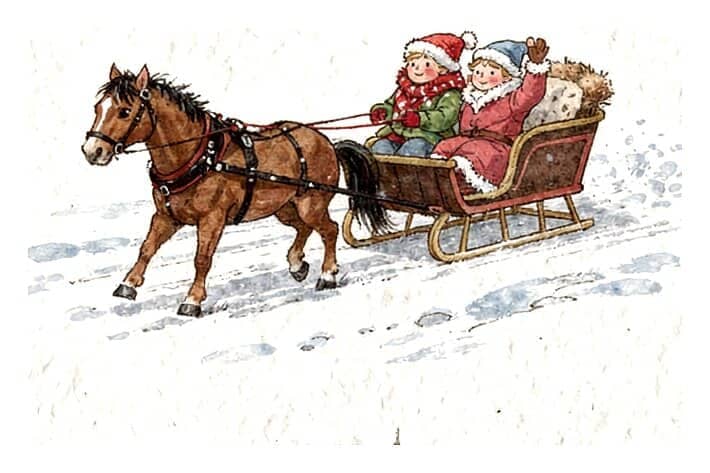


James Lord Pierpont, an American songwriter, wrote “Jingle Bells”, and it was first printed in Boston in 1857 under another name, “The One Horse Open Sleigh”. Whether it was first sung at a Thanksgiving service nobody can say for sure: some accounts tell that story, but the song never mentions Thanksgiving, or Christmas either. It is a winter song about sleigh rides.
At a glance
- Words and music: James Lord Pierpont, born in 1822, died in 1893
- First printed: Boston, 1857, by Oliver Ditson & Co., as “The One Horse Open Sleigh”
- Named “Jingle Bells”: when it came out again, two years later
- Holidays it mentions: none
- Played in space: December 1965, aboard Gemini 6
The man who wrote it
James Lord Pierpont was born in 1822, the son of the Reverend John Pierpont, a Unitarian minister who spoke out fiercely against slavery. From an early age, James went looking for adventure far from his family in Boston. He ran away from boarding school at 14, joined the crew of a whaling ship and spent nearly ten years at sea. When the California Gold Rush began in 1849, he went west to look for gold, and came home no richer.
In 1853 he moved to Savannah, Georgia, to be the organist at a Unitarian church where his brother was the pastor. Pierpont tried several kinds of work, but he had the most success as a songwriter. He was also the uncle of John Pierpont Morgan, who grew up to be one of the most powerful financiers of his time.
A song with two names
The sheet music came out in Boston in September 1857, from the music publisher Oliver Ditson & Co. Its cover calls it “The One Horse Open Sleigh”, a song and chorus “written & composed by J. Pierpont”, and dedicates it to John P. Ordway. When it was published again two years later, it had the name we know: “Jingle Bells”.
Two places call the song their own. A plaque in Medford, Massachusetts, near Boston, says Pierpont wrote it at the Simpson Tavern there in 1850. In 1985 Savannah put up a marker of its own, across from the church where Pierpont was music director when the song was published. One historian, Kyna Hamill of Boston University, found that Pierpont was still in California hunting for gold in 1850, and she thinks he wrote the song in Boston in the early summer of 1857. Everyone agrees on one thing: the snowy sleigh rides in it are Massachusetts ones, not Georgia’s.
Was it a Thanksgiving song?
Read the words and you will not find Thanksgiving, or Christmas, anywhere in them. Today it is a Christmas favorite, but it is a song about racing sleighs through the snow, and its less-known verses tell of a tumble into a snowbank and taking the girls out for a ride.
 A tale people tell
Some accounts tell that “Jingle Bells” was first sung at a Thanksgiving service, at the church of Pierpont’s father or his brother. It is a story people tell. History.com’s history of the song doubts it: the words may have been too lively for a church.
One early performance we know of comes from a playbill Kyna Hamill found. It lists “One Horse Open Sleigh” in a show on September 15, 1857, by Ordway’s Aeolians, the minstrel troupe John Ordway led: white men who performed in blackface. So the song may first have been heard in public in a minstrel show. Pierpont seems to have written about a dozen songs for Ordway’s troupe.
Pierpont stayed in Savannah, and when the Civil War came he sided with the Confederacy and joined a Georgia cavalry regiment, while his father served the Union side as an army chaplain. He spent his last years in Florida and died in 1893.
Jingle Bells in space
In December 1965, nine days before Christmas, the two astronauts aboard the Gemini 6 spacecraft told Mission Control they could see an unknown object flying in orbit. Then, instead of a report, came music: Wally Schirra played “Jingle Bells” on a tiny harmonica while Tom Stafford shook a handful of small bells. They had brought the bells along for the trip. The harmonica Schirra played is now kept at the National Air and Space Museum.
The words, as they were first printed
Here are the words as the 1857 sheet music prints them, spelling and all. The first two verses are set under the notes, then comes the chorus, printed twice over; verses three and four are printed below the music.
Dashing thro’ the snow,In a one horse open sleigh,O’er the hills we go,Laughing all the way;Bells on bob tail ring,Making spirits bright,Oh what sport to ride and singA sleighing song to night.
A day or two agoI tho’t I’d take a rideAnd soon miss Fannie BrightWas seated by my side,The horse was lean and lankMisfortune seem’d his lot,He got into a drifted bankAnd we—we got up sot.
Jingle bells, Jingle bells,Jingle all the way;Oh! what joy it is to rideIn a one horse open sleigh.
A day or two ago,The story I must tellI went out on the snowAnd on my back I fell;A gent was riding byIn a one horse open sleigh,He laughed as there I sprawling lie,But quickly drove away.
Now the ground is whiteGo it while you’re young,Take the girls to nightAnd sing this sleighing song;Just get a bob tailed bayTwo forty as his speedHitch him to an open sleighAnd crack, you’ll take the lead.
Quick answers
Who wrote “Jingle Bells”?
James Lord Pierpont wrote both the words and the music. It was first printed in Boston in 1857.
Was “Jingle Bells” written for Thanksgiving?
Nobody can say for sure. Some accounts tell that it was first sung at a Thanksgiving church service, but the words never mention Thanksgiving, or Christmas: it is a song about winter sleigh rides.
What was “Jingle Bells” first called?
“The One Horse Open Sleigh”. It was published again as “Jingle Bells” two years later.
Was “Jingle Bells” played in space?
Yes. In December 1965 astronaut Wally Schirra played it on a tiny harmonica aboard Gemini 6, while Tom Stafford shook small bells.
More: Christmas carols and music, who wrote “Silent Night”, Christmas in the United States and what a carol is.
Where our facts come from
- Library of Congress, "The one horse open sleigh", J. Pierpont (Boston: Oliver Ditson, 1857), catalog record and page scans, sm1857.620520 (Music Division, Sheet music for copyright deposit, 1820–1860), Record fields: contributor "Pierpont, J." (also lyricist); "Boston : Oliver Ditson, 1857"; rights ("the Library is not aware of any U.S. copyright protection"). Scan image 1, the cover: "To John P. Ordway, Esq."; "The One Horse Open Sleigh"; "Song and Chorus"; "Written & composed by J. Pierpont"; "Boston, Published by Oliver Ditson & Co"; "Entered according to act of Congress AD 1857 by O. Ditson & Co"; handwritten "Deposited Sept. 16. 1857". Images 2–4 (pp. 3–5): verses 1 and 2 under the notes (p. 3), the chorus twice (pp. 4–5), verses 3 and 4 printed below the music (p. 5)
- Christopher Klein, "8 Things You Might Not Know About 'Jingle Bells'", History.com (published December 16, 2016; updated December 11, 2025), Item 1 ("Born in 1822, songwriter James Lord Pierpont composed the music and wrote the lyrics"; uncle to John Pierpont Morgan, "one of the most powerful financiers of the Gilded Age"; "tried his hand at several vocations but experienced the most success as a songwriter"); item 2 (son of "a fiercely abolitionist Unitarian minister named Reverend John Pierpont"; "From an early age, James sought adventures far away from his family in Boston"; ran off from boarding school at 14, a whaling ship, "nearly a decade at sea"; the Gold Rush of 1849, "no wealthier"; 1853, organist at a Unitarian church in Savannah where his brother was pastor); item 3 ("first printed by a Boston music publishing house in 1857" as "The One Horse Open Sleigh"; "reissued two years later" as "Jingle Bells"); item 4 (the Medford plaque, Simpson Tavern, 1850, "the Boston suburb of Medford"; "Boston University faculty member Kyna Hamill's research, he was still in California chasing gold"; the 1985 Savannah marker "across from the Unitarian church where Pierpont was music director when the song was published"; "Hamill surmises" early summer 1857 in Boston; "not in dispute": sleigh rides "in Massachusetts, not Georgia"); item 5 ("a staunch supporter of the Confederacy"; remained in Savannah; the 1st Georgia Cavalry; his father "chaplain of the 22nd Massachusetts Infantry"; "lived out his final years in Florida before his death in 1893"); item 6 ("no mention of Christmas or any other holiday"; "now a Yuletide staple"; "Some historical accounts report that the tune was first performed for a Thanksgiving service at the church of either Pierpont's father or brother, but the lyrics might have been too risqué"; the less-known verses); item 7 ("first printed in September 1857", dedicated to John Ordway, organizer of "a troupe of white men performing in blackface called Ordway's Aeolians"; "Ordway's minstrels"; "It appears the same was the case for about a dozen of his subsequent songs"; Hamill's playbill of September 15, 1857); item 8 ("Nine days before Christmas in 1965", Gemini 6, the report of an object in orbit, Schirra's "tiny harmonica", Stafford's "small sleigh bells they had brought along")
- Smithsonian National Museum of American History, object record "Hohner Little Lady No. 39 Harmonica", ID 1988.0783.449 (nmah_1306513), through Smithsonian Open Access, Record notes: "Astronaut Walter M. Shirra played 'Jingle Bells' on Gemini VI Mission, December 15-16, 1965. He was accompanied by Astronaut Thomas P. Stafford, Jr. on the jingle bells"; the original harmonica is in the National Air and Space Museum